Alternatives to iTunes: how 5 rival music services match up

How well do the current crop of online music services stack up against the iTunes Store?
When I did my inaugural round-up of iTunes alternative last year, I was looking for ways to avoid the high price of iTunes, and I succeeded. I found six rivals that offered significant savings—at least 10% and potentially much more. My criteria included services aimed at music lovers who want the option to buy music by the track or by the album. Several of the alternative services included interesting differentiating features, with the biggest being the all-you-can-listen-to subscription model.
So what's new? When I took a closer look recently at five of those six services (including a fresh look at iTunes itself), I found that not much has changed from last year—except the owners. Last December, Apple acquired Lala, my favorite from last year. As I noted earlier this week, Lala's innovation has ground to a halt. Apple is no doubt working feverishly on incorporating Lala's cloud-friendly features into the next generation of the iTunes Store. But for now, you'd be hard-pressed to spot any changes in the iTunes music store.
I looked at three main factors: price, selection, and ease of use. To make price comparisons, I created a basket of 10 rock, folk, country, and classical albums, six recent releases and four back catalog choices from the previous century.
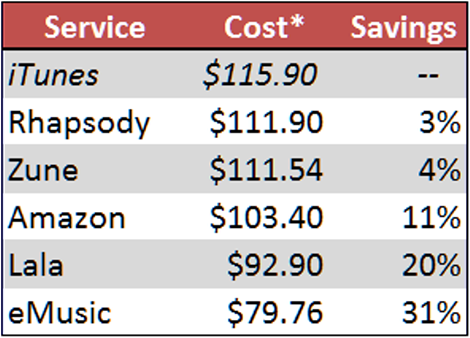
On price, iTunes was once again the most expensive, with the highest price for the collection. See the chart at right for details; the asterisk in the Cost column indicates that two of the five alternative services didn't offer the entire selection of albums—Zune Marketplace was missing two and eMusic had only six of the ten albums on my list. To figure the total price tag for those two services. I calculated the cost of the missing albums using the prices from the iTunes store. Amazon MP3 and Lala offered significant savings over iTunes, with total savings of 11% and 20%, respectively. Rhapsody offered only trivial savings over Apple's store, and the Zune prices were all over the map, with three albums costing more than their iTunes rivals.
There is no question that iTunes has the biggest selection of all the services. According to a January 2010 report from eMarketer, the iTunes Store has roughly 11 million tracks, followed by Amazon at 10 million and Lala at 8 million; Rhapsody, eMusic, and the Zune Marketplace have 6 million tracks to choose from—not the same ones. I was not at all surprised to find some recent releases missing at eMusic; I was surprised, however, that the new release from She & Him, "Volume Two," was unavailable from Zune.
When it comes to ease of use, it's logical to assume that the dedicated iTunes and Zune apps, which integrate an online store with playback, library management, and sync functions, are the best choice. If you own either of those devices and don't buy much music in a typical year, that's probably a reasonable decision. But Amazon, Lala, and eMusic all include lightweight downloader apps that are specifically designed to manage music properly and even add it automatically to the iTunes or Windows libraries. I found on both Windows PCs and Macs that I didn't have to jump through any hoops to get downloaded music into either location. It just worked.
I left a few services out of this round-up. Amie Street was on last year's list, but its selection is too limited (a sort of eMusic Lite) for me to include it this year. Likewise, after testing Napster (which was purchased by Best Buy last year) I chose not to include it; I found its latest incarnation as frustrating as ever to use. I also left out Walmart MP3, which has low prices but a very weak selection. 7Digital, which is based in the UK and only recently launched in the United States, is on my list for the next update in this series.
For a more detailed look at the rival music services, see the next page.
Next page: iTunes rivals in detail -->
Among the competitors, here's an executive summary of each of the five digital-media services I looked at, in alphabetical order (I left out AmieStreet, which was in last year's roundup):
As was the case last year, there's a lot to like at Amazon. Its MP3 store has a huge selection (10 million tracks, versus 11 million at iTunes) and it consistently has lower prices than the iTunes Store or Microsoft's Zune Marketplace. It offers regular specials, including an MP3 Daily Deal and bargain bins filled with categorized lists of albums for $5. The downloader utility works very well with iTunes and Windows music libraries. If you're a price-conscious music lover, this should really be your main stop.
Amazingly, this little music service is still alive and kicking after nearly 12 years, outlasting high-profile competitors like MSN Music and Yahoo Music. Its selection got a significant boost in June last year when the company struck a deal with the Sony-affiliated labels to sell albums in its back catalog (two years old or older), and it got another influx of titles early this year thanks to a similar deal with Warner Music. All of the tracks available for download from eMusic are in MP3 format, with no DRM, and the downloader utility lets you choose where you want the tunes to go.
The business model is also unlike any other service: you pay a monthly or annual subscription fee that gives you a specific number of credits for use each month. One credit equals the right to download one track, with most albums being capped at a "cost" of 12 credits regardless of how many tracks they contain. As a result, the average cost of an album from eMusic is around $5. If you show up looking for a specific album, especially one that's relatively new, you'll probably be disappointed in eMusic. But if you like a wide range of music and are happy with the idea of picking up four or five surprises each month, it's awesome.
LalaYou can still go to lala.com and do most of what you could do last year at this time, with the noteworthy exception of uploading tracks from your own music collection. You can still match tracks in your collection to the Lala catalog, or pay 10 cents a track for streaming rights, and then listen to your virtual collection from any web browser by logging on with your free user account. And while you're logged on you can listen, once (and only once) to any album that's not in your collection. Lala was a low-priced alternative to Apple last year, with average prices roughly 26% lower than iTunes. Since Apple acquired the company, those prices have gone up. I looked at the receipts for the 17 albums I purchased from Lala over the past year and found that five of them had gone up in price. Beta testers report that Lala's iPhone app works well, but Apple has no comment on when or if it will be released to the public
I didn't expect this graybeard to be around this year, and in one respect I was right. The old Rhapsody, co-owned by Real Networks and Viacom, is dead. The former owners announced plans to spin off the Rhapsody service into its own company earlier this year and completed the transition less than two weeks ago. It's still too early to tell how the new Rhapsody will do. The new owners kept the existing subscription model but lowered the price to a flat $10 per month (which includes the option to sync to one device from a so-so selection of portable players, including the entire Sandisk line). There's an interesting selection of consumer electronics and PC products that can directly tap into a Rhapsody subscription. Rhapsody appears to be staking its future on mobile subscribers. It has iPhone and Android apps now and promises upgrades to both that will allow members to download any track from the Rhapsody catalog to a phone even when you're offline. That feature is worth waiting for.
Microsoft's Zune software (Windows only) is gorgeous and easy to use—and it works even if you don't have a Zune player. For purchases, its prices are about as high as those at iTunes, with few discounts. To add unnecessary confusion, purchases are made in Microsoft Points, which you have to purchase in $5 blocks. The real claim to fame for this service is the Zune Pass subscription service. For $15 a month, a Zune Pass allows you to listen to any track in the catalog, synchronize it on up to three Zune devices, and keep 10. Most tracks are now in MP3 format. Microsoft has aggressive expansion plans for the Zune Marketplace, including Windows Phones. I'm willing to bet that it's easily accessible from Windows 8 as well.