Blu-ray, HD DVD, and Vista

Summary: As part of my ongoing Vista Media Center project, I'm about to add Blu-ray and HD DVD playback capabilities to my new living room system. Unlike most upgrades, though, this one isn't a simple matter of plugging in a new drive and loading some updated drivers. You'll need to jump through no fewer than six hoops to get Blu-ray or HD DVD working on a Windows PC.
As part of my ongoing Vista Media Center project, I'm about to add Blu-ray and HD DVD playback capabilities to my living room system. I already know that the system is fully capable of recording and playing back over-the-air high-definition content. Now I'm about to find out if it can handle the more demanding high-definition optical formats.
Unlike most upgrades, though, this one isn't a simple matter of plugging in a new drive. No fewer than six separate hardware and software pieces must be in alignment before high-def media playback is possible:
- A compatible drive. The good folks at LG USA have sent me a pair of their new second-generation Super Blue Multi Drives drives, which handle both Blu-ray and HD DVD formats. The GGC-H20L ($399) reads both formats and has standard CD/DVD writing capabilities; the GGW-H20L ($499) can write to Blu-ray media as well. Both drives should be available for retail sale beginning in September.
- Playback software. Windows doesn't include its own native software for playing back either Blu-ray or HD DVD media. For that, you'll need a third-party program. The LG drives arrived with an OEM version of CyberLink's Power DVD Ultra, which works on Vista and on Windows XP SP2.
- Sufficiently powerful discrete display adapter. You'll want an Nvidia, 7600-series GPU or better (with an 8500 series or better recommended); for ATI, a Radeon X1600 series is required, with an HD2400 or better recommended). In either case, you'll want a minimum of 256MB of onboard video RAM and up-to-date drivers. (According to CyberLink, Intel's latest 945/965 integrated graphics will work as well, but I'd need to see that to believe it.)
- An HDCP-ready video subsystem. To get full high-definition output, your video card and display must both have digital connections (DVI or HDMI) and both must support High-Bandwidth Digital Content Protection (HDCP). If any portion of the system is lacking, you can still get analog playback, roughly equivalent to a standard DVD.
- A CPU that can handle the load. Decoding and delivering a full AACS-encrypted 1080i/1080p HD signal takes a fair amount of CPU power. Any dual-core CPU running at 2.0 GHz or better should be sufficient.
- And, of course, high-def media. I used my Netflix account and had three HD titles delivered to me last week, one in HD DVD format, two in Blu-ray format.
CyberLink includes a handy Advisor program that allows you to profile the current system and see how well it measures up to the challenge of HD media. When I ran it on my living room Media Center system, here's what I got back:
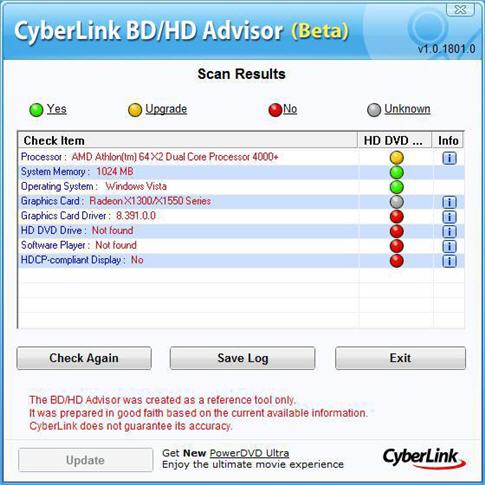
I expected the red bullets next to the drive and player entries; those will turn green as soon as I install the drive and the accompanying software. The CPU is above the minimum standard and should be able to deliver a consistently good experience. The graphics card is a bigger problem. The Radeon 1300 Pro is just below the minimum standard; it would probably deliver a few glitches under extreme loads. More importantly, it is not HDCP-ready, which means it would provide only analog output. And the selection of HDCP-ready video cards in a low-profile format is limited; MSI is sending me a review unit of their Nvidia 8500GT-based card with the necessary low-profile bracket for testing. (It's available for $77 at Newegg.)
I won't be watching any Blu-ray or HD DVD movies in the living room until the fresh video adapter arrives, but meanwhile I've been able to confirm that all the other pieces work well. A test machine in my office includes all the necessary pieces, including a 1080p display. I was able to connect the LG drive using a SATA-to-USB adapter and no trouble playing back movies in both formats.
Performance on this system was impressive, with smooth, glitch-free playback and an impressive level of detail, better than any cable or satellite HD program I've seen. I checked the CPU load on the 2.0GHz AMD processor (similar to the one in my living room system) and it was consistently in the 60%+ range. One advantage of the Nvidia 8-series boards is that they handle much of the decoding directly, sparing the CPU, so I'm hoping that the video upgrade will mean lower CPU loads.
Kick off your day with ZDNet's daily email newsletter. It's the freshest tech news and opinion, served hot. Get it.
Talkback
What's the point of this
You still get the movie and that's all pirates are concerned with. Look at all the low quality handy cam in theatre crap you hear about. So obviously this isn't about copy protection if you can DVD quality with out the HDCP. So I ask what's the point of this?
The point of this...
I do find it very annoying that older monitors/TV's were sold as HD Units yet many are not HDCP compliant. I assume you would have to purchase an entirely new display to bring your system up to spec.
BS in my opinion.
Yes, that's correct
Yes, that's true for protected content. It's not true for unprotected content, such as videos you shoot yourself or download, and it's not true for HD sources that don't require HDCP, such as cable and satellite HD set-top boxes.
Class Action?
Not everyone out there is in know when it comes high definition technology. The industry should not expect the consumer to understand what they are buying. If something is HD Compliant, it should work with everything that has high definition.
I also have the hunch that HDCP will actually increase the piracy of HD content. Once someone figures out how to break the encryption scheme it could be possible to create 1080P HD Disc that are security free.
I know I'd hit pirating services
Sounds like an appropriate response
Exactly
It's in the HD DVD media
The point, as I understand it, is to prevent easy, casual copying of HD content. Yes, you can make a DVD-quality copy through an analog output, but the difference in quality is dramatic.
If the security is in the media
So what's your point?
So what are you arguing? Are you suggesting that the makers of CE gear (including stand-alone players and PC drives) should put disk-cracking software in their boxes? Or that they should refuse to make these playback products at all and thus force the studios to stop using various protection schemes?
Suggesting?
In case it had escaped your notice...
Also, maybe I'm resuming too much here, but aren't the drm-free deals being struck pretty much ringing in the death of drm? Or am I wrong, and is major media convinced that they can come up with an uncrackable drm scheme and drm-free is like a temporary sop until they can come up with an uncrackable drm scheme?
Answers
"the drm-free deals being struck pretty much ringing in the death of drm"
Please name ONE "DRM-free deal" that involves HD visual media. The only ones I can think of are music-related.
Do you lock your doors?
If you are so smart, what would you recommend that the media companies do?
And why are you so worried about DRM anyways? If it is so easy to crack, then you can just remove it and go about your life.
Cat and Mouse Game
HDCP, DRM, EI-EI-O. It is all a waste of time. Some 8 year old hacker genius will break the code next week and it will all be for not.
Charge $5 per movie (to buy them) and people will buy them. Charge a buck or two to rent them and they will be rented. Continue charging an arm, leg and a left nut for them and people will find a way not to pay. It is worth the time to copy if you save $20/hour for your trouble.
Most people I talk to only want to watch most movies once, so the reproduction problem must be smaller than with music. The music industry should wake up and lower their prices as well. $1 per CD with literature would make it seem stupid to risk copying.
The late 70's - late 90's media gravy train is no longer viable. People are fed up paying a fortune for what was cheap before digital media existed. That is why people share. They feel that supply and demand rules are not working for entertainment. They feel like they have a right to get music and movies for free because the price has been too high for too long and they have more than supported the industry.
Bad analogy.
A proper analogy would be selling someone a house, with the doors locked, then refusing to give them keys, while conspiring with the police to arrest them and charge them with illegal entry if they find another way in, while also conspiring with the local utility companies to insure that their new house cannot connect to water, sewer, electric, phone, cable, etc.
Well
Yes, HD quality is magnificent and all, but most people have been pretty happy with DVD quality for the last 10 years. Why wouldn't they be happy with free (pirated) DVD quality if they've been happy with paying $20 for DVD quality for the last 10 years?
"Free but good enough" will always beat out "not free but high quality" in sheer numbers.
Most people were happy with black and white TV too
I think the content providers recognize that DVD-quality media is now and will continue to be relatively easy to pirate. For many people, it will indeed be good enough. But they believe that the difference between HD and SD/DVD will be enough that people will want to pay extra for the higher-quality media and that the popularity will grow over time.
We'll see if they're right.
Color was worth it
Now what does HD-DVD or Blue-Ray offer? Quality enhancements is all I see and really it's not that big of difference. Yes it's better and it is noticeable if you play them side by side but really if I watch HD in one house then watch in regular DVD in another I hardly notice the difference. The difference is there but what else does HD disks offer me. Why should I buy into it? I see not reason to.
Now offer me HD quality in a format that is not easily scratched, takes up less space, allow me to easily switch content similar to say better version of 5 disc player.
Huge difference to me
The fact that you can't see the difference doesn't mean that other people can't see a significant difference and be willing to pay for it.