Malware authors target Google Chrome

Summary: Sorry, Windows users. Switching to a different browser than Internet Explorer won't immunize you from malware attacks. The bad guys have begun preying on that misplaced confidence to push dangerous software, including Trojans and scareware. Here's a live, very dangerous example.
Every time I write about Internet Explorer, it's usually a matter of minutes—sometimes even seconds—until someone in the Talkback section proclaims, smugly, that they’ve switched to Google Chrome or Firefox and are therefore immune from malware attacks.
They’re wrong, and malware authors have begun preying on users of alternative browsers to push dangerous software, including Trojans and scareware. The problem is that most malware attacks aren’t triggered by exploits that target vulnerabilities in code. Instead, according to one recent study, “users are four times more likely to come into contact with social engineering tactics as opposed to a site serving up an exploit.”
Follow-up: Malware attempts that use Apple-focused social engineering are now in the wild. I just found one via Google Image search. See for yourself: What a Mac malware attack looks like.
I found a perfect example yesterday, thanks to an alert from Silverlight developer Kevin Dente. He had typed in a simple set of search terms—Silverlight datagrid reorder columns—at Google.com, using the Google Chrome browser on Windows. You can follow along with what happened next in the screenshot gallery that accompanies this post.
The first page of Google search results included several perfectly good links, but the sixth result was booby trapped. Clicking that link in Google Chrome popped up this dialog box:
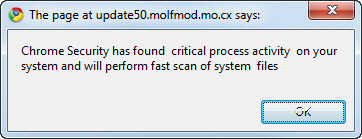
That led to a basic social engineering attack, but this one has a twist. It was customized for Chrome. If you’ve ever seen a Google Chrome security warning, you’ll recognize the distinctive, blood-red background, which this malware author has duplicated very effectively.
After the fake scan is complete, another dialog box comes up, warning that "Google Chrome recommends you to install proper software."
That’s terrible grammar, and this social-engineering attack is likely to fail with an English-speaking victim, who should be suspicious of the odd wording. But a user whose primary language is something other than English might well be fooled. And the malware author has anticipated the possibility that you might click Cancel in the dialog box. If you do, it still tries to download the malicious software.
Each time I visited this page, the download I was offered was slightly different. My installed antivirus software (Microsoft Security Essentials) didn’t flag it as dangerous. When I submitted it to VirusTotal.com, only five of the 42 engines correctly identified it as a suspicious file. Less than 8 hours later, a second scan at VirusTotal was a little better. This time, eight engines confirmed that the file was suspicious. Microsoft’s virus definitions had been updated and a scan identified the rogue file as Win32/Defmid.
Panda and Prevx identified the file as "Suspicious" and "Medium risk malware," respectively. BitDefender, F-Secure, and GData flagged it as "Gen:Trojan.Heur.FU.quX@am@e97ci." AntiVir detected it as "TR/Crypt.XPACK.Gen." Kaspersky says it is "Trojan-Downloader.Win32.FraudLoad.zdul." Every other antivirus engine, as of a few minutes ago, waved this suspicious executable right through.
Meanwhile, back in the browser, Google Chrome’s warnings are completely generic. If you download the software it shows up in the Downloads folder looking perfectly innocent.
Interestingly, this set of “poisoned” search terms also affected Bing, although the dangerous search result was on a different site, which didn’t show up until the fifth page of search results. And the download that it offered was, apparently, a completely different Trojan/scareware product. But the end result would have been the same, regardless of which browser I was using.
This case study shows that malware authors are beginning to adapt to changing habits of PC users. There’s nothing inherently safer about alternative browsers—or even alternative operating systems, for that matter—and as users adapt, so do the bad guys.
Be careful out there.
Kick off your day with ZDNet's daily email newsletter. It's the freshest tech news and opinion, served hot. Get it.


Talkback
Have you seen one of these attacks in the wild?
I wish you wouldn't start with "Windows users"!
It gives everyone else a smug FALSE sense of security!
RE: Malware authors target Google Chrome
Of course, I'm forwarding this to several of my Windows clients, so they know to keep an eye out for it, because even if they install it by mistake, I'm the one who gets to clean it up afterwards.
RE: Malware authors target Google Chrome
There are lots of other ways to compromise a Mac other than EXE. Any hacker knows that. Scarier for Mac is how easy it is to infiltrate it without the user knowing it. I much rather have this happen on my PC because when I see something like that at least I know there is a malware attempt.
I'll bet if I click on that link in Linux
Please Ed! Tell me I'm wrong! :D
lol...
RE: Malware authors target Google Chrome
Really. How would that work? Care to enlighten us?
There is only so much that can be done with ANY OS
Typical FUD from somebody who hasn't used it before
RE: Malware authors target Google Chrome
I usually use MSE for my primary a/v a/m but MBAM for the little buggers that get through that are fresh. I never have in issue with my computers but then again I know better and keep my stuff up to date.
If a user does get their machine compromised then tell the user to F8 into safe mode with networking, download MBAM, Update and scan. This happened to my Sister the other day using a non updated machine and running newest Chrome browser.
I use Firefox 4.0 with Adblock Plus and the malware domains subscription which usually blocks most threats from ever appearing at all. I also use MVPS Hosts file as a main gate bouncer keeping out more crap.
RE: Malware authors target Google Chrome
I had a problem with suspicious activity on a machine running MSE. I ran the latest MBAM and a couple of others and found nothing. I ran an MSE update and re-scanned and got 4 Java criminals. MSE seems to be doing a good job with very recent disease vectors.
RE: Malware authors target Google Chrome
Do a google image search for ciclon and click the first image that comes up.
RE: Malware authors target Google Chrome
@cspencer1113
RE: Malware authors target Google Chrome
I saw this a few days ago, someone called me to their computer when the warning popped up. As you said, when I clicked Cancel it prompted for a download.
The problem with what you have written is that it does not target Chrome in a technology sense. If it were to have executed the code, as opposed to initiating a download, I would agree. Chrome even asked if I wanted to download the file. Any website can attempt a download, it is just that this used the words "Google Chrome."
In my opinion, this is nothing more than the "You are the winner from [your city]" cons.
RE: Malware authors target Google Chrome
I get the point, but I just don't see why you would write such common sense in a tech blog. If this were aimed at 8 year old children using a computer for the first time I would understand, but it isn't.
RE: Malware authors target Google Chrome
Me, at the moment I'm running Opera on Linux. If I'm generous and assume 2% desktop share for Linux and 2.5% for Opera and ignore the fact that there's probably less use of a closed source browser on Linux than Windows, cause, like, software should be free, man ;-), that means there's probably about 0.0005% interest in targeting me for a social engineering attack. :-) Thanks to my previous comment making fun of other Linux users there's probably about 35% chance of being bitten by a penguin in the next six months however....