ie8 fix
madison

Privacy protection and IE9: who can you trust?

By | February 14, 2011, 6:00pm PST

Among the most significant new features in Internet Explorer 9 is a framework for giving users control over their online privacy. Microsoft announced Tracking Protection a few months ago and has shown a few demos since. Last week it gave the public its first crack at actually using the technology in the IE9 Release Candidate.

I’ve already explained how Tracking Protection works. (The short version: you can block third-party tracking cookies, web beacons, and even ads by importing a list into IE9 and enabling it.)

By design, Tracking Protection is disabled and no third-party lists are installed. If you want to block third-party scripts and cookies and ads, you have to choose to turn the feature on. Third parties can make it easy for you to do that. If you visit Abine.com using IE9, for example, you can get to this page that allows you to install a Tracking Protection List (TPL) automatically:
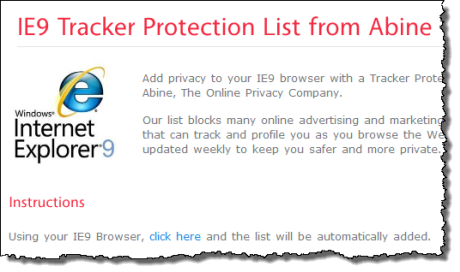
But how do you know whether this list is trustworthy? Is it based on solid research and up to date? How do you know the motivations of a list’s publisher? Microsoft is counting on a reputation system to emerge and for communities to make their recommendations about these lists. It doesn’t help that one of the five lists that Microsoft highlights for IE9 RC users just happens to give a handful of Microsoft-owned domains a free pass on privacy.

Part 1: IE9 and Tracking Protection: Microsoft disrupts the online ad business

Gallery: Using Tracking Protection Lists in IE9

In its initial announcement of Tracking Protection, back in December 2010, Microsoft acknowledged that this is just the first step in terms of developing a privacy protection platform that really works:

We designed this functionality as a good start to enable consumer choice and protection from potential tracking. We provide a tool in the browser, and consumers choose how to use it. As with everything on the web, we expect it to evolve over time especially as the broader privacy dialog continues. We’re communicating about it now as part of our transparency in the software development process.

So who can you trust? That question is especially important when you take into account the design of this feature in the IE9 RC. You can install multiple TPLs, and an Allow rule on any list trumps a Block rule on another list. So if you’re the owner of a big network of web properties, and you see a site visitor arrive using IE9, wouldn’t you want to helpfully offer that visitor the option to install a Tracking Protection List that whitelists all your domains? All in the interests of improved user experience, of course.

You can see an example of this potential conflict in the first batch of publicly available Tracking Protection Lists. I downloaded the current version of four lists from this Microsoft-hosted page (PrivacyChoice offers two versions of its lists, so I used the All Companies list). What I found after a close look inside these TPLs was surprising.

The data is in simple text files, with a fairly straightforward syntax. Here’s the beginning of Abine’s TPL:

Name: Abine Tracking Protection List
Address: http://www.abine.com/tpl/abineielist.txt

File:
msFilterList
-d statcounter.com counter.js
-d addthis.com addthis_widget.js
-d analytics.live.com masanalytics.js
-d scorecardresearch.com beacon.js
-d diig.com diggthis.js
-d charbeat.com charbeat.js
-d alexametrics.com atrk.js
-d google-analytics.com siteopt.js

Each line after the msFilterList header is a rule. The –d means that the rule blocks traffic from the domain on that line that contains the substring shown after the domain. So in this snippet, the analytics scripts from Microsoft’s live.com and Google’s google-analytics.com are blocked. A +d means that requests to the domain on the same line are allowed. And when multiple lists target the same domain and substring, the Allow rule wins.

I imported the four raw TPLs into Microsoft Excel and cleaned them up for analysis. One revealing way to slice the data was to look at the number of Block and Allow rules defined in each list. See anything odd about this list?

Publisher Block Allow
EasyList 2,189 47
PrivacyChoice 463 1
Abine 94 0
TRUSTe 0 3,958

All data current as of February 12, 2011.

Hmmm. One of these lists is not like the other. In fact, you can make some guesses about the purpose and scope of each list just from those numbers, and I bet those guesses would be accurate. On the next page, I’ll share what I learned about each company and its list.

Page 2: Four Tracking Protection Lists under the microscope –>

Topics

Ed Bott is an award-winning technology writer with more than two decades' experience writing for mainstream media outlets and online publications.

Disclosure

Ed Bott

Ed Bott is a freelance technical journalist and book author. All work that Ed does is on a contractual basis.

Since 1994, Ed has written more than 25 books about Microsoft Windows and Office. Along with various co-authors, Ed is completely responsible for the content of the books he writes. As a key part of his contractual relationship with publishers, he gives them permission to print and distribute the content he writes and to pay him a royalty based on the actual sales of those books. Ed's books written prior to fall 2011 have been distributed by Que Publishing (a division of Pearson Education) and by Microsoft Press. As of November 2011, Ed is a partner in the independent publishing company Fair Trade Digital Exchange, which exclusively publishes his books.

On occasion, Ed accepts consulting assignments. In recent years, he has worked as an expert witness in cases where his experience and knowledge of Microsoft and Microsoft Windows have been useful. In each such case, his compensation is on an hourly basis, and he is hired as a witness, not an advocate.

Ed does not own stock or have any other financial interest in Microsoft or any other software company. He owns 500 shares of stock in EMC Corporation, which was purchased before the company's acquisition of VMware. In addition, he owns 350 shares of stock in Intel Corporation, purchased more than two years ago. All stocks are held in retirement accounts for long-term growth.

Ed does not accept gifts from companies he covers. All hardware products he writes about are purchased with his own funds or are review units covered under formal loan agreements and are returned after the review is complete.

Biography

Ed Bott

Ed Bott is an award-winning technology writer with more than two decades' experience writing for mainstream media outlets and online publications. He's served as editor of the U.S. edition of PC Computing and managing editor of PC World; both publications had monthly paid circulation in excess of 1 million during his tenure. He is the author of more than 25 books on Microsoft Windows and Office, including the recently released Windows 7 Inside Out.

66
Comments

Join the conversation!

Just In

RE: Privacy protection and IE9: who can you trust?
TimPeris 8th Nov
Who cares if google suffers from this, it's there own fault for not monitorign there partners, and if they had chosen a better company direction. Advertising is hated in Snail mail and email, why would it be any different in websites. Companies need to make this optional, at least when it comes to displaying the ad. Google's index is getting to big and well they still can't provide proof that Advertising companies aren't paying them to show up on top, which relentlessly ruins your search results. I don't' have this problem because from my business aspects have chosen to not use Google due to my profits margins. My own opinion here and probably someone Else's, I don't care if this effected google, because well if I didn't' know better, I wouldn't want to pay techs like me regularly to removed partner ad's/malware! I make so much money on Marketing companies who are partnered with Google it is disgraceful!! Google woudl deserve it!
0 Votes
+ -
You know what...
Peter Perry Updated - 14th Feb 2011
Wireless broadband providers are charging by the gig and every little bit counts! I do not want ads wasting my bandwidth so why not provide this to customers.

Something tells me we're going to see a whole bunch of php required tags embedded in pages once this technology hits.() ()
0 Votes
+ -
@Peter Perry one more note, I do see this taking a big chunk out of Google's revenue and that will hurt the search Giant Big Time!
0 Votes
+ -
It's smart...
LiquidLearner 14th Feb 2011
@Peter Perry

Microsoft, while they like ad revenue, doesn't survive on it. Ads are Google's lifeblood. But I don't think usage will be high enough to matter. You have to go in and turn it on, requiring a few seconds of your time, which means it will escape the grasp of most people.
0 Votes
+ -
LiquidLearner, having it off by default
John Zern 15th Feb 2011
@Peter Perry is probally done for those that will wonder what went wrong with the install as they can't see ads if it was on by default. happy

That, and to keep Regulators happy.
0 Votes
+ -
Google This and Google That! haha.....
i2fun@... Updated - 15th Feb 2011
@Peter Perry Why is why I can't believe the Microsoft's "Embrace Extend Extinguish" modus operandi has changed. It seems they really want them to keep using these anticompetitive misinformation techniques that only ended up failing last time around. So you fools can jump on the MS coat tails, use Bing, support this asinine attempt to spread your mis-information in a blind attempt to pull money out of Google's pockets. But it's not to stop ads anyway. Only to control tracking and it's being implemented in all browsers.

But if you want to watch videos from the largest content provider (including embedded in MS's own video site) in the World, then you will still have to deal with Google making money off Ads at least there, or you can not watch 'em (even YouTube videos links on Bing Video Searches)!!! The tracking? Google doesn't make money off tracking anyway..... only off the ads these tracking companies place and they don't care if the tracking is disabled or NOT!
@i2fun@... Microsoft heard about Mozilla's Privacy (plus extensions they already have available) plans and had to respond with at least something that better ensures user's control of privacy online. The thing is this system isn't in IE browser itself like Firefox and leaves the same old holes in IE that are the reason it is the most insecure browser on the planet to date. Things like VB Script and Active X! .....huge monstrously destructive and insecure technologies from the last 15 years of IE dominance on the web!

http://blog.mozilla.com/blog/2011/02/08/mozilla-firefox-4-beta-now-including-do-not-track-capabilities/

So this is nothing new. Simply much like "DO NOT TRACK" headers in Firefox!

Then Google followed with an Add on too. So Microsoft was simply forced to respond!
0 Votes
+ -
@Peter Perry

Who cares if google suffers from this, it's there own fault for not monitorign there partners, and if they had chosen a better company direction. Advertising is hated in Snail mail and email, why would it be any different in websites. Companies need to make this optional, at least when it comes to displaying the ad. Google's index is getting to big and well they still can't provide proof that Advertising companies aren't paying them to show up on top, which relentlessly ruins your search results. I don't' have this problem because from my business aspects have chosen to not use Google due to my profits margins. My own opinion here and probably someone Else's, I don't care if this effected google, because well if I didn't' know better, I wouldn't want to pay techs like me regularly to removed partner ad's/malware! I make so much money on Marketing companies who are partnered with Google it is disgraceful!! Google woudl deserve it!
lovely 3 thanks for sharing! Hermes Lindy Bags
0 Votes
+ -
RE: Privacy protection and IE9: who can you trust?
tonymcs@... Updated - 14th Feb 2011
On the one hand, this is great for users sick to death of advertising.

On the other hand, it's a death knell for ZDNET and other blogging sites. These sites only exist because of advertising and bloggers are paid for the number of posts they attract (that is posters who are potentially looking at the ads).

If IE9 (and presumably the other browsers will catch up) has wide takeup, then the main revenue for these types of sites will take a significant hit.

Any idea how ZDNET et al will survive with diminished advertising revenue Ed?
0 Votes
+ -
Contributr
A lot of dominoes have to fall
Ed Bott 14th Feb 2011
@tonymcs@...

This will take several years to play out. Ask me again next year at this time...
0 Votes
+ -
@Ed Bott

When I see you playing the guitar next to the subway, I'll throw you a dime happy
  • Flagged
Forcing you to another subway entrence?
  • Flagged
0 Votes
+ -
Yeah but Ed won't have a dime
search & destroy 15th Feb 2011
Alan will.

LOL... grin
0 Votes
+ -
@tonymcs@
Any idea how ZDNET et al will survive with diminished advertising revenue Ed?

Another obvious question to address might be:
How will the bigger, badder and better funded players find ways to effectively sidestep it?

Seems there's always an end-around, backdoor or circumvent to be found in every computational puzzle. plain

@Ed Bott
It doesn't help that one of the five lists that Microsoft highlights for IE9 RC users just happens to give a handful of Microsoft-owned domains a free pass on privacy.

Attaboy MS! And so it begins. wink
0 Votes
+ -
@klumper
Let's be clear. In this space they are not a monopoly.
0 Votes
+ -
@tonymcs@...

All of us non-primary Windows users. We're gold.
0 Votes
+ -
Please learn elementary grammar
bmeacham98@... 14th Feb 2011
It's "whom can you trust," not "who can you trust."
0 Votes
+ -
Yes, yes
klumper Updated - 15th Feb 2011
@bmeacham98@...

But this is a Microsoft *Windows related* classroom. Not an English class.

The reason we came up with so many acronyms, leetspeak and tidbits of mindless jargon was to cover our wholly imperfect computing and communication bases in the first place. It also helps cover up any grammatical slip-ups and profundency splatters much more effectively, on the Internet and beyond. But you know that.

Oh, and in God we trust. There's the missing answer to your non-question . . .
I trust.
0 Votes
+ -
@bmeacham98@... I agree itshould be whom, but its not elementary grammar. Last I saw, grammar is not on any of the national tests, therefore the schools do not have it in their curriculum anymore. We teach kids to memorize, not think.
0 Votes
+ -
Contributr
In ordinary usage...
Ed Bott Updated - 15th Feb 2011
@bmeacham98@...

I started my career as a copy editor. I know grammar inside and out. In general, modern grammarians find this construction perfectly acceptable and even preferable for ordinary speech and writing.
0 Votes
+ -
Can you do us a favor?
xp-client 14th Feb 2011
So can you keep this table of blocked/allowed updated over time?
0 Votes
+ -
IE9 Propaganda
xp-client 14th Feb 2011
Maybe you should also point out that IE8 also has this feature but simply less prominent. See http://www.vista4beginners.com/AdBlock-Plus-Filters-Internet-Explorer-8 and http://img146.imageshack.us/img146/5753/inprivatefiltering.png
0 Votes
+ -
Contributr
I've pointed that out before
Ed Bott Updated - 15th Feb 2011
@anonymuos

The differences are, unfortunately, huge.
0 Votes
+ -
RE: Privacy protection and IE9: who can you trust?
berriend Updated - 15th Feb 2011
@Ed Bott
Is it really that different? Last year I activated the InPrivate Filtering for IE8 (small registry edit to turn it on and keep it on), but I never found a feed or list available anywhere to subscribe to, other than the Easy-List. I didn't install that list at the time, though, and I just let the automatic analysis proceed. I periodically scan the analysis results and manually set Allow/Block for each detected site. It worked (works) really well, allowing me to block a lot of annoying stuff. I always figured it was never publicized enough to attract any attention, or else the required expression formatting remained somewhat mysterious (kind of like regex, but with some annoying quirks), so nobody took the trouble to implement a feed.
I only mention all this to say that your description of this scheme seems to be exactly what IE8's InPrivate Filtering scheme was intended to be, except maybe they have left out the analysis and automatic blocking part.
0 Votes
+ -
@Ed Bott yes and how convenient to say there are HUGE differences without mentioning specifcally what they are! With a simple reg tweak, InPrivate Filtering can be turned permanently on. Of course, with Microsoft Glasses (TM), you will notice GIGANTIC differences where there aren't.
0 Votes
+ -
@anonymuos

If I'm not mistaken, the previous implementation had to be reactivated every time the browser was opened. A deliberate and bald-faced attempt to introduce "breakage" for lack of a better term into the ad-block scheme.

Which is why I'm underwhelmed with the IE9 version. I don't think MS has lost its desire for a certain amount of breakage, I think MS has made it more subtle.


happy
0 Votes
+ -
This whole "protection privacy" scheme is just a dog & pony show to placate NBMers into believing IE8 (and now IE9) is better than Firefox. They will never come up with anything as good as AdBlock.

Sad, they'll fall for it. Truly sad.
0 Votes
+ -
RE: Privacy protection and IE9: who can you trust?
billwoo Updated - 15th Feb 2011
Excellent article, thanks Ed !

Wonder what the impact of this is (if any) on those of us using a modified Hosts file to block many sites such as the one available from:

http://www.mvps.org/winhelp2002/hostsvista.htm

Surprised you did not mention this well-known and highly regarded technique.

thanks, Bill
0 Votes
+ -
Contributr
The focus of this piece is IE9
Ed Bott 15th Feb 2011
@billwoo

There are many ways to block traffic to unwanted hosts on the Internet, including host files, third-party software, plug-ins, and so on. The focus here is on IE9 and the fact that Microsoft plans to submit this as a W3C standard.
0 Votes
+ -
@billwoo Jes for sure On the other hand, it's a death knell for ZDNET and other blogging sites. These sites only exist because of glass nail file wholesale glass nail file wholesale advertising and bloggers are paid for the number of posts they attract (that is posters who are potentially looking at the ads).
Great stuff for zdnet will be Powerline networking. If IE9 (and presumably the other browsers will catch up) has wide takeup, then the main revenue for these types of sites will take a significant hit.
0 Votes
+ -
The one thing that is absolutely certain is that I do *NOT* trust is Microsoft.
0 Votes
+ -
Well, I don't trust Google or Apple
John Zern 15th Feb 2011
@drf999
So we're just balancing each other out!
@drf999

Those who can not trust much won't be trusted much either.

~~~~~~~~~~
Doubt is not a pleasant condition, but certainty is absurd
~ Voltaire, 1694-1778

The fixity of a habit is generally in direct proportion to its absurdity.
~ Proust
0 Votes
+ -
RE: Privacy protection and IE9: who can you trust?
Loverock Davidson 15th Feb 2011
Its great that IE9 is getting this feature. Same rules apply for me, almost everything will get blocked except the sites I deem worthy enough to be whitelisted.
We new youd show us the way. :-;
0 Votes
+ -
TRUSTe provides absolutely no value to consumers, it is purely a modern-day protection racket.
0 Votes
+ -
Ever notice that TRUSTe...
search & destroy 15th Feb 2011
...is prominently displayed on Adobe's website?

That says a lot, now doesn't it? wink
0 Votes
+ -
RE: Privacy protection and IE9: who can you trust?
none none Updated - 15th Feb 2011
Microsoft plan to bring the design for a tracking protection list, as well as a persistent setting to indicate tracking preferences to the W3C as a proposal for Web standardization.

Is it appropriate to respond to this news with an expression of relief that we don't have to guard our privacy any more?

I didn't think so. So what's the purpose of it? Is this an attempt to show the industry can police itself to avoid regulation? That certainly makes me feel more safe!

Any design to signal user preferences to data trackers needs to be complimented by enforcement on the other end to ensure the preferences are honored. There's no way around that fact, and that means regulation.

Lacking that. it's still the plugin coder living in his mom's basement who has my trust.

Just what, exactly, is the proposed standard? Is it the file format for the TPL? Big deal.


happy
0 Votes
+ -
Berkeley privacy round table
elementale 15th Feb 2011
First.. here the real link to that event:
http://www.law.berkeley.edu/10219.htm

Second, at the BCLT Round Table on Browser Privacy, right after the MS and FF guys explained their approaches to halt tracking, the two technical guys on the panel then explained in about 2 minutes each how these could be gotten around.

The problem is, tracking is an arms race. Once you have a list of blocked sites.. the advertisers will get new domains.. possibly daily, possibly hourly, to route around this problem.

And once you block things in the header (the Firefox method) you are asking the advertiser not to track.. and why would we trust them? And who audits that?

We need a comprehensive approach to this problem of being stalked all around the internet by companies (Google alone has over 50 trackers on the NY Times.com website, out of the over 100 found on each page there).

Each individual needs to be in charge of whatever tracking about themselves happens.. and cross site tracking needs to end. Then we create a marketplace based upon users sharing what they want to.. and if they don't, well then no sharing or probably, lots will opt out of self-tracking.

You may think that sounds crazy, but think of mileage programs. Many opt-in because the rewards are worth it. They self track with the help of an airline, by aggregating CC miles, hotel and rental car info, all into a mileage account that they trade for valuable stuff.

This is very doable. We just need to make it happen. And shut down the arms race.

Mary Hodder
Personal Data Ecosystem.
0 Votes
+ -
Are wild cards allowed? such as
-d ad*.com
0 Votes
+ -
While you have the lists in Excel, what's the overlap (if any) between sites blocked by the other lists but allowed by TRUSTe?
0 Votes
+ -
1) Download (but don't install) the TRUSTe list. 2) Change all the "+d" entries to "-d". 3) Install. 4) Don't let it update, but check for new lists periodically. Thank you, TRUSTe, for giving me a great list of whom to block.
Actually the only +d in the PrivacyChoice list actually seems to be a template entry to add to the positive list. It shows up as +d not_tracking as of today. So in reality it does not whitelist any site.
0 Votes
+ -
IE9 RC played havoc with my gadgets on Win7 pro; the beta worked fine. I really like your work here Ed. I'll try IE9 on official release.
0 Votes
+ -
Instead of opting-out (or at least try to) from being tracked, you can fool trackers and also let them know that they are being fooled in case they decide to track you without your approval. see Breadcrumbs Privacy Software.
www.GetOnlinePrivacy.com
0 Votes
+ -
Instead of opting-out (or at least try to) from being tracked, you can fool trackers and also let them know that they are being fooled in case they decide to track you without your approval. see Breadcrumbs Privacy Software.
www.GetOnlinePrivacy.com
0 Votes
+ -
Who can you trust?
james347 15th Feb 2011
Not Microsoft, hence not I.E.
If you want *good* privary and tracking protection I'd recommend settling to no less than Torbutton, ( http://www.torproject.org/torbutton/index.html.en ) which is only available for firefox (and derivatives) though but even if you, for some reason, fancy IE more you should at least read Torbutton FAQ so you understand the measures it takes and reason for them as you might well come to conclusion that to get good enough protection your browser preference might be less important...

Do not make the mistake of thinking that Torbutton is just a button that switches you to use tor-proxy when enabled, it does quite a few other things to prevent tracking and to protect your privacy.

And while at it, consider also using plugins AdBlock and NoScript in addition to Torbutton.
0 Votes
+ -
Thanks for the Great Info
jpr75_z 15th Feb 2011
As always Ed, you provide very useful information, some of which you cannot find elsewhere. Thanks !
0 Votes
+ -
whom

! ! !
Who cares if google suffers from this, it's there own fault for not monitorign there partners, and if they had chosen a better company direction. Advertising is hated in Snail mail and email, why would it be any different in websites. Companies need to make this optional, at least when it comes to displaying the ad. Google's index is getting to big and well they still can't provide proof that Advertising companies aren't paying them to show up on top, which relentlessly ruins your search results. I don't' have this problem because from my business aspects have chosen to not use Google due to my profits margins. My own opinion here and probably someone Else's, I don't care if this effected google, because well if I didn't' know better, I wouldn't want to pay techs like me regularly to removed partner ad's/malware! I make so much money on Marketing companies who are partnered with Google it is disgraceful!! Google woudl deserve it!

Join the conversation!

Formatting +
BB Codes - Note: HTML is not supported in forums
  • [b] Bold [/b]
  • [i] Italic [/i]
  • [u] Underline [/u]
  • [s] Strikethrough [/s]
  • [q] "Quote" [/q]
  • [ol][*] 1. Ordered List [/ol]
  • [ul][*] · Unordered List [/ul]
  • [pre] Preformat [/pre]
  • [quote] "Blockquote" [/quote]
ie8 fix
ie8 fix

The best of ZDNet, delivered

ZDNet Newsletters

Get the best of ZDNet delivered straight to your inbox

Facebook Activity

White Papers, Webcasts, & Resources
ie8 fix
ie8 fix