Between the Lines

Larry Dignan, Andrew Nusca and Rachel King

HP makes its mobile move; Saves Palm from collapse; Will developers stick?

By | April 28, 2010, 1:16pm PDT

Summary: Hewlett-Packard has stepped in as a surprise buyer for Palm. HP will buy Palm and its webOS operating system for $1.2 billion, or $5.70 a share. The deal saves Palm, which said its business was unraveling quickly.

Updated: Hewlett-Packard has stepped in as a surprise buyer for Palm. HP will buy Palm and its webOS operating system for $1.2 billion, or $5.70 a share.

With the deal HP becomes a smartphone player because it will acquire an operating system, intellectual property and handset designs. It’s likely that HP CEO Mark Hurd will give Palm some manufacturing discipline and scale.

The deal has been approved by both boards of directors (statement).

Palm put itself up for sale after struggled to move inventory at Verizon Wireless. The company had innovative software, but failed to keep up with new smartphone designs. At the $1.2 billion price, Palm’s primary investors—Elevation Partners—get out of the company roughly in tact. Meanwhile, Palm’s business was just getting worse. The company projected fourth quarter revenue between $90 million and $100 million. Palm said in an SEC filing:

Revenues for the fourth fiscal quarter are being impacted by slow sales of the company’s products, which has resulted in low order volumes from carriers.

Wall Street estimates, which have come down dramatically, were projecting Palm revenue of $164 million for the fourth quarter. Simply put, HP just saved Palm from near certain doom.

You could argue that HP overpaid given the rate Palm’s sales were tanking, but the deal revolves around the future of the WebOS and what HP can do with it–think Slate. According to Stifel Nicolaus, the WebOS was worth $800 million to $1 billion for a highly motivated buyer. For HP, the Palm deal means that Hurd has another part of the company’s IT stack to fill out. HP has basically been a no-show in the smartphone market—aside from the iPaq (right)—but with Lenovo rumored to be a bidder for Palm and Dell aggressively moving into smartphones, the company had to make a move.

In a conference call to discuss the deal this afternoon, Executive VP Todd Bradley repeatedly referenced “connected” devices and the strengths on both side. HP isn’t sharing any product rollout plans until they get closer to the closing of the deal, which is expected in the third quarter, pending regulatory approval.

However, he suggested that one of the first moves would be to use HP’s retail and commercial channels to broaden the reach for distribution of Palm’s consumer smartphones. As for expansion into tablet or slate products, Bradley said those are new markets that have potential for adoption by both consumers and commercial verticals, such as health care and education.

Asked why HP didn’t just jump on to the Android bandwagon, Bradley said that the product lines - whether smartphones, tablets or netbooks - were still in the early stage market and that HP will be able to attract and build a developer market that will make WebOS more compelling and more competitive.

It also came as no surprise that HP - as a Silicon Valley pioneer built on the spirit of innovation - might want to maintain control over the path of a mobile OS for better integration with other products. Bradley mentioned that the both companies are Silicon Valley-based companies with “a passion for innovation.”

And while no one asked the question directly, Bradley also noted that Microsoft will remain a strategic partner of HP, and said it is a “huge piece of our business today and will continue to be so.”

Also: HP Slate with webOS: The potential iPad rival from HP’s acquisition of Palm

In a statement, HP outlined its strategy as the following:

  • Take Palm’s WebOS;
  • Use HP’s scale and financial heft to bulk Palm up;
  • Leverage HP’s channel and enterprise connections to make Palm a player;
  • And create a mobile ecosystem.

Add it up and the HP purchase of Palm may be enough to keep developers—a primary factor in smartphone success—in the fold.

Palm CEO Jon Rubinstein is expected to remain at the company.

There are multiple threads to ponder in this deal. Among them:

  • With Palm, HP can become a viable threat to Research in Motion and Apple. On the Apple front, Palm has a nice operating system that was built to compete with the iPhone. However, the ecosystem for Palm just wasn’t there. HP could change that equation somewhat, but it’s unclear whether it’ll pan out from a consumer perspective. More likely, HP will make Palm an enterprise play and look to threaten RIM with mobility. HP can make Palm devices a part of the IT stack Hurd is pushing.
  • Can HP keep developers in the fold? If you’re a developer looking at this deal you can breathe a little easier because Palm won’t disappear tomorrow. That fact, however, doesn’t change Palm’s market share and growth prospects. HP will have to turbo charge growth for developers to remain interested and double down on the WebOS.
  • The tablet connection. HP has been making a lot of noise about its Slate, an iPad rival. It’s unclear whether Windows 7 will be lightweight enough for a smallish netbook replacement. Palm’s WebOS could show up on tablets just like Android and the iPhone OS. Andrew Nusca took the liberty of mocking this one up.
  • HP’s smartphone strategy emerges. Will HP be able to keep up with the cool smartphone kids like HTC and Apple on the design front. Palm designs haven’t been able to keep up and HP is an unknown entity.
  • The emergence of PC vendors as smartphone dealers. HP, Lenovo and Dell are all plotting smartphones. The convergence of the PC and smartphone and tablets could accelerate. Do these PC brands translate to smartphones?
  • Will HP play with Microsoft’s Windows Phone 7? HP counts Microsoft as a long-time partner. Now it owns its own operating system the relationship could be strained.

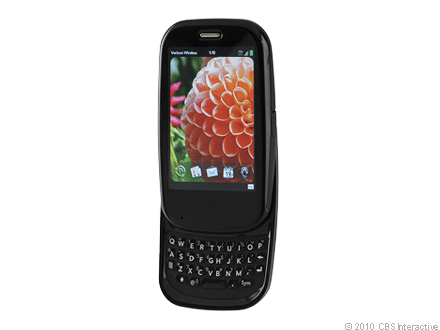
Related:

Kick off your day with ZDNet's daily e-mail newsletter. It's the freshest tech news and opinion, served hot. Get it.

Topics

Larry Dignan is Editor in Chief of ZDNet and SmartPlanet as well as Editorial Director of ZDNet's sister site TechRepublic.

Disclosure

Larry Dignan

Larry Dignan has nothing to disclose. He doesn’t hold investments in the technology companies he covers.

Biography

Larry Dignan

Larry Dignan is Editor in Chief of ZDNet and SmartPlanet as well as Editorial Director of ZDNet's sister site TechRepublic. He was most recently Executive Editor of News and Blogs at ZDNet. Prior to that he was executive news editor at eWeek and news editor at Baseline. He also served as the East Coast news editor and finance editor at CNET News.com. Larry has covered the technology and financial services industry since 1995, publishing articles in WallStreetWeek.com, Inter@ctive Week, The New York Times, and Financial Planning magazine. He's a graduate of the Columbia School of Journalism and the University of Delaware.

For daily updates, follow Larry on Twitter.

66
Comments

Join the conversation!

Just In

RE: HP makes its mobile move; Saves Palm; Will developers stick?
yarinsiz Updated - 11th May 2011
Great!!! thanks for sharing this information to us!
seslisohbet seslichat
0 Votes
+ -
Palm & HP Silence Naysayers
KerryArthur Updated - 28th Apr 2010
As could have been seen in the April 19th entry
here entitled "What if Palm doesn't find a
buyer?" there were many naysayers predicting
doom and more doom for Palm.

One "expert" source said:
"Although we believe Palm being acquired is
unlikely, we expect that any possible
acquisition of the company would likely be
defensive or for its IP portfolio, as opposed to
a strategic buyer."

I for one am glad they were wrong and glad also
that HP is acquiring (they have the corporate
largess, if you will, to handle parallel
brands). There is great merit in Rubinstein's
resolve and this acquisition attests to his
leadership in tough times (such an outcome,
contrary to what this entry title suggests,
cannot be due only to HP wanting to be Jesus-
like). I wish him and Palm all the best and look
forward to replacing my Centro with something
running WebOS.

(And no, apart from owning a Centro, I'm in no
way affiliated with Palm Inc.)
0 Votes
+ -
WebOS is as good as dead
ericesque 28th Apr 2010
I can't think of a surer way to kill off WebOS than have
HP buy it. HP can't write a lick of decent software to
save its life and HP sure as heck doesn't "get" the app
craze.

WebOS is about to go down in a blaze of folly.
0 Votes
+ -
RTFA
htotten 28th Apr 2010
the programmers at Palm are staying!!!!
0 Votes
+ -
Ummm no, they're not
Johnny Vegas 28th Apr 2010
A portion of them will be enticed to stay for 6-12 months by retention bonuses. The rest will be looking else where asap. For the rest, once the retention bonus period is up they'll be gone to. Enterprenarial innovators like start up atmospheres, not stodgy corporations. My guess is webos will soon be over in india on life support. It's the Hurd way.

Regardless they will not be able to muster any 3rd party app support. With MS, Nokia, Apple, and android there's enough already. Sorry webos and RIM. Same with ipad, windows, and android/chrome. No need for a webos slate.

Be lucky if it makes it 3 years before they use it as a total write off...
0 Votes
+ -
Reduce HURD's bonus by $1.2 billion
BoulderDave 29th Apr 2010
This crazy folly of spending $1.2 bill for something that's going extinct should be recooped by HP reducing Hurd's golden parachute by this amount.
0 Votes
+ -
congrats!
ericesque 28th Apr 2010
you learned what RTFA stands for this week. By
next week, if we're lucky, you'll stop using it
like everyone else.

Unfortunately, htotten, despite your
commendable efforts, reading the article didn't
translate into comprehension. The article
DOESN'T say the programmers are staying. It
simply said their positions are not being
terminated immediately. This still leaves a
major component to the equation-- whether the
programmers will decide to stay on under HP.

If they do stick around it will be just long
enough to figure out how HP works. Any of the
developers with a shred of talent will almost
certainly begin searching for another employer
in the first year.
0 Votes
+ -
It'll die without help
CobraA1 28th Apr 2010
It's as good as dead without any help. While I
certainly didn't want to see it come to this -
frankly, Palm has been way too slow to get
their stuff to market.

Maybe HP can help Palm get more hardware to
market, and maybe Palm can help HP create
software.

As long as they continue to play their
strengths, they should do fine.
0 Votes
+ -
WebOS has little or no value.
No_Ax_to_Grind 28th Apr 2010
If Palm had understood that they would not be going under.
0 Votes
+ -
C'mon Axe
htotten 28th Apr 2010
I guess Symbol has no value either....HP is going
to use WebOS in their Medical Equipment
devices...vertical...niche...verrrryyyyy
profitable.....
0 Votes
+ -
I respectfully disagree.
heres_johnny 29th Apr 2010
I respect your opinion, Ax, but I must disagree. I have a Palm Pre. The software is dynamite, the hardware meh mainly because of construction issues. I think HP acquiring Palm means that they will stay alive long enough to have hardware designs that match the ability of the software to rock hard. Of course, the other reason they acquired Palm is to put WebOS on a tablet, where it will absolutely RULE. When testing out the iPad in an Apple store, I kept having one thought come up again and again; 'this tablet would be awesome with WebOS on it instead of this jankety iPhone OS'. It's a can't-miss proposition.
0 Votes
+ -
WebOS is why HP jumped into the fray!
Olderdan 28th Apr 2010
Apparently you have never USED WebOS. It's dynamite.
Every bit as nimble and well designed as iPhone OS (and
more because it already has Multitasking). A better
notification system and the flexibility to work with the
hacker community (not against them). WebOS is the top
reason for *any* company to acquire Palm.
0 Votes
+ -
Agreed!
htotten 28th Apr 2010
WebOS is the key. Can you imagine the medical
equipment using WebOS instead of embedded
"whatever"?
0 Votes
+ -
WebOS in Medical devices
minardi 29th Apr 2010
Well good luck with that one, maybe in 10 years. To record, or use data
with medical devices, the OS would have to be certified by the FDA.
0 Votes
+ -
Dump the crippled OS it has now and put a real touch based OS on the
Slate and you could have a serious winner.
I think it was a good move. The good software folk of Palm will stay. They now have a giant behind them to give the money needed to make it happen. If we don't try to make them an Apple or Blackberry slayer, we can see them as a good choice--especially if they take the enterprise approach.
0 Votes
+ -
Bad move
croberts 28th Apr 2010
HP basically paid 1.2 billion for a mobile OS.

They could have tailored android for free, or wait for MS to finish the R&D on Win Mobile 7.

So they really paid 1.2 billion for what, the Palm Pre hardware intellectual property?!?

The Pre is an OK hardware design, but come on...
0 Votes
+ -
RE:Bad Move - you're wrong
villanim 28th Apr 2010
Obviously you have not used WebOS judging by your comments. The only advantage that Android and Apples mobile OS have is the amount of applications available for their devices, that is all. WebOS has more functionality out of the box with it's first version than Apple or Andorid does with their latest versions. From true multitasking, to unified messaging, to Exchange support, to a much better browser. I could go on but I will stop here. Apples hardware design is superior, I will give you that, as I do like the larger screen, but I do like the physical keyboard on the pre and pixi. With Android devices you do not know what version of the OS you will get, and they are not all upgradeable to the most current version, with Palms devices they all run the same OS, are OS upgradeable (automatically BTW), are not tied to propreitary software for activation and backup (itunes anyone), are remote wipe capapble (which iphone just got), phone is backed up daily (again automatically so you can restore your phone if you replace it or it is lost or stolen, again iphone just got that capability). HP invested in the OS, not the hardware, as the OS will run on slates, netbooks and other devices with embedded OS's.
0 Votes
+ -
I have never used WebOS but
fmcgowan 28th Apr 2010
I currently have a Motorola Droid.

It is currently running a version 2.6.29 Linux kernel, so it should be able to do true multitasking. I haven't really tried, though; it is a phone not a desktop. When I got my original Droid about a month ago, the Android version was 2.0. ; it has been updated at least 3 times and is now on 2.1, according to the system info widget. It tells me when an update is available and I grant permission to proceed with the installation. It is painless.

I have already had to replace my original Droid; after laundering the phone I was unable to reload the OS (the hardware said it was ready) the Verizon store couldn't, either. The new one automatically populated my contacts and applications. I have no complaints about the phone, Verizon or Asurion, the insurance carrier that replaced my still new phone without hesitation.

I don't see all the advantages you say WebOS would provide; perhaps I would if I switched. As I am happy with my Droid, switching is not in the cards right now.

I hope HP and Palm do well together but I am not switching now.
0 Votes
+ -
Oh dear...
Graham Ellison 28th Apr 2010
What you don't seem to understand, is that what you prefer is utterly
irrelevant. All your errors apart, market results speak for themselves.
0 Votes
+ -
irrelevant
dhays 29th Apr 2010
What is irrelevant is your comment. Individual preference make up that market!

Story--
I hope it does well. I like HP devices. I have no smart phone, tablet/pad or any other device like that, so I cannot speak from experience.
I have never used Linux in any flavor, did use Unix at AT&T (old company not new company--back when SBC was a subsidiary not parent)
I may never get some kind of device someday not likely soon, may wait until some of the dust settles. I use my phone as just that--a phone!
Another thing--people need to work on their spelling and word usage. Intact is one word, as two words it has a totally different meaning. When we neglect spelling, it makes your words harder to understand. If you find an error in my post it is due to typing errors, not misspelling.
0 Votes
+ -
I do believe...
nix_hed 28th Apr 2010
...that out of the new smartphone OSes released in the last 3 years,
WebOS is pretty much last in the marketplace. And in terms of OOB
functionality, Android and iPhone have it. Lots of it. And if it's not
there, you can usually find an app that gives you that functionality.

In terms of multitasking, I'd rather do one thing at a time with either
OS than kill my battery. That's all there is to it.

Oh, and the iTunes thing - Palm hacked it's way into iTunes
connectivity many, many times before. I think someone got jealous of
great software, and didn't want to write their own or license the ability
to function with it.
0 Votes
+ -
I'd rather see WM7 on a future Slate...
Cylon Centurion 28th Apr 2010
NT
0 Votes
+ -
What about WebOS
Norm Cimon Updated - 3rd May 2010
My wife and I purchased Pres after our older phones fell apart. I'd been waiting for something other than the IPhone for a while. Its a wonderful device but I'm not fond of the provisions Apple has for developers, not even a little bit.

We've never looked back and the only question I had was whether Palm could market it's way out of a paper bag. We have our answer. Whatever else HP may be accused of, not having marketing chops is not in the list.

As for WebOS? It's outstanding. When we first got ours my wife mentioned that there was no way to take movies. I suggested that she wait a while. That feature, and others, were simply added during one of the automated upgrade cycles.

The other prize, not mentioned here, is BeOS, an OS that was light years ahead of its time in building multi-processing in from the ground up. HP now owns all that code. Will they do anything useful with it? They certainly have opportunities.

The 1.2 billion is chump change for HP. I think they got real value in return. We'll see what they do with it.

I'm happy. I know my great little phone has real backers now. Palm was one confused outfit.
As an owner of Palm devices since 1996, I feel this purchase by
HP was crucial in saving Palm's WebOS. I just bought the Palm
Pre plus for Verizon and can attest that everything works better
with the new OS except the abundance of applications that was
available on my Treo 700p which I have owned for the past 4
years. The bottom line is that competition with iPhone and Android
will yield better products for the consumer. The original Palm Pre
marketing was horrendous while Apple's was perfect showing the
applications capabilities. I look forward to additional Pre apps and
future OS updates. Not having Palm in the smartphone business
would simply be a tragedy since they were the original pioneers.
0 Votes
+ -
There's plenty of value in WebOS...
Playdrv4me Updated - 28th Apr 2010
...given an entity that can provide a proper
ecosystem, and maintain and support it.

I absolutely loved my iPhone but suffered with ATTs
weak data network when traveling between major cities
(which I do alot), where others traveling with me had
perfectly usable EVDO reception from Sprint.

I finally got fed up enough with this issue to make
the move back to Sprint after a many year hiatus. The
phone that finally pushed me into the transition was
in-fact the Pre. I can say that after using the thing
for a year it has come the CLOSEST to providing the
fantastic interface and usability I had with the
iPhone. In addition to that, the open-source nature of
the O/S has allowed me to customize it even further to
work just the way I need it to.

UNFORTUNATELY, the hardware is laughably cheap and the
design is stuck in the '90s. If I could get WebOS in
something as sturdy and durable as an iPhone form
factor, WITH a keyboard, I'd have my perfect device.
This even accounts for Android which frankly doesn't
feel nearly as polished to me as WebOS does (possibly
because WebOS's development team has some Apple
roots).

HP by contrast has always had nice mobile hardware,
but a terrible O/S in Windows Mobile. The fusion of
these two has the potential to create some interesting
offspring. I just went from entirely dismissing the
Slate due to what will most certainly be a bloated Windows7
experience, to thinking it could be a VERY viable
alternative were it running a beefed up version
of a trim and efficient WebOS.

Of course, HP could also make things worse and turn
this into a disaster. Will be interesting to see what
happens.
0 Votes
+ -
alot
dhays 29th Apr 2010
No such word as alot, it is two words a lot.
0 Votes
+ -
HP reloaded... LOL
i8thecat Updated - 29th Apr 2010
HP reloaded the gun they have been shooting
themselves in the foot with... Wow... This is
going to be entertaining to watch...
0 Votes
+ -
Wouldn't have been a bad move if...
doodlius 28th Apr 2010
They paid too damn much for it! Sure, HP ought to be able to make *something* out of WebOS, but fer cryin' out loud, $1.2 BILLION? Waaaaay too much. They won't sell enough phones to cover that bet. And how many phone OSs does the world need, anyway? There are at least 3 good ones out there right now (iPhone, Android, Symbian) - is there even *room* for WebOS? Can you generate *any* demand for it? You gotta ask these questions before you pony up that kind of dough.

So they must be thinking of some other use for it. But even if they use it for medical devices (as somebody earlier suggested) and can actually sell them, it will be a long time before they see any positive ROI. I have to question HP's "Hurd mentality".
0 Votes
+ -
This will hurt HP
jscott418 28th Apr 2010
I have no doubt that HP has way over paid for Palm. I am really confused as to what if anything HP will be able to gain by spending 1.2 billion for a phone OS that has already died?
0 Votes
+ -
Clueless about technology
zdnetviewer 28th Apr 2010
You're confused because you must not own a Palm Pre or a Palm Pixi. These smartphones run on the Linux platform with a layer of the webOS mobile operating system. It was built from scratch and surprisingly works extremely well and intuitive. It sports multitasking features no other smartphone can compete with. If you put this baby on more advanced hardware, it can kill off competition easily. Palm didn't quite have the financial power to do that; but HP is one wealthy powerhouse with a solid and wide portfolio of existing business clients around the world. Put their strengths together and they can both achieve their goal in taking a major bite of the mobile market share.
0 Votes
+ -
A decent write-off?
matthew_maurice 28th Apr 2010
This isn't a failure of bebo proportions, as $1.2 is "beer money" for
HP (and they actually get something real for it). But HP is nuts if
they think they're buying a shot at their own vertical in the mobile device
arena. It's not clear that there's room for MS to break in with the
iPhone/Android OS duopoly, so a WebOS resurrection is almost
inconceivable.
0 Votes
+ -
thoughts
CobraA1 28th Apr 2010
"The company had innovative software, but failed to
keep up with new smartphone designs."

Even then, they were innovating too little, too late.

PalmOS would have been great if it had released
earlier - like, say, before the iPhone. But no, they
decided to move at a glacial pace and release PalmOS
after the iPhone.

Palm had a chance to enter the market early and set
the bar for what would become the smartphones.

But no - they procrastinated. They waited too long.
They didn't get the OS finished soon enough, and they
didn't get devices out soon enough.

Even when people KNEW that Apple was about to release
an OS that could overshadow other OSes - Palm still
procrastinated. They still waited.

And this, well this is the result of a company being
too slow to be useful.

Palm is a great company that has a great vision.

They're just way too slow at bringing their vision to
the market.

Maybe HP can help them. After all, HP has a decent
track record of bringing new products to market. I
wouldn't say cutting edge, but still a whole lot
faster than Palm.
0 Votes
+ -
Procrastination and late deliverables?
zdnetviewer 28th Apr 2010
Funny how you've just described the job for the man who recently resigned from Palm and decided to work for Twitter. Read up on news articles about Mike Abbott's resignation, the former senior vice president of software and services for Palm. Now you can blame Mike for that instead of Palm as a whole.
0 Votes
+ -
The WebOS is fine as is
tech_walker 28th Apr 2010
All they need is new phones and developer interest. The new phones are more for buzz, the Pre just needs a faster processor. My wife has an iPhone and I wouldn't trade my Pre for hers in a million years.
Mobile hotspot trumps any app in the app store for me.
Of course I'd stay as a developer. I've got some popular products already on the Palm App market making me some good revenue on the side.

Besides, the $1,000,000 prize awards for Palm webOS is still ongoing. Competition is getting heavy as the deadline nears at the end of June. Developers are looking into all sorts of gimmicks, enhancements, and advertisements just to get a piece of the million dollar prize!
It's not HP who would necessariy be responsible for coding or development. Palm will still be on point for that. Meanwhile, 3rd party developers like myself will continue to code more apps upon more apps for the webOS mobile operating system so my side cash can continue flow.
Hopefully HP is planning on using the hardware minds at
Palm and bringing in a few Android developers. The iPaq
is an unmitigated disaster.

Unless they can make apps from the Android marketplace
available on webOS, I don't see this as a good move for
HP.
Palm will use dialup wireless service for $9.99 monthly for the needy people.
0 Votes
+ -
I want to pay only $9.99 monthly for a ultra cheap smartphone using unheard of dialup wireless service that has yet to exist.. Teligent went out of business a decade ago. Same for Metricom ,remember them?
0 Votes
+ -
"With the deal HP becomes a
smartphone player because it will
acquire an operating system,
intellectual property and handset
designs."

No no no, no it doesn't. Will someone
please explain to these guys that they
make really decent, sturdy printers ...
and nothing else? What on earth
makes them think they can suddenly
become players in a game that
requires years of thinking, marketing,
trust development as a top - down,
aspirational choice that builds a
following?

And if Palm's WebOS is so good, how
come it has so few followers and
developers so far?

A lot of the responses here are
emotionally driven. That's fine if
you're trying to get laid and you're like
16 or something. But in the grown up
world, there are real issues to
consider, like asking:

Why will WebOS suddenly become a
viable option [since it clearly hasn't
been for years], just because Palm
now has a sugar daddy... sorry, new
owner?

Despite the attempt at humour, that's
a grown up business question. And
here's another:

What part of this deal doesn't scream
desperation on the part of yet another
tech co's board, to get some small
part of a market that's been around
since 2001 [according to that famous
sage Bill Gates], earlier if you take into
account Apple's Newton and others?

I know fear is the great motivator in
the universe. That's a given. And every
device needs an operating system.
Mobile phone operating systems are
historically garbage. Those are two
more givens.

But between 2001 and 2010, the
computer industry incumbents did
absolutely nothing with the mobile
concept. Now, because Apple has once
again employed the philosophy of
Wayne Gretsky, to great effect,
everyone else is playing catchup -
again.

So what qualities do HP think they're
going to bring to the table, and
succeed where Microsoft and Dell etc
have already failed or have planned to
fail?

The required disciplines include:
Vision, Innovation, R&D, Design and
Marketing. Have any of them excelled
in ANY of these fields?

And the time factors involved are also
crucial, yet already historical. Just ask
Apple how long they've been working
on iPad.

Sure, the opportunities are enormous,
but you need to have that vision in the
first place. You need to implement an
R&D programme 5, 6, 10 years ago.
You need to understand the market
and have a ready ecosystem to sell
into. You need to be capable of
designing great products. You need to
have talented innovators working for
you.

Bolting an OS onto an existing product
that wasn't designed for it, is like...
well, that's how we got Windows isn't
it?

This reminds me of the day they
announced Microsoft's rescue of
Yahoo. Sinking boats do not win races,
and stopping to pick up drowning
men only slows you down.
0 Votes
+ -
pay attention.
Hogleg 28th Apr 2010
Can you say cross-licensing? Palm's IP portfolio is magnificent...apple should have considered it just for that alone. Palm reinvented the corporate PDA strategy and they were smart enough to patent EVERYTHING they did.

Airplane mode? Say hello, Palm.

And HP not bringing anything to the table? Do you have any idea about their IT presence in the corporate environment? Remember a little PDA of their own a while back? Ring any bells?

Badmouth windows all you want. That's a strawman. The fact is HP has enough corperate market penetration and heft with its not-inconsiderable presence to make this deal work. The impact on their medical technology ALONE could make this deal worth it.

Its you OS Snobs always bragging how linux will run on anything...what do you think WebOS is? If HP does it right, be ready to see an enterprise monster that rivals other phone companies and OS's combined.

Of course they could screw it up. So could RIM if their new OS flops, or MS if they cant claw their way back, or Android if it fragments any more, or even Apple, if they continue to alienate some of their developers and partners. But it's HP's race to lose...it's not doomed from the start.

So why so bitter? Trying to post from your iPhone in Iowa?
0 Votes
+ -
Business issue, not emotional
Graham Ellison 29th Apr 2010
This is a Business issue, not an emotional one.

You cleanly don't understand why Palm have already failed and Apple
have succeeded in the same business.

And I don't even know how to help you if you seriously think Apple
"should have considered" Palm's cross-licensing, or "magnificent" IP
portfolio prospects as an opportunity. The slow death of a competitor is
only positive in the long run.

What you need to understand is that history is never a good guide to the
future success of any business. [I used to be a great runner...] Just
because Palm once had a PDA [I had two] doesn't mean JS about their
capability to produce one that sells in 6, 12, 18, 24 months time.

So drop the emotions and stop seeing bitterness in the reality of this
situation, and my clear headed assessment of it. I celebrate failure as
much as I celebrate success. Why? Because we learn more from failure,
and more from others' failures even than our own.

Learn that lesson today, if nothing else, and move on.
0 Votes
+ -
a lot of words for nothing
Hogleg 29th Apr 2010
you completely fail to address the issues.

1. The IP is valuable. Cross licensing or straight up licensing means HP will get paid in cash or kind for anyone who wants to use one of the many many many ideas Palm has patented. It isn't just apple who uses these ideas.

2. HP has the resources to dump into fixing the problems with Palm. Their past products are generally well-received. They have corporate inroads already established and both companies have experience with the corporate IT world.

3. Palm failed because of craptacular marketing, comparatively poor hardware, and forgetting what their strengths originally were. What was one of the number one markets for Palm? Medical. What is one of the huge markets for HP? Medical. The relationship is already symbiotic, and it hasn't even started yet.

4. Apple's real success is end user success. It was not designed to be a corporate tool and it shows. All the changes they have made still don't best webOS's viability as a corporate tool. In fact, unless WinPhone7 pulls a rabbit out of a hat, WebOS will still be a better corporate OS. It's inherent usability for the end user is at least on a par with iPhone OS or Android.

5. You're right, it's not an emotional issue. And that's why saying history can't teach us is absolutely ridiculous. Any teacher of anything ever would fail you, just for saying it. Systems have rules, and by definition rules produce particular results with particular input. When you submit the same input, you get the same result, always. Formal logic. Einstein said insanity was performing the same action and expecting different results. That's not to mention you're telling me on the one hand Palm failed for a reason and that's why it will fail again and on the other history can't tell us whether it will fail again. Somewhat inconsistent, are we?


If HP can continue to produce the relatively solid hardware of which they are capable, it will come down to apps. If webOS is supported (even in house) by apps, it will succeed. If no one ever makes the fart machine app, I thing HP with weather the storm.
0 Votes
+ -
Short on accuracy
Graham Ellison 29th Apr 2010
You really need to learn to read and pay attention to the real detail.

I never said: "history can't teach us".

What I said is: "What you need to understand is that history is never a
good guide to the future success of any business." And that's absolutely
true. Past success is not even an indicator of future capability, never
mind proof of anything other than historical fact - ultimately mere
anecdote if the player can't repeat the performance.

And, having left school in 1974, I have no need for the approval of any
history teacher, least of all one who can't even quote accurately.
0 Votes
+ -
Good. Then you fail.
Hogleg 30th Apr 2010
I suppose the steps we took to combat this recession based on the historical models of the last big one were a fluke? The only way you get inconsistent results is with inconsistent decisions. Or, I suppose, insanity.

And by all means, ignore your own example. Continue to say Palm has failed in the past so it will fail in the future, then argue that the past can't determine future success.

I love the smell of inconsistency. It smells like...victory.
0 Votes
+ -
I hope they leave them independent
tech_walker 28th Apr 2010
The webos is perfect for a tablet like the iPad.
0 Votes
+ -
Where should developers go today?
Ken_z 28th Apr 2010
If it takes HP until 2011 to deliver products based on this
purchase where should developers be looking to put their
efforts today? Remembering that Apple is holding WWDC
'10 for developers starting June 7th.

If I was a developer I would hold off on the HP side until the
dust clears, leaving Apple and Google as the companies
offering the best financial opportunities for now.
0 Votes
+ -
HP buys Palm.
wanderson 28th Apr 2010
There are no circumstances where HP will continue to offer Palm "SmartPhones" with WebOS against Windows Mobile. Microsoft has HP by the short and curlies - basically dancing to "their" tune, so WebOS "may" go into other hardware like medical devices, but certainly not against any offerings from the Redmond gorilla.

Anyone care to make a wager of ice cream sundae against that prediction?
0 Votes
+ -
I will.
Hogleg 28th Apr 2010
I think you're wrong. HP still offers machines with Linux, and the fact that they don't sell says more about people accepting Linux that it does about MS stranglehold.

The more adaptable, better product will win out. In fact, if HP arranges for their phones to actually interface with their other equipment, they could pick up a nice boost.

HP is too big of a bite, even for MS. They (ms) don't have them by the short and curlys, they just better hope win7 phone (or whatever its called today) is a better OS. When it comes to phones, all bets are off; the market will dictate, for reals. That's the beauty of OS's that can actually compete.

Everyone say thank you, Android. Love it or hate it, it forced everyone to get off their asses and work for a living.
0 Votes
+ -
bad information makes bad judgement
wanderson 29th Apr 2010
Unfortunately you have some bad information.

Microsoft has made valiant attempts to thwart Linux adoption with The Gap, The London Stock Exchange, Virgin America, HTC, Verizon Android [and dozens more], and recenlty had a tantrum when Samsung "declared publicly" that they are moving all of the mobile phones over to Android within next 12 months - effectively kicking Windows 7 Mobile to the Curb.

Therefore, the issue is not the popularity of Linux - aka Android, WebOS and Meego (Intel & Nokia), and RedHat in enterprise - which is escalating rapidly, it is how Microsoft (attempts to) sabotages and blocks any Linux projects out of fear and an inability to compete by providing better products/services. Brute force intimidation and marketing to the inane seem the only tools they have.

These "unpopular" ploys against Linux-anything by Microsoft and it's supporters - without facts or reason are stupid.
0 Votes
+ -
Great!!! thanks for sharing this information to us!
seslisohbet seslichat

Join the conversation!

Formatting +
BB Codes - Note: HTML is not supported in forums
  • [b] Bold [/b]
  • [i] Italic [/i]
  • [u] Underline [/u]
  • [s] Strikethrough [/s]
  • [q] "Quote" [/q]
  • [ol][*] 1. Ordered List [/ol]
  • [ul][*] · Unordered List [/ul]
  • [pre] Preformat [/pre]
  • [quote] "Blockquote" [/quote]
ie8 fix

The best of ZDNet, delivered

ZDNet Newsletters

Get the best of ZDNet delivered straight to your inbox

Facebook Activity

White Papers, Webcasts, & Resources
ie8 fix