Tech giants may face dollar daze

Technology bellwethers with a big chunk of their businesses overseas have benefited from a weak dollar compared to other currencies, but the gravy train may be coming to a stop.
A weak dollar has helped technology giants such as Google, Amazon, eBay, IBM, HP and others even as the U.S. economy slows. Here's how it works: These companies with significant international operations collect revenue in other currencies such as the euro and then convert earnings into dollars. Voila. Your growth rate looks much better. Conversely, a weak dollar acts as a headwind for a company based abroad like SAP.
Here's a look at the dollar vs. the euro on a five-year chart via Yahoo Finance:
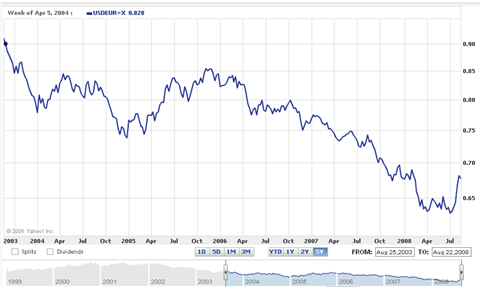
That recent rally in the value of the U.S. dollar (that blip higher at the tail end of the chart above) may indicate that tech growth rates may be slowing. To wit:
- In a research note on Monday, Bernstein Research analyst Jeffrey Lindsay raised rang the alarm for Internet companies with substantial multinational operations. Simply put, Google, Amazon and eBay may take a hit on currency fluctuations.
- HP said on its third quarter conference call last week that revenue was up 10 percent from a year ago, but gained 5 percent excluding currency impact. HP CFO Catherine Lesjak noted that "given our significant international exposure, our results may be favorably or unfavorably impacted by currency. As we’ve seen in the last few weeks in particular, currency rates can at times be volatile." Needless to say, CEO Mark Hurd and Lesjak were peppered with currency rate fluctuation questions for the rest of the call. The company line: Currency fluctuations are hard to call and the impact to earnings isn't clear cut due to hedging and other activities.
- IBM on July 17 said its second quarter sales growth was 13 percent, or 6 percent with constant currency. "We hedge the major cash flows to mitigate the effect of currency volatility as we manage our cash globally," said IBM CFO Mark Loughridge at the time. It's telling that Loughridge only had to field only two questions about currency on Big Blue's conference call. What a difference a month between HP and IBM earnings makes. Loughridge added that "it’s very difficult to analyze the effect of currency on the bottom line." Cowen & Co. analyst Louis Miscioscia on Aug. 21 cut his revenue target on IBM due to a stronger dollar. In the following chart Miscioscia illustrates how Big Blue would be have a mid-single digit growth rate if it weren't for currency gains.

Of those aforementioned examples, the impact of the weak dollar on Internet companies could be the most notable. After all, Google earned half of its revenue for the trailing 12 months from overseas, Amazon had 47 percent and eBay had 53 percent, according to Lindsay. If the dollar continues to strengthen you're going to hear a lot more about currency rates on those conference calls. The second quarter questions focused mostly on the U.S. economy.
Meanwhile, analysts have focused on currency impacts for old-line technology companies like HP and IBM, but have largely skated past questions for Internet companies. It's possible that Google's third quarter conference call may sound more like HP's with all the hypothetical questions about currency what-ifs.
Here's a look at the currency gravy train for Internet companies:

Lindsay wrote:
A strengthening dollar is problematic for Google, Amazon and eBay – all three of which receive roughly half of their revenues from overseas – but surprisingly the player with the biggest value exposure is Yahoo! EBay earned 53% of its trailing twelve months of revenue outside the U.S., while Google earned 50%, Amazon 47%. Yahoo! by comparison earned just 30% of its revenues overseas over the same period, and might be expected to have lower currency exposure overall, but this is not the case. The value of Yahoo!'s two large minority investments, Yahoo! Japan and Alibaba, are denominated in Yen and Renminbi respectively - a strengthening dollar diminishes both of their contributions to Yahoo!'s dollar-denominated value per share.
Lindsay in his report focused on three possibilities for Internet companies. A base case where the dollar remains flat relative to other currencies through the end of 2009. A pessimistic scenario where the dollar appreciates against other currencies by 10 percent through 2009. And an optimistic scenario where the dollar slides 5 percent through the end of the year.
Note the pessimistic scenario for Google and the Internet gang may be good for you personally. The stronger dollar means lower oil prices. Here's the summary of the potential impact on Internet company earnings:

Lindsay notes that the currency impacts on companies are asymmetric--a falling dollar boosts results, but a rising one will deliver a bigger blow to margins. This issue goes well beyond the companies mentioned here. The upcoming quarter may make us all familiar with currency fluctuations.