Windows XP just won't die: Remains most used OS in April

Summary: Windows XP's market share is falling, while Windows 7 is slowly rising. But it may not be until 2013 where the latest operating system overtakes the decade-old software.
Windows 7 is catching up, and Windows Vista is almost dead in the water, but Windows XP just seems to linger on.
Despite Microsoft setting a firm deadline for when it ceases to support for the aging operating system --- April 8, 2014 --- the majority of users refuse to upgrade the decade-old software, according to Net Applications.
The number of those using Windows XP is falling albeit slowly, while figures show an increasing number of Windows 7 users. But it may not be until late 2012 --- or more likely early 2013 --- until there is a crossover of the operating systems.
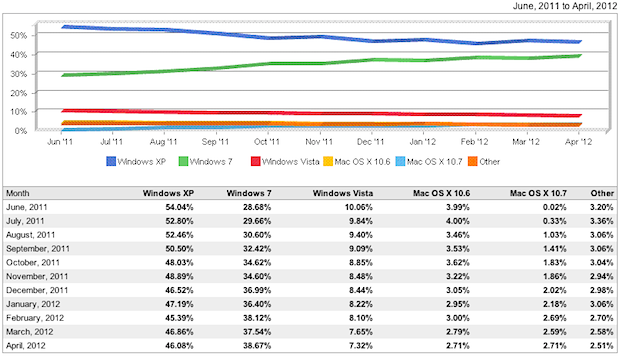
Analytics company StatCounter currently pegs Windows XP at 31.8 percent, and Windows 7 at 47.5 percent, but the two firms rely on different methods of totalling up their figures.
With Windows 8 set to divide the enterprise, and with patches, fixes, and updates for Windows XP set to expire in April 2014, it appears likely that businesses will eventually upgrade to Windows 7 rather than jumping straight in to Microsoft's upcoming release.
The latest Windows version is seen as the safe middle-ground between Windows Vista, which was heavily criticised for its poor performance and compatibility issues, and Windows 8, which its vast user interface differences may require extensive user retraining.
But for the developing regions, Microsoft could keep Windows XP in play for those running old PC technology. It remains a great operating system, and though the company moves to set it aside in favour of new revenue streams in future Windows upgrades, it could still offer a lease of life to those in the emerging markets.
Image, data credit: Net Applications.
Related:
- Windows XP finally dips below 50 per cent mark
- Ten years since Windows XP hit manufacturing
- Five core criticisms of Windows 8
- Windows 7 overtakes Windows XP global share
- ZDNet’s Great Debate: No post-PC era vs Pro post-PC era
- Windows 8, Office 15: Get used to Metro, it’ll be everywhere
Kick off your day with ZDNet's daily email newsletter. It's the freshest tech news and opinion, served hot. Get it.
Talkback
Windows 8 Set to Divide the Enterprise
I'm amazed that more people dont see this...
I dont care how dumb you might THINK Microsoft is, they do have people working there who track Windows usage and are quite capable of disseminating the facts and statistics.
The facts and statistics clearly tell them quite bluntly a couple of things that would be more than a clue to all, even the complete dumbest of corporate executives. That???s why I don???t care how dumb you may think MS is. What the statistics clearly say is that XP is still in broad use. That???s bluntly clear. What should also be bluntly clear is that its still in broad use because it still works pretty darn good and to replace it cost money.
What should also be pretty clear is that Windows 7 has been pretty darn popular with the public and it works well, and just like XP, it would cost money to replace it. Logic should dictate to anyone that its not likely that Windows 8 will bump piles of Windows 7 operating systems off of too many computers for years to come, that???s what the facts about Windows XPs history shows us. If you think this has somehow escaped Microsofts attention, your going to have to explain how MS missed that important point but everyone else in the world suspects that will be the case.
No way, no how, does Microsoft think that within a short period the world will start adopting Windows 8 in some broad way that will knock XP right out and start the beginning of the end for Windows 7. At least not on the desktop or laptop, non touch screen environment.
Windows 8 was built primarily to start the world toward the more touch screen centric computing environment we seem to be moving to. For smartphones and tablets, its going to be the first real crack at a pretty much full function OS for portable touch screed devices, and for desktops and laptops its still going to be able to function just fine as well. Although Microsoft knows full well that it will not be called upon for that for quite a few years. Windows 7 has that covered for some time to come.
Don???t care if you love or hate Microsoft, I think if you cannot at least concede that what they are doing here, or at least trying to do has more than a flash of forward thinking brilliance to it your not very IT analytical. What Microsoft is doing is simply creating he worlds first fully functional touch screen OS for the masses, ALL the masses, smartphone, tabs desktop, laptop, whatever. And they don???t care when you start using it. At least not a lot yet. Whenever your ready, they got you covered.
Agreed. Windows 8 is intended to be the start of where computing is heading
Enterprise tablets/phones
But they need to remember their own history. They overtook Unixes/Netware in the workplace exactly because theye were a sucess in consumer/SoHo computing market.
It's too soon to determine Windows 8' impact on the enterprise
Half a brain
Windows XP just won't die: Remains most used OS in April
...or not so different
Unfortunately in the proprietary world customers don't have a choice. Microsoft will eventually force them to buy again a new version.
How are they forcing people to upgrade?
Give it up already with the proprietary world garbage. People can download linux for free but they don't.
Device Drivers Are The Anchor For XP
Linux == Yes
Win XP == Yes
Win 7 == NO!!
It really pains me to have to replace perfectly good hardware because Microsoft changed the driver model. Add the cost of a Windows 7 license to the cost for new hardware and you've got a non-starter.
I refuse to waste my money so foolishly.
I agree
More reasons to switch!
Whats a load of bull
Yep, load of bull. Windows 7 in-built driver support is excellent.
blah, blah, blah, blah
What doesn't have drivers?
And who's responsible for that?
No, it's because the HW manufacturer refuses to continue support on their products. Five years is enough time to develop drivers.
My users are mostly still on XP for one very good reason...
I am the Net Admin for a college in a large state university, and with the huge budget cuts we have endured in the past two years...there are no new computers coming our way anytime soon.
Very understandable
" What will your uni do when XP is EOL'd in 2014?"
But, if I can't get Win 7 boxes...and Win 8 for enterprise insists on using the Metro interface on the desktops...I'll probably kill myself!
why not try a free alternative?