ie8 fix
madison

Translation please: Nokia and Microsoft join forces against Google and Apple for mobile dominance

By | February 11, 2011, 9:43am PST

Summary: Facing the grim prospect of a smartphone market controlled by Apple and Google, Nokia and Microsoft form a desperate alliance to make Windows Phone relevant again.

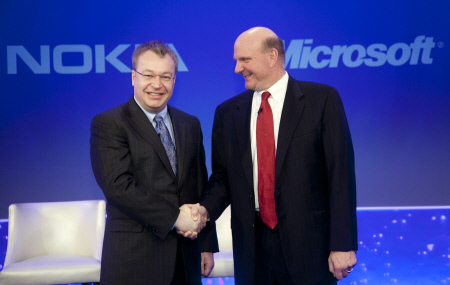
Nokia and Microsoft today announced they would form a “long-term strategic alliance” to challenge the Apple and Google hegemony in the mobile space. At a news conference this morning, Nokia President and CEO Stephen Elop, and Microsoft CEO Steve Ballmer laid out their new high-level strategy, complete with the usual buzzwords like “innovation” and “ecosystem”. But what were they really saying?

Here are a few excerpts from the event, interspersed with my own light-hearted take on what it all means:

[Elop] The entire smartphone market is growing rapidly and we should be setting the pace.

Translation: Nokia doesn’t want to be at the mercy of another company like Google in what we consider to be a critical and core part of our business.

The game has changed to a battle of devices to a war of ecosystems.

We built great hardware, but the users didn’t come. We thought our software was pretty good too but if nobody uses it and develops for it, what’s the point?

I am an optimist.

Hopefully we can jump off this burning platform and land on something soft. Micro-soft to be exact.

Today I’m excited to announce that Nokia and Microsft intend to enter into a strategic alliance, subject to the completion of a definitive agreement.

This is an alliance, a two-way street. It’s going to go much deeper than anything we could have done with Google and Android. We won’t settle on being “just another licensee”.

Together we have the opportunity to disrupt the current trajectory in the battle of ecosystems. Our long-term strategic alliance will build a global ecosystem that creates opportunities beyond anything that currently exists. Together, we will deliver great mobile products.

The gloves are off. Neither one of us has been able to put a dent in the Apple/Google duopoly, but together we think we can pull it off.

Nokia will bring a tremendous brand, great mobile products, global reach, our application store, maps, and location assets to this partnerships. At the same time, Microsoft will bring a great software platform with Windows Phone, and the brands that mobile consumers want, like Bing, XBox Live, and Office.

Our companies both have strengths and weaknesses. Our strengths compliment Microsoft’s weaknesses, and vice-versa. And with a few tweaks to mapping and location Bing will be great.

Nokia will adopt Windows Phone as our primary smartphone strategy.

Forget all that stuff we tried before. We’re going all in. Well, almost all in. We’ll keep a few “non-primary” options open in case this doesn’t work out.

We will bring Windows Phone to extended price points, market segments, and geographies.

Windows Phone is currently stuck in an expensive niche. We’re going to make it available cheaper, and blur the line between smartphones and dumbphones.

We believe this is good for Nokia. It gives us an opportunity to focus our investments where we can best differentiate. It gives us a faster path to the United States marketplace. And it gives us a broader opportunity to take advantage of our location based assets, including Navteq.

We spent $8 billion on Navteq so we’re going to try to use it as much as we can. Want some Navteq in your Bing?

We also believe it’s good for developers and publishers. They can take the skills they already have for Windows and Windows related platforms and apply those to this new ecosystem around Windows Phone. It gives them broader access to Microsoft’s tools and the efficiencies that comes with those development tools.

Tools for developing for Nokia phones in the past were foreign to developers and hard to use. Now we can just tell them to use Dev Studio and .NET. Everybody loves .NET, right?

It allows developers to gain new forms of monetization, access to Nokia’s worldwide store, in billing infrastructure, in short for developers that makes it easier for them to make money and it gives them access to Nokia’s global scale.

Come to the dark side, we have cookies. (sorry, couldn’t resist - Ed)

Steve Ballmer, Microsoft CEO too the stage after Elop. While he was obviously thrilled that MS won the battle for Nokia’s heart and mind, if you listen carefully you’ll see he’s mindful that Microsoft has other partners on Windows Phone too.

[Ballmer] Four months ago, Windows Phones went on sale. The people who would use the Windows phones have been delighted. We’ve gotten fantastic reviews, great feedback from customers, and we’ve seen strong engagement so far from developers, with over 8,000 applications already in the marketplace.

Translation: Surprise, it doesn’t suck. And a lot of people downloaded our development kits. While 8,000 apps doesn’t sound like much compared to Apple’s 300,000 apps, it’s early days. Ignore the fact that we keep changing the platform every few years so you have to throw out all your old stuff.

We do dream bigger though: more innovation, greater global reach, and more scale. That’s why we’re so excited to be here today. This partnership with Nokia will accelerate, dramatically accelerate, development of a vibrant strong Windows Phone ecosystem.

When we grow up, we want to have fanbois like those Apple and Google guys. We want people to walk into an phone store in Shanghai and ask for a Windows Phone.

The fact that Nokia has a primary focus on Windows Phone *hardware*, and services, really means we can work with them in a different kind of a way to aggressively drive innovation on the Windows Phone platform.

They’re not going to compete with us on the software side, which is really the only thing we care about. So we’ll be free to aggressively pursue patent litigation against Windows Phone competitors.

Nokia’s global expertise and focus on all price points and market segments will benefit Windows Phones broadly, and Nokia’s Windows Phones specifically.

Just because we’re partnering with Nokia, we’re not going to leave the other Windows Phone makers out in the cold. We love you too!

The Windows Phone ecosystem should ensure more innovation in the market, more choice for consumers, and better opportunites for developers and for service providers to showcase the enhancements and improvements that they’re making through their networks.

We’re all about the choice and openness.

This partnership is good for Microsoft and it’s good for Nokia.

Maybe this will get our stock price out of the doldrums.

No journey is completed in a single step. Over the next year you’re going to see us take many steps both individually and together. We need to and we will collaborate closely on development, joint marketing initiatives, and a shared roadmap so that we can really align and drive the future evolution of the mobile phone.

It’s all vaporware and press releases right now, but stay tuned. We just wanted to get the word out now to try and blunt the momentum by Apple and Google.

We’re already working together to create the first Nokia Windows Phones, and we’ve reached out to chip vendors, mobile operators, and developers. You’ll hear more from us in all of those areas over the next weeks and months.

If I had a Nokia Windows Phone in my pocket I would show you. It’s going to take a while.

We need to learn along the way. We’ll share what we’re learning with other partners in the Windows Phone ecosystem, and as a result we all benefit.

Given our track record in smart phones, neither of us know exactly what we’re doing. Hopefully we can learn enough from Nokia to make all of our Windows Phones successful.

This technology world is a lot of fun. It’s crazy. It moves forward. It’s propelling not only the world economy but a lot of the excitement and innovation for consumers around the world. At Microsoft we’re driving many of those innovations with products like IE9, Kinect, and of course the Windows Phone. The opportunity for Microsoft to work together with Noikia to drive these ideas and innovations forward is exciting. We’re pleased to be here today.

Translation: Yes, I’m a geek, and proud of it. And my company has lots of extra cash to play with so we can take the long view. If at first you don’t succeed…

Kick off your day with ZDNet's daily e-mail newsletter. It's the freshest tech news and opinion, served hot. Get it.

Topics

Ed Burnette is a software industry veteran with more than 25 years of experience as a programmer, author, and speaker. He has written numerous technical articles and books, most recently "Hello, Android: Introducing Google's Mobile Development Platform" from the Pragmatic Programmers.

Disclosure

Ed Burnette

Ed Burnette is a Manager of Mobile Development at SAS. However the postings on this site are his own and do not represent the positions, strategies, or opinions of his employer.

Biography

Ed Burnette

Ed Burnette has been hooked on computers ever since he laid eyes on a TRS-80 in the local Radio Shack. Since graduating from NC State University he has programmed everything from serial device drivers and debuggers to web servers. After a delightful break working on commercial video games, Ed reluctantly returned to business software. He currently develops enterprise software for Android phones and tablets.

In his copious spare time, Ed writes and speaks about all kinds of technology and software. His most recent books include the Eclipse IDE Pocket Guide from O'Reilly and Hello, Android: Introducing Google's Mobile Development Platform from the Pragmatic Programmers.

25
Comments

Join the conversation!

Just In

RE: Translation please: Nokia and Microsoft join forces against Google and Apple for mobile dominance
nikos777 14th Feb 2011
wow! that means that is starting a real war! im curious to see what will happen! Rhodes
0 Votes
+ -
Regarding "throwing out your old stuff"
John Carroll Updated - 11th Feb 2011
Ignore the fact that we keep changing the platform every few years so you have to throw out all your old stuff.

One of the advantages of only allowing apps to be written in .NET focused XNA and Silverlight as oppposed to, say, binary apps is that even if it ran on different processors, the app wouldn't know the difference.

Making XNA and Silverlight a requirement offers a lot of flexibility. It's exactly like Android's Java baseline, which offers hardware flexiblity.

Apple doesn't need to do that, as they don't license to anybody.
@John Carroll

I had to roll my eyes a bit at that too.
Perhaps Ed is unhappy that Nokia didn't go with Android? Why do people think that there can be only one good OS?
@mep01378 There's room for more than one, but I don't think there's room for nearly as many as we have now. Too many choices divide developer attention, especially when some of the choices go out of their way to discourage cross-platform development.
@Ed Burnette

How are you doing moving that iOS app over to Android? I am sure it's just a re-compile and vice versa? I suppose Apple vs Flash is an illustration of what you just said? Wasn't there API changes between Android releases?

I don't really care what Google's or Apple's policies are in regards to this but it would seem to me that none of the players are different in this regard.
@John_Carroll Microsoft has a history of introducing new and incompatible ways of doing the same thing over the years. For example consider Win32, GDI, DirectX, WPF, XAML, and so forth. Remember Plays4Sure? Windows CE? RDS? ADO? WinG? HTA? It's like, "Do it this way, no do it that way, no here's a new way." And if you don't follow the new way then even if it still works it looks so bad compared to people doing it the new way that you really have no choice.

I can't even count the different platforms they've tried for mobile. Windows CE? Pocket PC? All the versions of Windows Mobile? Now Windows Phone 7? The optimist in me would like to think they'll stick with the current Windows Phone 7 programming model for years to come, making incremental improvements in it, with innovations but no do-overs. But the pessimist in me looks at the wholesale changes of the past that they have put developers through and says it won't be long before they push us to something completely different.
@Ed Burnette
Sorry, I respect your andriod development skills, I read your book from Pragmatic. Other than that I don't think you are skilled at Microsoft toolset. FYI, WPF, XAML are not different. They are two interfaces of developing apps for the same thing. XAML is like ASPX wher ASPX uses to define the web page and C# is codebehind or codebeside. Like XAML is a rich markup interface to develop WPF based Windows apps or Silverlight apps. Please, please get to know facts before write something like this. This type of mistakes definitely put your professionalism as biased.
I think you exaggerate the gyrations somewhat, mixing a things that are only mildly relevant to mobile development in there. Consistency-wise, it's a cross between monolithic apple and the open source bazaar (not that there aren't good .NET-oriented open source projects, too).

My main point was that, by basing it on .NET (Silverlight and XNA), two thoroughly modern development paradigms, it gives them a lot more freedom to play around with the underpinnings.

Take rumors that WP7's CE underpinnings may get replaced with an ARM version of Windows (which seems inconceivable now, but Sinofsky isn't exactly open about his plans there). It wouldn't affect Silverlight or XNA apps one jot.

That, perhaps, is why I'm less concerned about changes in platform with WP7. They chose fairly cutting edge technology for the APIs, and it's .NET, so changes at the platform level don't affect the API at all.
@Ed Burnette
You forgot to mention Kin. ;-0
@Ed Burnette You forgot ASP to ASP.Net. ASP.Net 1.1 to 2. I wouldn't be surprised if they dropped WebForms for MVC.
@Ed Burnette

I've used dumbphones, the first MS smartphones and touchphones, Android in a few of its fragmentations and iPad and iPhone. WP7 is better for both users and developers. a sophisticated, elegant OS that seamlessly integrates with business and home PCs for the overwhelming majority of the world that uses Windows.

We tried developing for iOS, but they restricted real HTML5 web apps. The best that can be said about Android and Apple development tools is that they're very retro, if you like retro.

Just finished an educational game for WP7 using the MS development system and until Google and Apple lift their games, we won't be going backwards.
@John Carroll
Seriously? Either you haven't been coding for that long, or your memory is very short.

At the top of the risk actualization tree is the branch everyone developing with Microsoft tools falls off of: millions of companies built for NT, rebuilt for 2000, revised for 2003/XP, now face rebuilds for the 2008 Server/Vista combination -and can look forward to throwing away any successes they achieve in this process just as soon as Microsoft gets whatever they want to sell next out the door.

In contrast, non-Microsoft development tools I have worked with since the late 1980s have generally proven automatically upgradeable to new technologies. All you need to do is stick to standards and steer clear of all things that are Microsoft-only.

-Mike
@Spikey_Mike: Every generation of Windows has something new, to be sure, that if you code against makes it incompatible with the last version, but backwards compatibility is one of Microsoft's stronger suits...and a yoke that holds back evolution of its platform.
This is about the best interpretation I have seen yet on this alliance. I just hope that Nokia can last long enough to see it through. Based on their track record I wouldn?t trust Microsoft as far as I can throw a bus.
@Rick_K
This is best biased opinion from a Android book writer, it is nothing more than that. I respect Ed's Android professionalism, but he is no more than an fandroid. Period. This blog proved it.
@Rama.NET He actually hit it on the head. It did not take a genius to see that between the lines they were saying that we wanted Android but Google wouldn't give us an artificial position of prominence. Google most likely said no...that's why its open source....it up to you to carve your own place at the top. WP7 was the only options they had left.
@storm14k
Oh, thats why Google was there first to offer money and get Nokia onto Android. Sorry, I know you are good at java programming, and I respect that, but beyond that your comments on Microsoft are nothing but rant.
0 Votes
+ -
Too funny Ed
Dietrich T. Schmitz, ~ Your Linux Advocate 11th Feb 2011
Thanks for the laughs.
0 Votes
+ -
Quisling
lektron 11th Feb 2011
"Collaborationism is cooperation with enemy forces against one's country. Legally, it may be considered as a form of treason. Collaborationism may be associated with criminal deeds in the service of the occupying power, which may include complicity with the occupying power in murder, persecutions, pillage, and economic exploitation or participation in a puppet government."

Last year a strategic partnership was formed, a new CEO from Microsoft is installed at Nokia and he sells out Nokia to Microsoft's loser architecture, drops all their great upcoming developments. With other words, Microsoft is cash-rich, they have a lot of cash stuck in Ireland, and simply buy market share by wrecking Nokia. Think of Palm. Partners don't make even business with Microsoft. As an employee of Nokia I would start a general strike... unless this American does a mubarak and takes a plane home to Seattle.
@lektron

What great development? The UI on Symbian^3 still stinks.
0 Votes
+ -
"Dance of the Desperates"
Userama 12th Feb 2011
Best definition of this unholy alliance that I've seen.
@Userama

Best description of how the ABM trolls here are reacting wink
0 Votes
+ -
The beginning of the end?
bswiss 12th Feb 2011
The really telling thing is that Nokia's stock went down on the news. It's a sign that Microsoft is approaching its inevitable great fall, when announcing a major partnership with MS has a pronounced negative impact on stock prices.

- - - - - - - - - - - - - - - - - - - - -

The irony is that something like Meego is exactly what I wanted for a smart-phone or tablet -- might have been a preferred choice for a netbook, too. I can't be the only one.

Android is OK. I think it it's a bit Rube Goldberg and heavy on resources, but at least it is still Free/Open Source all the way through). I guess I'll have to settle for Android for now -- but only because there's nothing better out there.

WebOS is nice in it's way. Though like Meego and Android it is built on top of Linux the rest is proprietary, not open (though they seem fairly good at letting other people play in their sandbox via "side-loading" apps). Done right, I might actually prefer it to an Android smart-phone or tablet, at least under some circumstances.

After that, the best choice might actually be an iPhone. I know -- overpriced and not nearly as cool as its fans think. At least it can at least be jailbroken.

But Phone 7 is just a non-starter. Even if it seems to work nice, and have an attractive interface (a matter of taste) you won't be able to trust it. And who wants to give business to a company with the moral standards of Microsoft? And who wants to buy a product with the quality and security record of Microsoft behind it? And who wants to invest in it -- especially in the notoriously unsuccessful spheres beyond the Windows and Office anchors that have kept Microsoft afloat despite its overall record?.

- - - - - - - - - - - - - -

Meego gave Nokia a credible shot at being a contender, an actual innovator in charge of its own course. If that was too risky, they could have played safe by taking part in the Android game as well. But now they've hitched themselves to the Phone 7 wagon, and will have to struggle not only with the realities of clawing for position in the smart-phone market, but also with the realities of depending on an unreliable Microsoft and mediocre MS software.

That Nokia's stock went down on the news of the MS-Nokia partnership seems to support the argument that investors saw it this way, too.

Of course the stock will probably bounce back fairly soon, because many knee-jerk investors will see the Big Bad Monopolist as the winner now and therefore the winner always. But these aren't the investors who actually think about underlying fundamentals.
@bswiss
What, open source means good? This is the dumbest post I ever read on net. FYI, Android is not totally free and open source. You are paying your privacy there and any Android phone that came from a maker/carrier is closed, FYI. MeeGo may be good, but the architecture of it is not simple and standards based even if it is using a lot of other goodies. Thats why they had issues in implementing it. Every company have failures and gains, I can show you things that failed across Google. Also I can show the products that Google scrapped without any merit. Please.
0 Votes
+ -
Re: "dumbest post I ever read"
bswiss Updated - 12th Feb 2011
@Rama.NET

I am so honoured to be the recipient of your most recent "dumbest post I ever read" accolade.

It feels so wonderful, to receive clear confirmation that one is doing something right.

I do hope that I can count on your continued support in receiving further commendations from luminaries such as Loverock Davidson and yourself, among others.

With sincerest gratitude,
bswiss
wow! that means that is starting a real war! im curious to see what will happen! Rhodes

Join the conversation!

Formatting +
BB Codes - Note: HTML is not supported in forums
  • [b] Bold [/b]
  • [i] Italic [/i]
  • [u] Underline [/u]
  • [s] Strikethrough [/s]
  • [q] "Quote" [/q]
  • [ol][*] 1. Ordered List [/ol]
  • [ul][*] · Unordered List [/ul]
  • [pre] Preformat [/pre]
  • [quote] "Blockquote" [/quote]
ie8 fix
Click Here
ie8 fix

The best of ZDNet, delivered

ZDNet Newsletters

Get the best of ZDNet delivered straight to your inbox

Facebook Activity

White Papers, Webcasts, & Resources
ie8 fix
ie8 fix