ie8 fix
madison

Collaborative Networks vs Social Networks


By | June 8, 2009, 11:24pm PDT

Summary: During a telephone conversation between us last week Aaron Fulkerson of MindTouch said he was going to pick up on my Collaboration Networks meme, and he has now produced a solid post on this topic. Aaron takes on the number one issue plaguing widespread adoption of broad Enterprise 2.0 strategy: piecemeal departmental use of collaboration tools, [...]

During a telephone conversation between us last week Aaron Fulkerson of MindTouch said he was going to pick up on my Collaboration Networks meme, and he has now produced a solid post on this topic.

Aaron takes on the number one issue plaguing widespread adoption of broad Enterprise 2.0 strategy: piecemeal departmental use of collaboration tools, while useful parochially, do not create a meaningful information fabric that weaves the entire enterprise together.

Tools and technologies are often budgeted for at a departmental level rather than being designed to interoperate between departments, which provides better financial and organizational value. The ability to scale the entire company instead of grappllng with disparate next-generation toolsets in each department that don’t work well with other parts of the business is the way to multiple 2.0 silos in the future.

Many enterprise vendors are now adding components such as wikis, blogs, social profiles, tagging and so on as ‘features’, but…

This approach to software development does not work. The resulting application suites are monolithic, inflexible, not extensible, expensive to scale and are invariably difficult, if not impossible, to integrate with other enterprise technologies. This class of software forces business users to adopt the myopic social visions imagined by the developers, which are nearly identical to their corresponding consumer web implementations. In short, social software is not solving business problems.

Aaron also picks up on the need for flexibility and interoperability with existing applications and the crucial differences between consumer oriented social life networking and business focused collaboration networks:

…information fabric is a federation of content from the multiplicity of data and application silos utilized on a daily basis; such as, ERP, CRM, file servers, email, databases, web-services infrastructures, etc. When you make this information fabric easy to edit between groups of individuals in a dynamic, secure, governed and real-time manner, it creates a Collaborative Network.

This is very different from social networks or social software, which is focused entirely on enabling conversations. Collaborative Networks are focused on groups accessing and organizing data into actionable formats that enable decision making, collaboration and reuse. Collaborative Networks will increasingly be critically important to business and organizations by helping to establish a culture of innovation and by delivering operational excellence.

The following chart from Aaron does a nice job of differentiating from the noise around consumer social media:
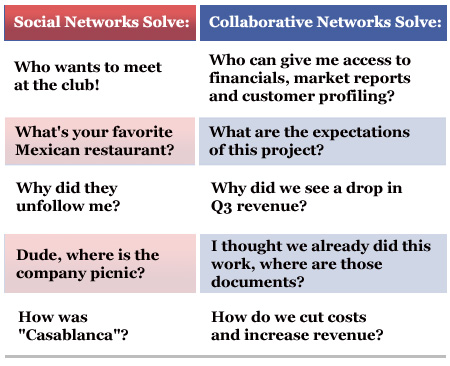
The point is clear: casual social life organization is very different to working together through deliverables to achieve results. It is this type of organization that justifies budgets…the apparently random chatter around sociable networks is not an attractive proposition in a business scenario on a number of levels.

A good example of large teams of people pulling huge amounts of information together to meet deadlines are the much maligned newspaper business. While the financial model in the newsprint business is currently a disaster, the ways newsrooms are being organized is going through changes as the fascinating Nieman Journalism Lab has been documenting in ‘a collaborative attempt to figure out how quality journalism can survive and thrive in the Internet age’.

Journalists are given considerable latitude to work in whatever way they want so long as the end result is a successful edition of the newspaper. The best Enterprise 2.0 work methods give people unstructured, highly flexible tools to achieve well defined deliverables. There is considerable conversation in the social media space about tools effectively being a means to an end: this is clearly nonsense. As I’ve said before buying a toolkit doesn’t make you a mechanic any more than starting blogging makes you a journalist. Using that blog to then talk and instruct about blogging is a form of navel gazing.
In a great piece called ‘inside five newsrooms that HL Mencken wouldn’t recognise‘ Zachary Seward takes us through ‘five newsrooms that are new, innovative, or otherwise noteworthy’.

Particularly interesting, partly due to the depth of information provided, is the English Daily Telegraph, which recently integrated its web and print operations while laying out the newsroom around a central “hub.”

The above video provides some great insight into the collaborative process that gets news out several times a day. By putting all the modular components of the business together around a hub the Telegraph is able to combine content for print, web, audio and video and combine content to make it consistent across rich media and come alive.

Clearly a news organization isn’t the same as a manufacturer or software developer, but the homogenized way of working, in this case physically (all grouped around a central hub) provides great synergies and cross pollination opportunities that are goal driven. Delivery of news packages that are better than the opposition is not dissimilar to developing a better widget in a shorter time frame, and the economies of working well together are central to that success.

Kick off your day with ZDNet's daily e-mail newsletter. It's the freshest tech news and opinion, served hot. Get it.

Topics

Oliver Marks provides seasoned independent consulting guidance through the Sovos Group to companies on the effective planning of 'Enterprise 2.0' strategy, tactics, technology decisions and roll out.

Disclosure

Oliver Marks

Oliver Marks professional work is defined by an objective viewpoint of the broad spectrum of vendors and options available to his clients and readers of this blog. Oliver provides an impartial perspective of vendors and is focused on contractual affiliation with clients in order to select appropriate solutions. As such he has no business relationships with the companies or services he recommends. Oliver is a founding partner of The Sovos Group. The opinions, concepts and views put forward in this blog are solely those of Oliver Marks.

Biography

Oliver Marks

Oliver Marks is a founding partner at SovosGroup.com which provides seasoned independent consulting guidance to companies on the effective planning of 'Enterprise 2.0' strategy, tactics, technology decisions and roll out.

With extensive senior management practical experience in international enterprise collaboration, Oliver previously managed the Sony PlayStation 'WorldWide Studios' collaboration extranet, and has worked with the American Management Association, Sun, Docent/SumTotal Systems, Harvard Business School and McKinsey & Company on major initiatives around knowledge transfer and change management.

Oliver has dual US/UK citizenship and has worked on Asian, European and American global enterprise collaboration, and spoken at various conferences. He is based in San Francisco.

His personal blog is at www.olivermarks.com.
12
Comments

Join the conversation!

Just In

Collaborative network = Social Team Collaboration
paul_hightech 25th Mar
Great info.

As Ldatta said it a great link to look at
http://allcollaboration.com/home/2009/12/21/comparing-collaboration-and-social-networks.html


I would also recommend to look at this innovative social collaboration network provided by WorkCollaboration.com [work collaboration systems located in New York] and tools to be able to work over the Internet using Private Network.

Work Collaboration system provides collaborative software and services to the individuals and businesses with a primary focus on delivering high quality project management, content management and video conferencing software and services to enable first class of secure social collaboration.

100% Free for nonprofit and charity organizations, people with disability and non-commercial use.

See all features and compare
http://www.workcollaboration.com/services.aspx

Watch Demo
http://www.workcollaboration.com/demos.aspx
0 Votes
+ -
An excellent piece highlighting the misconceptions of social networks at work. After a collaborative networking, our teams are always inspired, re-energized and are more productive while social networking gives us the space to wind down after work not during.

Your "...buying a toolkit doesn?t make you a mechanic.." resonates with my finding out very recently (unfortunately!) that an electrical drill, hardware and drapes/shutters complete with instructions will not automatically make me an expert in installing curtains in my home.
0 Votes
+ -
Aaron's right on the mark with Collaborative Networking versus Social Networking. Social focus should be outside the enterprise. Why should companies pay for you to be social?
Oliver, love it, as usual. What are your thoughts on borrowing some ideas from the "Third Place" social community idea for the workplace? I know you know from experience that a bit of the social needs to exist in the Collaborative Network, or else it's big, fat, boring dead-fish experience, which isn't really a great way to get people to stick around. And, as you point out, Lego-ing features onto existing stuff doesn't do it, either.

So, aside from serving lattes and biscotti online, how might your Collaborative Network merge with the Social to create a "Third Work Place" perhaps?
0 Votes
+ -
I agree. Guided collaboration, with a purpose, is what matters.
Ugly Research: Guided Collaboration 10th Jun 2009
Excellent article. It seems that many things labeled "collaboration" either aren't very collaborative, or don't explicitly guide people toward meeting specific goals. In my work, I help companies enable what I call guided collaboration -- much along the lines of what you describe. Well done.
0 Votes
+ -
I would extend this to make the point that collaboration is actually a cluster of activities that i label "creative, connective and compounding". Creative is where you're enabling a specific team to work toward a specific goal, regardless of geographic and other challenges. Connective is where you're finding relevant information, activity or expertise elsewhere in the organization outside your team, and compounding is finding work that has been done in the past that can be reused or leveraged in some way. I go on about these concepts in some length here: http://www.slideshare.net/dllavoy/social-workplace-for-govt-20

But in essense - yes- collaboration and social networking are not the same things at all.
- Deb
0 Votes
+ -
Very interesting press release on how the fortune 100 & fortune 2000 look at social networking

Link to press release:
http://www.the-dma.org/cgi/dispannouncements?article=1303
0 Votes
+ -
RE: Collaborative Networks vs Social Networks
srinimaverick@... 11th Jul 2009
There are some good points on collaborative networking but the article rambles in trying to make them.
0 Votes
+ -
I think that social networking sites can be used to solve common problems. In this case it is a site like http://applebatch.com. Applebatch is a teacher networking site that allows teachers to come together in one environment and solve problems. I think that if more site like this one come along, the view of social media sites should become more favorable.
0 Votes
+ -
A detailed comparison between Collaboration and Social Networks is available at: http://allcollaboration.com/home/2009/12/21/comparing-collaboration-and-social-networks.html

We identify at least four players or stakeholders in collaborations networks: Enterprise, Customer (current and prospective), Employee and Partner. Each player operates in the collaboration network with own objectives, motives and expectations, which are often asymmetric. See: http://allcollaboration.com/home/2009/12/22/understanding-objectives-of-players-in-collaboration-network.html

Lokesh Datta
http://allcollaboration.com/
Twitter: LDatta
0 Votes
+ -
collaborative communication


If you want to find more information on ERP software reviews, go to www.erp.com. You will get alot of tools and reviews to find the best software application for your business
0 Votes
+ -
logical comparison

For more information log on to www.erp.com

If you want to find more information on ERP software reviews, go to www.erp.com. You will get alot of tools and reviews to find the best software application for your business
0 Votes
+ -
Great info.

As Ldatta said it a great link to look at
http://allcollaboration.com/home/2009/12/21/comparing-collaboration-and-social-networks.html


I would also recommend to look at this innovative social collaboration network provided by WorkCollaboration.com [work collaboration systems located in New York] and tools to be able to work over the Internet using Private Network.

Work Collaboration system provides collaborative software and services to the individuals and businesses with a primary focus on delivering high quality project management, content management and video conferencing software and services to enable first class of secure social collaboration.

100% Free for nonprofit and charity organizations, people with disability and non-commercial use.

See all features and compare
http://www.workcollaboration.com/services.aspx

Watch Demo
http://www.workcollaboration.com/demos.aspx

Join the conversation!

Formatting +
BB Codes - Note: HTML is not supported in forums
  • [b] Bold [/b]
  • [i] Italic [/i]
  • [u] Underline [/u]
  • [s] Strikethrough [/s]
  • [q] "Quote" [/q]
  • [ol][*] 1. Ordered List [/ol]
  • [ul][*] · Unordered List [/ul]
  • [pre] Preformat [/pre]
  • [quote] "Blockquote" [/quote]
ie8 fix
Click Here
ie8 fix

The best of ZDNet, delivered

ZDNet Newsletters

Get the best of ZDNet delivered straight to your inbox

Facebook Activity

White Papers, Webcasts, & Resources
ie8 fix
ie8 fix