Researchers develop printable rubber-like OLED displays

By | May 11, 2009, 5:13pm PDT

Researchers at the University of Tokyo have given new meaning to the term flexibility in the context of displays. They’ve developed of a stretchable display connected by organic light-emitting diodes (OLEDs) and organic transistors with a new highly-elastic conductor.
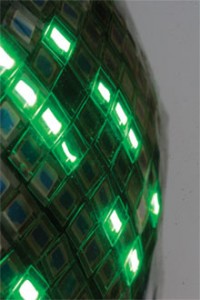
Credit: Takao Someya, the University of Tokyo

Credit: Takao Someya, the University of Tokyo

The rubbery display, pictured here on the left, can be stretched to 50% of its normal size, folded in half or crumpled up without incurring any damage, and can also cover complex three-dimensional objects.

As Technology Review writes, the technology can lead to displays and simple computers that you can wear on your sleeve, or wrap around your couch, or even serve as artificial skin for robots or prosthetic limbs.

Takao Someya, professor of engineering at the University of Tokyo, and his colleagues created the stretchy electronic circuits using a cheap industrial printing process by spraying carbon nanotubes with a fluoro-rubber compound.  Unlike their previous conductor, the new version is significantly more conductive, can stretch to more than twice its original size, and can be printed, according to an article from Nature Materials cited in the Technology Review article.  Plus, the printing is cheap, allowing for the organic transistors to cover a large-area and still operate efficiently.

The article offers a close look at how the intricate material is made:

Someya first combines carbon nanotubes with an ionic liquid–a liquid containing charged molecules–and a liquid polymer to make a nanotube-rubber paste. Then comes the crucial part: a high-pressure jet that spreads the nanotubes in the rubber. The jet makes the nanotube bundles thinner without shortening them and disperses the bundles uniformly in the polymer. “The longer and finer bundles of nanotubes can form well-developed conducting networks in rubbers, thus significantly improved conductivity and stretchability,” Someya says. The jet process also increases the material’s viscosity, making it suitable for high-definition screen printing.

The researchers use a printing mask to deposit 100-micrometer-wide lines of the conductor on a piece of rubber. Then they use the lines as a wire grid to connect organic transistors and OLEDs.

The current prototype is 100cm^2  (10 x 10), and contains 256 monochrome pixels (16×16 grid), but the research team is now working on improving the resolution and producing screens in color.

“A human-shaped display could be used to show medical diagnosis data, and there are various other applications,” said Someya.

Kick off your day with ZDNet's daily e-mail newsletter. It's the freshest tech news and opinion, served hot. Get it.

Topics

Christopher Jablonski is a freelance technology writer.

Disclosure

Chris Jablonski

Christopher Jablonski has no business relationships, affiliations, investments, or other actual/potential conflicts of interest relating to the content posted so far on this blog.

Biography

Chris Jablonski

Christopher Jablonski is a freelance technology writer. Previously, he held research analyst positions in the IT industry and was the manager of marketing editorial at CBS Interactive. He's been contributing to ZDNet since 2003.

Christopher received a bachelor's degree in business administration from the University of Illinois at Urbana/Champaign. With over 12 years in IT, he's an expert on transformational technologies, particularly those influential in B2B.

Related Discussions on TechRepublic

Did you know you can take part in these discussions with your ZDNet membership?
4
Comments

Join the conversation!

Just In

Agreed, but apps would go well beyond entertainment
chris jablonski 12th May 2009
When you factor in sensors, bio or otherwise, plus LBS, the volume of possibilities for medical, military, sport, and beyond, stretches the imagination.

-CJ
0 Votes
+ -
I hope I live to see...
mr1972 12th May 2009
A silly putty cell phone. happy

Folding interactive displays are going to be the next cool thing.
0 Votes
+ -
Other Future Applications
barry@... 12th May 2009
What about cars that can change color or clothing that can change color?

What about suits with built in cameras that display the what is on the oposite side of the suit for invisible cammo?
0 Votes
+ -
A leading engineer said about 5 years ago that fully-
foldable displays will be the next big leap forward.
The uses suggested on this page are good for novelty
value, but more practically, super-thin, super-
flexible screens are the key to 20" displays you can
fit in your pocket. Once they're fully-developed
(touchscreen, perhaps?) and affordable, it'll be a
mobile entertainment revolution.
0 Votes
+ -
When you factor in sensors, bio or otherwise, plus LBS, the volume of possibilities for medical, military, sport, and beyond, stretches the imagination.

-CJ

Join the conversation!

Formatting +
BB Codes - Note: HTML is not supported in forums
  • [b] Bold [/b]
  • [i] Italic [/i]
  • [u] Underline [/u]
  • [s] Strikethrough [/s]
  • [q] "Quote" [/q]
  • [ol][*] 1. Ordered List [/ol]
  • [ul][*] · Unordered List [/ul]
  • [pre] Preformat [/pre]
  • [quote] "Blockquote" [/quote]
ie8 fix

The best of ZDNet, delivered

ZDNet Newsletters

Get the best of ZDNet delivered straight to your inbox

Facebook Activity

White Papers, Webcasts, & Resources
ie8 fix