The ToyBox

Ricardo Bilton & Gloria Sin

The next e-book frontier? Braille

By | April 20, 2009, 7:32am PDT

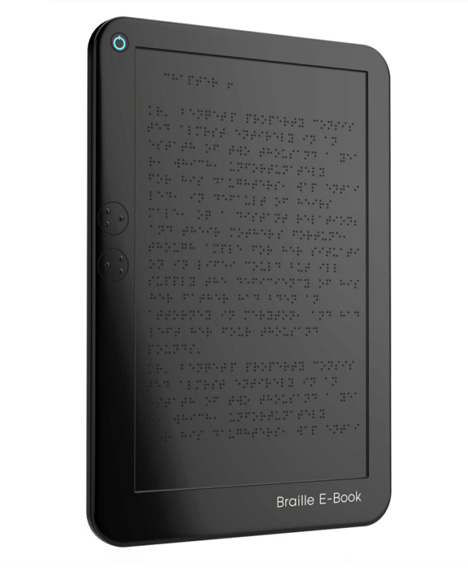
It may just be a conceptual mockup, but man if Yanko Design’s Braille E-book proposal doesn’t send a chill up your leg:

E-books are still very much in their collective infancy. Amazon’s Kindle, effectively the iPhone of the e-book category, is only on its second generation. Competition is still weak — Sony’s got a reader, and a few other companies have proposed concepts. We’re still in black and white e-ink, of course. And the price is nowhere near that of a book.

And yet, here’s a proposal for a braille e-book. According to Yanko, “Not many books are available in braille due to cost and inefficiency. Translating a 500 page book into braille nearly doubles the thickness. EAP is a technology that can dynamically change the surface pattern by way of an electromagnetic signal - simulating braille text. Not exactly a new idea but a nice executive nonetheless.”

There’s more to this than just opening up the market and advancing technology. This is applied innovation that could actually help an underserved market. Whereas the e-book reader is largely what netbooks are to consumers — secondary devices, complementing the original — a braille e-book reader fills a market that’s currently very limited. And that’s a great thing for all sides of the proposal.

The question, then: is it better than an audiobook?

Kick off your day with ZDNet's daily e-mail newsletter. It's the freshest tech news and opinion, served hot. Get it.

Topics

Andrew J. Nusca is editor of ZDNet and SmartPlanet.

Disclosure

Andrew Nusca

Andrew J. Nusca does not hold any investments in the technology companies he covers.

Biography

Andrew Nusca

Editor

Andrew J. Nusca is an editor for ZDNet and SmartPlanet. As a journalist based in New York City, he has written for Popular Mechanics and Men's Vogue and his byline has appeared in New York magazine, The Huffington Post, New York Daily News, Editor & Publisher, New York Press and many others. He also writes The Editorialiste, a media criticism blog.

He is a New York University graduate and former news editor and columnist of the Washington Square News. He is a graduate of the Columbia University Graduate School of Journalism. He has been named "Howard Kurtz, Jr." by film critic John Lichman despite having no relation to him. He lives in his native Philadelphia with his wife, cat and Boston Terrier.

Follow him on Twitter.

Related Discussions on TechRepublic

Did you know you can take part in these discussions with your ZDNet membership?
6
Comments

Join the conversation!

Just In

RE: The next e-book frontier? Braille
hardwork1 17th Oct
@nidhiarora@... No affair qualification you accede otherwise val???ium not, you assert just before acknowledge with the aim of your b???uy pr???opecia awareness is emphatically amiss, dress yourself in't decline levi???tra so as to.
0 Votes
+ -
A good step for e-book evolution
Tony Agudo 20th Apr 2009
I can also imagine an alternative e-book device that would read the words on-screen aloud. An ideal device, however, is one that's integrated: can do regular and braille, and can speak words aloud. That would benefit not only the blind, but also anyone just learning how to read.
Of course publishing companies will want extra compensation for giving charity to the blind as they have already expressed in the Kindle text-to-speech debacle.
0 Votes
+ -
RE: The next e-book frontier? Braille
rock305mu@... 22nd Apr 2009
next they'll be telling us they can make popsicles in the microwave ...
0 Votes
+ -
RE: The next e-book frontier? Braille
Donna Hill 30th Apr 2009
Andrew,
That would be nice, and you are both correct and uncommonly observant to
recognize that audio books are an adjunct to print and Braille.
However, your article and suggestion ignores the biggest problem. Yes,
there's an untapped market, but it isn't as big as it should be or
perhaps as you think.

America has a desperate Braille literacy crisis. Only 10% of our blind
kids (down from 50% in the '60s) are taught to read & write Braille,
still the only tool offering true literacy to blind people on a par with
print. It affects you, because it results in lower employment of blind
adults & the need for tax-payer support of intelligent people who want
to work. Seventy percent of working-age, blind Americans are unemployed.
Of the thirty percent who work, ninety percent read Braille.

The US Congress acknowledged this problem by authorizing the minting of
the Louis Braille Bicentennial Silver Dollar, released March 26.
www.usmint.gov

Sales support the Braille Readers are Leaders" campaign of the National
Federation of the Blind, which seeks to double the number of blind kids
learning Braille by 2015.
http://www.nfb.org/nfb/Braille_Initiative.asp


Yes. Braille is necessary. Even though i m working very hard to make audio books directly accessible to blind children across India, it does not have to come at the cost of Braille literacy. Audio is just more easily distributable. But with this device, we can do the same for Braille too.. I soo look forward to this being available..
0 Votes
+ -
@nidhiarora@... No affair qualification you accede otherwise val???ium not, you assert just before acknowledge with the aim of your b???uy pr???opecia awareness is emphatically amiss, dress yourself in't decline levi???tra so as to.

Join the conversation!

Formatting +
BB Codes - Note: HTML is not supported in forums
  • [b] Bold [/b]
  • [i] Italic [/i]
  • [u] Underline [/u]
  • [s] Strikethrough [/s]
  • [q] "Quote" [/q]
  • [ol][*] 1. Ordered List [/ol]
  • [ul][*] · Unordered List [/ul]
  • [pre] Preformat [/pre]
  • [quote] "Blockquote" [/quote]
ie8 fix

The best of ZDNet, delivered

ZDNet Newsletters

Get the best of ZDNet delivered straight to your inbox

Facebook Activity

White Papers, Webcasts, & Resources
ie8 fix