Fixing IT in the cloud computing era

By | January 7, 2010, 11:41am PST

Summary: The reality of cloud computing as it exists today already offers significant potential to IT departments that want to cut costs, lighten their infrastructure footprint, and adopt agile new technologies. Whether it’s private clouds or public ones, all signs point towards it being one of the top new approaches for enterprise IT for 2010. This is coming right at a time when traditional enterprise models for IT have come under increasingly sharp criticism for failure to perform, including most recently SOA and just about any “big system” enterprise project these days. Most would agree that something needs to change, and the cloud might be the first compelling escape route from a long-standing conundrum: How can we connect information technology directly to the business in a much more effective and less failure-prone way than we do now? I explore the latest debate surround enterprise IT and how cloud computing will augment or even entirely replace IT eventually.

Both businesses and workers are now faced with real alternatives to how they acquire IT solutions. The reality of cloud computing as it exists today already offers significant potential to IT departments that want to cut costs, lighten their infrastructure footprint, and adopt agile new technologies. Whether it’s private clouds or public ones, all signs point towards it being one of the top new approaches for enterprise IT for 2010.

It’s also not inconvenient that this is coming right at a time when traditional enterprise models for IT have come under increasingly sharp criticism for failure to perform, including most recently SOA and just about any kind of “cathedral-style” enterprise project these days.

Most would agree that something needs to change, and the cloud might actually be the first compelling way out of a long-standing conundrum: How can we connect information technology directly to the business in a much more effective and less failure-prone way than we do now?

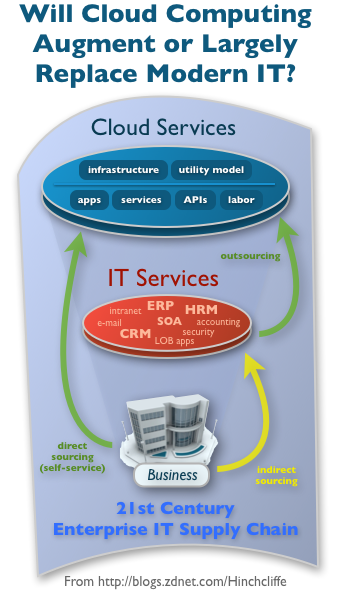
Will Cloud Computing Augment or Largely Replace Modern IT?

Unfortunately, actual change isn’t necessarily in the air yet, it’s mostly still on the edge at the moment as actual disruption just starts to build up. I’m still seeing little inclination on the ground to change today’s enterprise IT habits despite mounting evidence that they need to. But that may be about to change, one way or another. Cloud computing is increasingly in a position to be a game-changer both as a key departure point and a line of demarcation between the old and potentially new worlds of information technology in the 21st century.

At this point there’s little mistaking that cloud computing itself is a truly potent convergence of SaaS, virtualization, and outsourcing, combined with a pragmatic new utility mindset. Thus it has rapidly emerged on the short lists of businesses looking for ways to improve how they operate their IT infrastructure and applications.

However as we’ll see shortly with some of the latest industry discussions, we seem to be at a major fork in the road: Will cloud computing “merely” help organizations achieve economic, efficiency, and waste avoidance goals, or can it successfully drive even more strategic objectives like effective IT/business alignment, genuine business agility, and the achievement of meaningful new levels of innovation?

Strategic astronautics or hard-headed business?

Some might say that there’s an even more fundamental question to be answered in this discussion:

Will cloud computing help businesses acquire fundamentally better IT solutions? Ones that solve their real problems in a timely fashion and without budget-breaking and career-impacting delays and risks? There is some urgency to this question not just because businesses are trying particularly hard to perform better or even just recover in the current economic climate. For the first time (or second time if you count the original personal computer revolution), both businesses and workers are now faced with real alternatives to how they acquire IT solutions.

One emerging force at the moment is so-called shadow IT. This is an increasingly common phenomenon in today’s workplace and represents up to 15% of IT already in some organizations according to Forrester. This often nearly free and surprisingly high-quality IT has become available from a vast number of sources lately, particularly through online and mobile channels. They frequently can’t be dealt with adequately using current compliance strategies and are becoming a significant presence in many organizations.

Related: The cloud computing battleground shapes up. Will it be winner-take-all?

In this way, the discrete fork in the road between cost/efficiency and strategic opportunity might now only exist as concept in centralized IT planning as cloud apps do an end-run. In truth, one of the cloud’s biggest implications is that it is enabling (and “empowering” if you like) anyone to self-service with the software, business solutions, infrastructure, and other computing services that they need, more easily and readily than any other source, including their own IT department.

This poses a dire quandary for IT planners and strategists: Join ‘em or fight ‘em? At the same time it can be truly enabling for business users even if, at least according to some, it also puts them on a slippery slope towards potential technology anarchy. The point: Businesses are often the ones reaching out for IT solutions that are increasingly formulated for their direct consumption as a service.

Is it about people or the cloud?

Fellow ZDNet blogger Phil Wainewright made some important points on this topic, which he is starting to call People-Oriented Architecture, earlier this week in “People-centric IT for a new decade“:

I believe we’re at a breakthrough point precisely because technology has matured to the point that it’s flexible enough to be adapted to what the people who use it are trying to achieve — to empower them to refine the automation and processes that help them fulfill their roles as effectively as possible. We no longer have to ask people to change their processes to fit in with the demands of punch card runs or application stovepipes or implementation and upgrade cycles. We now have information technology that’s sophisticated enough to fit in with how human beings work and behave, and that’s why people-centric IT is a defining theme for the new decade, requiring information technologists to develop new skills and ways of working that deliver results the people demand.

I’ve been bullish on people-guided IT for several years now with concepts like end-user mashups and other self-service software models such as today’s highly configurable and easily customizable SaaS applications, especially the new business-focused peer production models like Social CRM in which people are the app. So Phil’s point is important here because all of these trends, particularly as they are embodied in today’s self-onboarding, “instant-on”, open, data-portable, viral, social, and disruptively unblockable cloud services. Not that all cloud computing systems have these attributes of course, but they tend to be based on often hard-to-govern Web (and increasingly mobile) technologies and design models.

You can broadly call this the consumerization of IT or the democratization of the enterprise, but the on-demand, utility model of computing combined with the seamless presence of today’s Internet within most organizations poses a clear challenge to traditional IT. It also points clearly to a — likely irreversible — slide into decentralized, lightweight, Web-oriented IT and what some are now calling emergent architecture.

Tim Bray: We’re doing it wrong

As I mentioned above, the discussion of how to get enterprise systems to meet business needs is heating up. Tim Bray, a highly respected industry thinker and co-inventor of XML, wrote a widely discussed post this week about “Doing it Wrong“, which paints a fairly bleak picture of how well the traditional, top-down model of creating IT systems (doesn’t) actually work:

Enterprise Systems, I mean. And not just a little bit, either. Orders of magnitude wrong. Billions and billions of dollars worth of wrong. Hang-our-heads-in-shame wrong. It’s time to stop the madness.

These last five years at Sun, I’ve been lucky: I live in the Open-Source and “Web 2.0” communities, and at the same time I’ve been given significant quality time with senior IT people among our Enterprise customers.

What I’m writing here is the single most important take-away from my Sun years, and it fits in a sentence: The community of developers whose work you see on the Web, who probably don’t know what ADO or UML or JPA even stand for, deploy better systems at less cost in less time at lower risk than we see in the Enterprise. This is true even when you factor in the greater flexibility and velocity of startups.

This is unacceptable. The Fortune 1,000 are bleeding money and missing huge opportunities to excel and compete. I’m not going to say that these are low-hanging fruit, because if it were easy to bridge this gap, it’d have been bridged. But the gap is so big, the rewards are so huge, that it’s time for some serious bridge-building investment. I don’t know what my future is right now, but this seems by far the most important thing for my profession to be working on.

It’s a pretty damning portrait of the state of the profession and one that CEOs, CIOs, and other executive leaders will not-so-eventually take note of as they look for better ways to run their businesses. But Tim’s point is right on (”the best thing, of course, is to simply not build your own systems.”) Just about any numbers you consult will show that businesses just aren’t very good at solving problems with their own software. Tim’s observation about the cloud being a key direction that the industry is (rightly) headed that will help address all this is my point here.

ZDNet’s own Michael Krigsman and world-renowned expert in IT project failures covered this topic today as well in the “Enterprise 2.0 Conundrum“:

Technology is not the problem. These problems are not technical matters, but arise from preconceived notions, deeply embedded work processes, and heavily invested expectation mismatches between IT and the lines of business they serve.

Michael goes on to ask whether we are hitting upon “seemingly-intractable problems that run deep into an organization’s technology, culture, and economics” that have kept the status quo of IT and business that they way that they have been for decades now. I think the question has begun to answer itself, with the Web having become the most effective “proving ground” for new approaches to software as well as world’s largest R&D laboratory. As I’ve pointed out a number of times with SOA in the past, models emerging from the Web are proving more effective. This has been the case with software development (open source), Web development (productivity-oriented platforms), Web 2.0, open business models, and other areas.

The big issue of course is that the Web is not the enterprise. While cloud computing offers a landscape in which Web-sourcing of just about anything is not only possible but often a much more compelling alternative, the reality is that there is a major divergence between the way many enterprises work and the way that the Web works best. It’s not going to work to directly transplant many of the effective processes of Web development and architecture to the enterprise.

So I fully agree with Phil that lack of people-orientation is the a significant cause of many IT failures and I concur with Michael that cultural issues often form a surmountable roadblock. Tim is also right on the mark that we’re doing enterprise systems wrong. But these statements, as useful as they are, are diagnoses, not solutions. And, like so many things in software these days, the Web is stepping into the vacuum.

Can the cloud really fix IT?

The cultural and organizational institutions in most large enterprises are so embedded that change is not likely to happen within, at least in the short term. Much more likely, as in any competitive environment (which by the way internal IT has not operated in up until now), it will be external disruption that will most often force change. This is the most likely manner in which the cloud, which while itself is decentralized, as a collective force will drive change by introducing direct competition for IT within most businesses (and, just as interestingly, government as well.) This will take place both through Shadow IT coming in the back door as well as by departments and divisions voting with their budgets for official cloud solutions that are much more easily acquired, consumed, and customized than classical enterprise IT solutions.

But it won’t be as simple as a simple transition from build to buy-from-the-cloud. As I said in “How the Web OS has begun to reshape IT and business” organizations will have to change their DNA as all businesses get more digital. But the buy model in the form of PaaS and SaaS will let them acquire some new 21st century-ready DNA quickly, at least below the waterline. And while aggressive adoption of agile enterprise processes, an enlightened revamping of enterprise architecture, or other stop-gap measures might offer some short term hope, the reality is that what Salesforce, Amazon, Google, and others are increasingly offering is the most compelling IT/business destination.

Related: Eight ways that cloud computing will change business.

This is a future in which whatever business solution you need is already in the cloud running with best practices, always up-to-date, always backed up, always pliable, and (usually) interchangeable, not to mention cheap and feature-rich to due intense competition. In this future, enterprise architects truly become business architects and business people become their own IT experts. Some of this is already here though much of it is not and there are certainly many issues to be worked out. But the writing is increasingly on the wall that this is the future of IT in the cloud computing era.

Will cloud computing transform your IT department or get rid of it? Your feedback is encouraged below in Talkback.

Kick off your day with ZDNet's daily e-mail newsletter. It's the freshest tech news and opinion, served hot. Get it.

Topics

Dion Hinchcliffe is an expert in information technology, business strategy, and next-generation enterprises.

Disclosure

Dion Hinchcliffe

Hinchcliffe & Company's Current Clients:

AIIM
AOL
Alcatel-Lucent
Best Buy
CBS
JackBe
ING
Intuit
Microsoft
Nexplore
Qualcomm
T. Rowe Price
Techweb
The World Bank
1105 Media
Reply Italy

Hinchcliffe & Company's Current Strategic Partners:

Asuret
O'Reilly Media
LG CNS
LMI
Social Computing Journal
Socialtext
Twiki

Hinchcliffe & Company's Past Clients:

Accenture
2BeWise
4Sports LLC
Gucci
IBM
Incubeta
Kapow Technologies
Mansueto Digital
Near-Time
nGenera
Swisscom
Sys-Con
Viscape

Biography

Dion Hinchcliffe

Dion Hinchcliffe is an expert in information technology, business strategy, and next-generation enterprises. He is currently Executive Vice President of Strategy at Dachis Group. A veteran of enterprise IT, Dion has been working for two decades with leading-edge methods to bridge the widening gap between business and technology. He has extensive practical experience with enterprise technologies and he consults, advises, and writes prolifically on social business, IT, and enterprise architecture. Dion still works in the trenches with clients in the Fortune 1000, government, and Internet startup community. He is also a sought-after keynote speaker and is co-author of several books on 2.0 subjects including Web 2.0 Architectures from O'Reilly as well as the upcoming Social Business By Design (due Spring, 2012.)

Talkback Most Recent of 26 Talkback(s)

  • Lack of control of his environment...
    just sent one of my colleagues packing up and out of the cloud. Even with the high cost of bandwidth, having his servers in house and everything under his total control made leaving the cloud worth it. The first time you have an emergency and your hoster can't get to you right away and you watch your biggest client walk, you will be through with the cloud forever.
    ZDNet Gravatar
    bjbrock@...
    7th Jan 2010
  • ZDNet Blogger

    I think many businesses will start with private cloud instances
    Thanks for the war story, they are very helpful for painting a picture of the cloud story today.

    While I agree that some of the actual technology and vendor implementations are in their early stages yet, causing some of the control issues you're talking about, the situation is actually the same as it would be with any service provider.

    In other words, you'd no sooner stop using mobile phones or a bank (real-world examples of public cloud services) because they provided poor service. Instead, you'd switch to a new provider. That's a much more likely cloud computing scenario in the future than opting to do it all yourself.

    Today the leverage in some cases can still be low enough that doing it yourself is still a possibility. But not in the future in my opinion.

    A good alternative for now is to build on cloud technologies in a private instance to "future-proof" your work and then move out to a public provider when it makes good sense.

    Best,

    Dion Hinchcliffe
    ZDNet Gravatar
    dionhinchcliffe
    7th Jan 2010
  • It will NEVER make "good sense" to move to the cloud...
    ...where I, as an IT Admin, have no PHYSICAL control over the servers.

    And when you bring HIPAA data into the equasion...forget about it.
    ZDNet Gravatar
    IT_Guy_z
    7th Jan 2010
  • ZDNet Blogger

    You don't generate your own power or bandwidth, right?
    You already outsource the power for your servers and don't have physical access to the generators. The same thing with the bandwidth you are using to the rest of the world. Those routers and fiber (at some point) belong to someone else and are under their directly control only.

    I do realize that IT staffers in particular seem to find the concept of cloud computing foreign, but we are otherwise happy in business and life to do let experts centralize and handle everything from our money to virtually every other service we need for less than we could do it ourselves. Computing is now a commodity as well and for more and more applications it just makes sense.

    My point is that since IT can be slow on the uptake, just be ready for when the business proposes it to you, or just as likely, does it without asking. This is where IT can really help, in making sure the first steps towards cloud computing are the right ones.

    As for HIPAA compliance, there are already a number of users running fully HIPAA compliant applications in the cloud today. You can get details on how to accomplish this from Amazon's white paper on the subject:

    http://aws.amazon.com/about-aws/whats-new/2009/04/06/whitepaper-hipaa/

    Thanks for taking the time to comment.

    Best,

    Dion Hinchcliffe
    ZDNet Gravatar
    dionhinchcliffe
    7th Jan 2010
  • Oranges and apples
    Losing power deprives accessibility for all.

    Losing bandwidth slows things down or deprives...

    Data is gold. You don't hand it over to strangers to steal or change, and you get lawyers to
    read the TOS.

    Or let's see you share all your data first, freely.

    In short, companies really need to be aware of things. Not sold on proverbial snake oil.
    ZDNet Gravatar
    HypnoToad72
    8th Jan 2010
  • ZDNet Blogger

    Yes, data is strategic and yes, lawyers should be involved
    I absolutely concur that data is the strategic lifeblood of businesses. But as we've seen with HIPAA-compliant cloud apps, data encryption and security can address most of these concerns. There are other strategies as well and I've clearly pointed out that private cloud approaches will be the starting point for many enterprises to acquire the skills. With private or hybrid clouds you still get some of the benefits by using the technology, yet you don't have to tackle the public cloud issues right away and can migrate when ready.

    But my central premise is that gaining the advantages of cloud computing is about keeping your the eye on the long-term strategic IT ball: The bigger cloud vendors already have better uptime than most large enterprises and certainly better than smaller ones. They invariably have better and more stringent best practices in place for backups, fault-tolerance, scalability, and other factors as well. Infrastructure is their core business, whereas most businesses have their competencies elsewhere in what they do. In other words, you aren't likely to be able to do it yourself as well.

    So are businesses sophisticated enough right now to create distributed IT supply chains that can successfully reap the potential rewards of the cloud? Do they have the legal, cultural, and process know-how to do it? Many don't, but the skills can be acquired and will have to be if the cloud confers the benefits it promises, which I think is fairly clear today.

    So while I fully agree that "companies need to be aware of these things", they should also be aware that they are also currently throwing away billions on poorly implemented and supported internal solutions, which is the point Tim Bray was making. We can put a stop to this by looking for new avenues for better approaches to IT. The cloud is one of them.

    Note: I also covered the pros and cons of cloud computing here:

    http://blogs.zdnet.com/Hinchcliffe/?p=488

    Thanks for taking the time to stop by and comment.

    Best,

    Dion Hinchcliffe
    ZDNet Gravatar
    dionhinchcliffe
    8th Jan 2010
  • Azure is gonna eat your job.
    But keep talking dude, keep talking ...
    ZDNet Gravatar
    CapitalismAteItself
    8th Jan 2010
  • Transform
    My guess is that transform is more likely as while there are some things that can be done in the cloud and that the cloud is good for having, some areas may be too close or mission-critical to put on the cloud yet. For example, I doubt where I work would go to a cloud-based ERP or CRM system as the past few years have seen new systems just put in that may make it hard to switch those right now. At the same time, some smaller parts are more likely to be in the cloud, like a CDN provider or some add-ons to the big systems where millions were spent, like where I work has a cloud-based translation add-on to our new CMS.

    I wonder how does SOX and the cloud go together? Does SOX compliance prevent companies from using the cloud in some ways as there would be things run by other entities? I see the cloud being good in some ways but security and availability concerns may block the big adoption from happening.
    ZDNet Gravatar
    JB King
    7th Jan 2010
  • ZDNet Blogger

    Yes, I think cloud adoption will be incremental
    As with situation you describe with your organization, I think "edge" IT like CDN will be migrated to cloud far before core IT such as ERP or CRM. That doesn't mean that it isn't starting to happen in some companies, particularly medium-sized ones that are more price sensitive.

    As for SOX, it's a definite issue but we see that European Union privacy laws and corporate regulation are a major problem for storing data, particularly about customers, if it's outside of certain geographical boundaries. Like HIPAA and the cloud (which I covered in my previous comment to this post), there are ways of making it work and many cloud vendors provide the features to comply with fairly strict security and encryption requirements in these settings.

    The bottom line: Mission-critical apps are quite suitable for the cloud yet while SOX compliance is something that's achievable with some work and it's worth investigating the issues now while you have time.

    Thanks for taking the time to comment.

    Best,

    Dion Hinchcliffe
    ZDNet Gravatar
    dionhinchcliffe
    7th Jan 2010
  • I dont think so
    Does the fact that you are telling Corporations that they need to change their methods of doing business, to meet the requirements of the IT?

    Does that seem a bit odd to you, the tail wagging the dog somewhat.

    Dont you think that CEO's and exec's do NOT want to be IT experts, and if they did im sure thats what they would be doing.

    Would it not be better to remove the need for management to be IT experts and for the IT to be tailed for the business, not the business for the IT.

    You're saying the cloud will be great, but business have to change their model to suit it, surly you know that, that is not going to work. CEO's do not want to be IT experts, and there are far too many Fears, uncertainties, and doubts regarding the cloud, as is the case with all forms of outsourcing.

    Not too many (smart) companies will put their crown jewles in the hands of people they do not know, from a company that is out to make money, and mabey making your data available to people who should not see it.

    Sure mabey day, when your internet connection, ISP, telecom company, Cloud server and all the rest of the chain (potential weak links).

    When that long system becomes faster than your local hardrive, then mabey you might get one or two on the cloud. (until the system fails).

    But execs dont want to be IT experts, they hire people for that, they interview them, and they may even check things like criminal records and such. Basicall they VET their IT people, put your data on the cloud and you lose all that security and control, you add many extra links to the failure chain, and the web will never be faster or safer than your local hard drive, or plug in USB HD that you lock in the safe every night.

    Im glad to see you are keen about cloud computing, but I would not bet my house on it's success.

    And how many IT workers will be out of work because of companies outsourcing their IT to some super conglomerate.

    Who may have interest in your data, and may go offline at any time, their ISP may fail, your ISP may fail, or any link in the chain that provide points of failure.

    IMO, this cloud does not have a silver lining.
    ZDNet Gravatar
    Aussie_Troll
    7th Jan 2010
  • RE: Fixing IT in the cloud computing era
    @Aussie_Troll
    Thanks for great article.
    hitman 2
    touchback izle
    jackie brown izle
    avatar hd izle
    kuzular??n sessizli??i
    h??zl?? ve ??fkeli 5 izle
    need for speed 5 izle
    buz devri ice age izle
    buz devri 4 izle
    buz devri 3 izle
    the guard izle
    monsters izle
    sevimli canavarlar izle
    win win izle
    kazananlar kul??b?? izle
    karanl??ktan korkma izle
    touchback izle
    ZDNet Gravatar
    mametmelis
    15th Oct
  • IT failures ?
    You mentioned IT failures that the cloud is going to "fix" (somehow).

    Would you be able to detail examples of the IT failures you refer to, to allow us readers to make informed decisions about what you are saying.

    Just saying "there are IT failures the cloud will fix" is a very poor and weak argument.

    So please, how about some example of the IT failures you are referring to in your piece.

    Because I cannot think of any significant IT failures, or any that will be rectified by moving your IT requirements to an outside company.

    Most IT failures I have seen are specific to custom applications for specific IT processors, you dont tend to see IT failures on generic systems, or common systems that many people use. (what you expect the cloud to be).

    So would for example the cloud fix the problems with the baggage IT system at that major airport that failed ?

    Or the FAA ATC system falling over?

    Would you be happy flying if you knew that the IT for the Air traffic control system was operated by google on the cloud over the internet?

    Would you be happy if your local bank announced that all their IT and therefore you banking details will now be held on some google server in another country ?

    How about all the medical records of every US citizen ? would you be happy to know all you're medical details and history was sitting on a server run by google "somewhere" on the cloud?

    I for one would certainly NOT want my personal data anywhere near another private company, where I have no control over staff, systems, reliability and priority.

    If you are a tiny company and your cloud system fails, and you call google and tell them, but they say sure, we are working to resume services starting with our biggest customers and working down, "one day" we'll get to you. "later".

    This is not the case if you have your own IT department, if you have a problem, it's their job to get it fixed, their no,1 proirity is YOU, their boss.

    there is no way you will be no.1 priority if you are just one of thousands of clients with a failed service.
    .

    Didnt computing start this way, one central computer and groups of "terminal servers" or user consoles. I did not work then, and as a result we have almost supercomputers at our fingertips. You want us to go back to the dark ages, so we can have all these fast processors spending their entire life running NOP's.

    (burning power).

    and again, until the internet is faster than you're local harddrive, this cloud wont fly.
    ZDNet Gravatar
    Aussie_Troll
    7th Jan 2010
  • cloud is the new outsourcing
    Thanks for this interesting "emperor wears no clothes" insight. It seems to me that one of the biggest drivers for the current interest in cloud computing is the notion that outsourcing to pure players can somehow mitigate the consequences of not building competency in in-house IT. See http://it.toolbox.com/blogs/future-of-work/cloud-computing-the-new-platform-wars-35558 for more elaboration on that theme.
    ZDNet Gravatar
    gengstrand
    8th Jan 2010
  • IT Denial
    Many IT professionals are in denial about the cloud. They are working to poke holes in it rather than acknowledging it as true competition to their services.

    Cloud services have simplified services that traditional IT has kept hidden and seemingly complex.

    Thanks Dion. Hit another one on the head.
    ZDNet Gravatar
    kinlane@...
    8th Jan 2010
  • IT Denial.....Not!
    IT is not in denial. True IT is an advocate of inovation and getting the job done as quickly, effectively and economical as possible. As part of these duties, it is the responsibility of IT to access the possible solutions, ie...the cloud. If the all angles have be researched and it is determined that the cloud is not a good solution, this is not denial; this is simply good solid IT work.
    ZDNet Gravatar
    Macive1
    17th Jan 2010

Talkback - Tell Us What You Think

Formatting +
BB Codes - Note: HTML is not supported in forums
  • [b] Bold [/b]
  • [i] Italic [/i]
  • [u] Underline [/u]
  • [s] Strikethrough [/s]
  • [q] "Quote" [/q]
  • [ol][*] 1. Ordered List [/ol]
  • [ul][*] · Unordered List [/ul]
  • [pre] Preformat [/pre]
  • [quote] "Blockquote" [/quote]

The best of ZDNet, delivered

ZDNet Newsletters

Get the best of ZDNet delivered straight to your inbox

Facebook Activity

White Papers, Webcasts, & Resources