Making government more open and social

That the government is joining the Web 2.0 revolution five years after it began is both welcome and needed... Can social tools and community-based approaches truly help our government function better and operate more efficiently? Will open access to government data create important new opportunities for citizens and increase transparency?
These two questions are currently top-of-mind in many public sector policy discussions this year. The questions also herald new forces at work in transforming the government landscape in many countries around the world in 2010, particularly as we'll see, the United states.
Far from being discussions on the fringe of technology, new open government efforts have begun putting social computing and open data in the very forefront of major government initiatives aimed at improving collaboration and participation.
Both of these national IT leaders quickly began promulgating a new vision of open government that was started last year with the Memorandum on Transparency and Open Government. This recently culminated in a concrete and ambitious mandate with a surprisingly short time frame in the White House's new Open Government Initiative. This directive represents the proverbial line in the 1.0/2.0 sand and makes transparency and data sharing a must-implement requirement across the federal government. With this, some level of real government transformation is not just possible, but likely.
Among other forward-looking goals, the new directive now requires federal agencies to make a minimum of three valuable data sets available online within 45 days. This is the process of what my friend and colleague W. David Stephenson calls the "democratization of data" and it has many potentially positive outcomes. For the first time, it's clear that -- at least on the open data front -- there is now an actionable mandate across the government that would make the open data industry on the Web very proud indeed. This is in terms of conception, however, and not realization at the moment; most of the government's open data initiatives -- such as data.gov -- are still too static and file-centric. They still have a lot to learn from the more modern, dynamic, and successful open APIs of today's Web.
Related: Building a vision for Government 2.0
At the same time on the social computing front, with Gartner's recent prediction that by 2014 social networking services will replace e-mail as the primary vehicle for personal communications for a significant percentage of business users, many agencies are seeing the writing on the wall: Social media and Enterprise 2.0 are moving steadily into the government. Agencies are now attempting to reconcile themselves with social collaboration as a powerful and potentially beneficial part of their internal and external communication strategies.
Early moves towards Government 2.0 have begun
The most recent notable example of this was the announcement from the Department of Defense on Friday concerning a major policy change towards "social networking services (SNS) and other interactive Web 2.0 applications", enabling them in situations that don't violate DoD governance requirements and when resources are otherwise available:
“This directive recognizes the importance of balancing appropriate security measures while maximizing the capabilities afforded by 21st Century Internet tools,” said Deputy Secretary of Defense William J. Lynn III.
Use of Internet-based capabilities, including SNS, have become integral tools for operating and collaborating across the DoD and with the general public. Establishing a DoD-wide policy ensures consistency and allows for full integration of these tools and capabilities.
Even in very secure and closed government environment such as the intelligence community and the DoD, we are seeing proactive moves towards social tools. Recently a new microblogging service called "Chirp" debuted in the DoD as a part of a series of Enterprise 2.0-style initiatives:
Chirp is a microblogging pilot that is part of the Intelink suite of tools. The site, modeled after microblogging sites like Twitter, is intended to provide situational awareness and information on breaking news. Chirp promotes collaboration through informal messaging. Like other microblogging tools, Chirp allows users to post messages of up to 140 characters. At (@) tags are used to bring chirps to the attention of a specific user. These are usually used when replying to a previous chirp posted by that user. Hash (#) tags are used to tag a chirp with metadata and allow users to search on particular key terms. More information about Chirp can be found at https://www.intelink.gov/chirp/.
As encouraging as these pilots are, however, the government is a very large entity and change is famously difficult to enact in either bureaucratic or technologically moribund environments, two states which are all too common in many levels of government. In the last few months, I've been spending quite a bit of time working with public sector groups and Enterprise 2.0 and an overall picture is starting to emerge about adoption. When it comes to Government 2.0, well beyond the core worries around "risk, control, and trust" that I discussed last fall, many of the adoption issues boil down to the specific situation in the local environment. In rough general order, the following items seem to be the ones that are directly affecting the degree to which a government agency can readily adopt 2.0 models.
Issues affecting Government 2.0 transformation
Please note that the issues below apply broadly to open data and social computing, both of which have sharing knowledge as a fundamental value, with the latter emphasizing the way in which individuals are centrally involved in the process of communication and knowledge exchange itself.
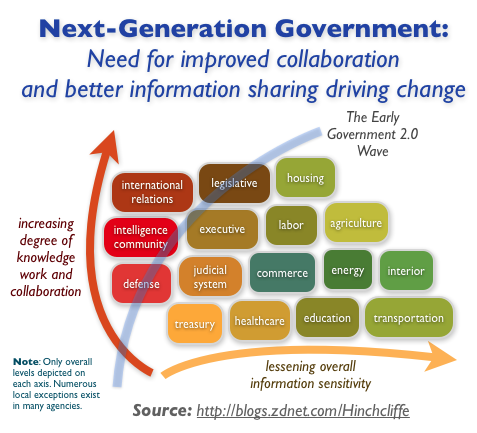
- The general level of knowledge work and collaboration. While there are now a number of good examples of digital open government initiatives at virtually all levels of government, they too often remain relatively isolated examples (at least until the latest open government policy initiatives are more fully implemented.) For now, despite serious security challenges in some cases, the drive to open up is coming from key places where collaboration is a primary function (I'm calling this the "first wave" of Government 2.0.) These include 1) at the nexus of government (executive branch), 2) in agencies that are highly mobile, hierarchical, and geographically distributed (defense) and 3) branches that must stay in close direct contact with citizens (the legislative branch, though unfortunately social networking is still used primarily for fund raising and not constituent engagement.) Thus where there is a core need, for whatever the reason, to share and collaborate, it becomes the first order driver even -- as we'll see -- when that sharing is difficult to do.
- The overall sensitivity of information that is handled. Depending on which part of the government you're talking about, the degree of control required over government information can range across a wide spectrum, from highly classified, need-to-know data on a secure network to data that is proactively shared and publicly available to anyone on federal, state, or local Web sites. Social computing and open data both pose major challenges to those that might want to apply them in environments that handle the former, the secure data. Yet it's this very process of information control that can result in knowledge hoarding and has been implicated time and again in significant intelligence failures such as the Christmas Day bomber. In general, I'm finding that environments that handle highly sensitive and actionable information are the ones that most need the cross-pollinating effect of social tools and open data. I also find that they generally know this. Despite this, there's no question that information sensitivity and the need for security has a major impact on the ability to adopt social tools and open data strategies in many agencies due to the perceived risk they often represent.
- Behavioral barriers. These are the reasons that we don't change our behavior when faced with better opportunities, for better or worse. They are also true both inside and outside of government. These behavioral factors generally fall into three categories: 1) The infamous not-invented-here (NIH) syndrome, 2) the "this doesn't apply to me" excuse which occurs when workers feel that what they're doing or how they are operating is unique for some reason and can't be grouped into larger, surrounding transformations of their environment, and 3) the 9x problem, a famous technology adoption barrier that says the people won't adopt new tools or solutions quickly unless it's almost ten times better than what they're using today. Unique to social tools in particular, is also a concern that requiring exposure within social tools could violate workers' privacy.
- A credible, actionable mandate from above. While there is currently some debate in the Enterprise 2.0 community whether social computing change is being driven most often from the top-down or bottom-up, there is just less opportunity for such grassroots efforts to flourish in the rule-bound public sector. While the open government initiatives I discussed above are almost certainly going to trigger some level of widespread changes in the near future, genuine room for change most frequently comes at the agency leadership level today. Mandates and their implicit permission to experiment have been shown to be effective in enterprise case studies of social computing and seem to work in the public sector as well. I would note, however, that there is some dilution of effectiveness due to the fact that many government workers are inured to the constant flow of new initiatives from above and often choose to see if they can "wait them out". Despite this, federal CIOs must understand the possibilities and drivers of social business models and communicate their plans for them to their workers.
- The widespread adoption of social computing in society. Social applications are becoming so popular in most developed nations that they often compete only with search as the most popular applications for most users, even above e-mail. This is a near-revolutionary change in user behavior and is what is driving so much attention about social media in general. As I noted last year, the business world is behind the consumer space, but is closing in rapidly, with the government bringing up the rear. The upshot is that the widespread use of social applications in workers personal lives and by their colleagues in the private sector is helping drive the agenda for Government 2.0 transformation in the public sector.
That the government is joining the Web 2.0 revolution five years after it began is both welcome and needed, despite a huge effort ahead that will have to map out and resolve the obstacles to progress while simultaneously learning how to capture the many potential benefits. These benefits include much higher levels of reuse of valuable assets that we all invest in as taxpayers, reduced duplication, better cross-pollination, and perhaps move of all, the ability to access and deeply tap into innovation.
With social computing already commonplace in a large number of businesses today, Government 2.0 may not be the 21st century equivalent of the space race of the 1960s, but it is offering a compelling and tantalizing vision of one in which transparency, participation, and civic engagement will almost certainly be significantly improved in next few years. That these goals are laudatory are of little question, but the real obstacles is not the technology but our ability to reach within ourselves and use the real change that technology makes possible to create a truly better outcome for us and and how we govern ourselves.