Social CRM: Ground zero for Enterprise 2.0 in 2010

Summary: There's been some debate recently on whether Social CRM is part of the broader Enterprise 2.0 story. I try to answer the question and explore some of the latest thinking on social business and how it can help transform the customer relationship for real competitive advantage.
Successfully maintaining meaningful and sustained relationships with customers has become a critical skill in the 21st century. What if customers were often the best people to help other customers? That's the basic premise of an emerging class of enterprise software usually referred to these days as "Social CRM" and which I covered in some detail late last year.
The general concept is that managing customer relationships in the classical way, meaning transactionally and one-on-one can be greatly improved by making the relationship less structured, more participatory, and created around an open community model. Social CRM can manifest itself in many ways, including self-organizing affinity groups within customer communities or by co-managing customer support requests in a shared, open venue, to describe just two popular approaches of many.
These new approaches do appear to transform the relationship that companies have their their partners and customers and are getting on the radar of customer support, product development, and marketing departments this year. But what's at the core of this approach that separates it from traditional CRM?My good friend and ZDNet blogger Michael Krigsman came away with the following perspective in his recent interview with CRM guru Paul Greenberg:
Successful customer relationships are based on interacting, cooperating, and collaborating with customers to provide mutual value. Technology is an important enabler but is secondary to relationship.
There's been some debate recently on whether Social CRM is part of the broader Enterprise 2.0 story and I think from the statement above it's clear that it is, and it's even more so when you look at close up in the wild. It's worth visiting GetSatisfaction for good real world examples from major, well-known firms.
Social CRM: Enterprise 2.0 with Customers
Enterprise 2.0 itself is popular term that captures the use of lightly structured social environments to collaborate and capture knowledge in a discoverable, reusable way. Typically, these tools are highly social (but don't necessarily have to be) and they're freeform, so that they can adapt to the problem at hand. Finally, Enterprise 2.0 is generally applied in a business setting between at least one to three types of participants: workers, trading partners, and customers. Social CRM fits the bill for all of these criteria, and of course, spans the full range of all three participants.
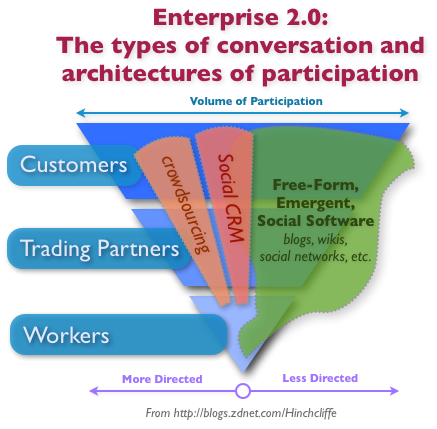
A typical Social CRM scenario is when customers want to communicate their problems (customer support) or desires (future product development requirements) to an organization and they're then given a social channel to do so. This channel could be as simple as a forum so that they can delve into their issue into more detail with the company and other customers. Or it might be something more deliberately structured to help customers support each other or to capture innovation. This structure might involve assigning case numbers or submission IDs and add them to an open, searchable database that can then be updated by anyone.
Whatever the method that is chosen (and it should be as open and freeform as possible), the key to effective Social CRM is that everyone in the conversation can contribute at any time in a transparent and authentic manner. It's probably an understatement to say that this isn't easy for companies used to having full control of the conversation, yet it's critical in order for Social CRM to work. Well known social business expert Jeremiah Owyang agrees, noting today that potent social influence is in the hands of most customers now, putting companies that don't have a Social CRM strategy into an increasingly difficult situation.
But anyone paying any attention can see the benefits of Social CRM: Closer contact with reality when it comes to what customers need or want, lower costs to engage with customer and resolve their problems or otherwise give them what they need, and ultimately just better results when it comes to having satisfied customers, many of whom actually become very closely connected with the company for everyone's mutual benefit.
Social CRM Just Window Dressing?
So I'd debate whether it's of any real significance to put Social CRM in its own category or just declare it a subset of Enterprise 2.0. One can make the argument however, that it's just an extension of traditional CRM with some social window dressing. In my mind, it's this latter issue to me that makes the question of categorization potentially important. A look at the popular CRM products of today largely turns up a set of tools that are often nothing more than glorified contact lists. The "R" in CRM is frequently e-mail management (albeit sophisticated) but not for actually managing the interactions of customers in a meaningful way. It's often more about pushing a message than it is real engagement.

That's not to say there isn't real value in CRM tools. There is. But successfully building and maintaining meaningful and sustained relationships with customers has become a critical skill in a 21st century digital business landscape that makes it very, very easy to switch to the competition. Traditional methods for staying in touch with customers don't hold a candle to true social engagement. Yet Social CRM is just a blip on the radar for most businesses as we enter 2010. But that's about to change: All the indicators that I'm tracking says that this will be one of the bigger aspects of what is increasingly being called "social business".
Social CRM stands to be one of the most interesting Enterprise 2.0 stories of the year, underscoring the importance of situated solutions to complement the more horizontally focused social computing initiatives we've seen in recent years. Consequently, I do believe that when it comes to companies actually engaging deeply and collaborating with customers to drive useful business outcomes, Social CRM will often do better than general purpose enterprise social software has so far in terms of achieving meaningful adoption at a strategic level.
As I can this year, I'll highlight the stories of successful Social CRM that are emerging. Please send me yours if you have one and I'll share them as I can.
Kick off your day with ZDNet's daily email newsletter. It's the freshest tech news and opinion, served hot. Get it.
Talkback
Social CRM - Extension of CRM?
Keep up being brilliant, man. I love your stuff.
Paul Greenberg
I agree. Here is my Social CRM definition looking at it more broadly
I agree, I love Dion's posts, commentary and analysis in this space and I try and get others to read his material.
A while ago I pulled together a PowerPoint deck outlining what Social CRM is and how it fits within / across an organisation.
It can be accessed here on SlideShare - http://bit.ly/PrBbC
I welcome any feedback on keeping the document up to date!
Agreed, Social CRM is when E2.0 goes beyond the firewall
I was hoping I made that point more clearly in my post but you're spot on for stating it even more succinctly than I did. I think your point about it also being operational is key as well. Good Social CRM will have many of the fundamentals of CRM and E2.0 both in my opinion.
Keep up the great work yourself, and see you around the blogosphere or at a conference very soon hopefully.
Best,
Dion Hinchcliffe
RE: Social CRM: Ground zero for Enterprise 2.0 in 2010
Keep up the great work yourself, and see you around the blogosphere or at a conference very soon hopefully.<font color="LightGrey"></font></a><a href="http://www.revivalymaske.com/"><font color="LightGrey">pembe maske</font></a> <font color="LightGrey"></font></a><a href="http://www.energybalancebileklik.com/"><font color="LightGrey">energy balance</font></a> <font color="LightGrey"></font></a><a href="http://www.oynaoyunu.com/"><font color="LightGrey">oyna oyunu</font></a> <font color="LightGrey"></font></a><a href="http://www.moliva.web.tr/"><font color="LightGrey">moliva</font></a>
RE: Social CRM: Ground zero for Enterprise 2.0 in 2010
Where does Idaho rank? We have been living in Montana for the past 5 years and I am not supri<a href=http://www.hipersexshop.com.br>sexy shop</a>to find it #3 on the "worst" list. Considering a<a href=http://www.hipersexshop.com.br>sexshop</a>move to Idaho to escapthe high cost of living a low income in MT. There may not be a sales tax here but they get you if you own property!
RE: Social CRM: Ground zero for Enterprise 2.0 in 2010
I can't agree more with this statement:
<b>Traditional methods for staying in touch with customers don?t hold a candle to true social engagement. </b>
As you have pointed out in this post and others, a few things need to happen before the true power of Social CRM can be unleashed. For one, organizations need to understand that it's a two way street and, to that end, they cannot control the entire message. Also, from a technology standpoint, I would think that many "Enterprise 1.0" apps may not be sufficient for storing, accessing, and analyzing much of the unstructured data generated by the very tools that you describe. Whether that means new apps, new architectures such as SaaS, data marts or warehouses, or some combination of each is probably a company-specific decision.
RE: Social CRM: Ground zero for Enterprise 2.0 in 2010
Excellent post, distilling some thoughts and concepts which have been brewing for quite sometime. Whether Social CRM belongs under the E20 umbrella, if you will, is not as important as solving business problems.
You address that later point quite well, in the transformation diagram. I would extend some of 'jobs to be done' part of Social CRM a little, as there are distinctions to be made. For example, I think that Social CRM needs to keep the process centricity, in order to make sure that the conversations taking place actually leads to action, or else they lose value.
Contact management is also one that absolutely needs to enter the Social age, but I would hope beyond simply community management. For the Support side of CRM, Community is the answer. For other parts, Social Network management is important as well, answering the question "how do I know this person".
Thanks for a great post!
Cheers,
Mitch
RE: Social CRM: Ground zero for Enterprise 2.0 in 2010
You make one great point: SCRM is no more than a part
of a good E2.0 strategy (in what I call the proper
definition of E2.0 as set by McAfee -- not the
commonly implemented technology-only model of Wikis
and Internal Collaboration). I have to applaud that,
as not too many of the E2.0 proponents stop to think
about it sufficiently. Yes, the talk about Customer-
Centricity (a tenet of E2.0 really), but they don't go
far enough implementing it -- they just die at the IT-
level discussion and implementation of the tools
without truly engaging the customer. It is in that
model that SCRM engages the customer and brings it
into the E2.0 deployment.
I think you get that and I agree there... Alas (or
However, or But if you prefer -- and you probably knew
this was coming) your description of SCRM falls short
of the potential of it. You are simply calling a
community a SCRM implementation (a definition that is
favored and pushed on by some of the vendors) -- which
basically stalls it at the same level as those E2.0
implementations I mentioned before. There is much you
are missing in that perspective.
SCRM is about communities, but that is only one of the
layers for it. It is about identifying customers as
part of multiple communities, and about engaging them
via those communities to provide ideas, feedback,
complaints, and support each other. But stopping
there is doing the same disservice as saying that E2.0
is about implementing Sharepoint.
The real value that SCRM provides is the aggregation
of that "feedback" (all the contributions from the
customers via their communities of choice -- and I
have a broader definition for community that simply a
forum) and processing it via analytical tools (the
most underutilized component of a CRM implementation -
whether SCRM or CRM), creating Actionable Insights,
and feeding those insights to the organizations
systems and processes involved in making the
organization customer Centric (I would usually call it
E2.0 at this point, but that would not fit with your
definition of it above) as food for improving the
processes and products that are then given back to the
customer in the form of better experiences -- on which
we then capture feedback again.
This continuum is what I call the Experience Continuum
and the true essence of the value of the properly
defined E2.0 (or, in the poorly defined E2.0 as back-
office and SCRM as front-office, I call it
convergence).
This is a critical differentiation because it is where
all this implementations and strategies show the value
-- in the ability to actually implement a customer-
centric organization using the tools and methodologies
we are commonly referring to as SCRM or E2.0. This
model is what a social business is all about (as much
as I don't like the term, describes well the
organization that engages socially both internally and
externally with the purpose of serving customers
better and fulfilling the purpose of the organization
better).
So, getting off my soapbox -- Bravo for using E2.0
properly, and for including SCRM as the customer-
facing portion of that -- but please make sure to take
SCRM all the way back into the organization, and the
organization all the way out to the customer to
describe the value they both provide to the social
business.
Just two cents more to add to the pot... and we are
still way short from making that first dollar.
Great points, I hope everybody reads this
Thanks kindly kind for stopping by and adding these excellent thoughts.
Your point about "bringing customers into the E2.0 deployment" is a smart one and it's one of the points I was making about how Social CRM will actually drive a good amount of enterprise engagement with social computing this year.
And while my post bandied about a lot of popular buzzphrases (E2.0, Social CRM, and social business), each one is an important landmark on the social landscape that can help us sort out where all the pieces fit in our businesses. Thanks for seeing this for what it was in terms of refining the thinking in this space. Note that I'm not heavily invested in these phrases myself except to the extent they create useful and recognizable shorthand.
Best,
Dion Hinchcliffe
RE: Social CRM: Ground zero for Enterprise 2.0 in 2010
i agree
Employees at my company suffer from application fatigue. When one's daily work is spread across eight or nine separate software systems, additional functionality gets lost behind use complexity. As we shop for an E2.0 platform we demand it replace the functionality of at least two and preferably three, current applications. The advantage of "all-encompassing social capability" is that it allows us to <a href=http://www.articles4health.net>health</a> operate within the finite capacity for users to span their jobs across multiple platforms.
RE: Social CRM: Ground zero for Enterprise 2.0 in 2010
days when it comes to social media and E2.0. You simply
cannot control for people possibly leaking sensitive business
information or making vendors angry with something. I think
you are spot on and I hope that Social CRM takes fire and
proliferates. I would love to see this technology become
adopted by most of the Fortune 500, at the very least.
RE: Social CRM: Ground zero for Enterprise 2.0 in 2010
http://conversationenablement.files.wordpress.com/2010/02/e2_and_socialcrm_new.jpg
As you can see I am proposing to show how much the different stakeholders are allowed to access.
Best regards,
Paul
RE: Social CRM: Ground zero for Enterprise 2.0 in 2010
small emerging company in India and for me investing
into a CRM was a crucial decision and with all the
choices in the market, I wanted to go with someone,
which is scalable and is something, which, as a system
does not requires me to change and re-shape processes
in my company. Now with mutiple choices and being much
confused I zeroed down on Salesforce and Sage.
But the interesting part is when I found employees
from Sage India talking to me on twitter (@sageindia)
and also I went through their blog, which made it much
easier taking a decision and am happy with their
product.
Hence the social angle to the CRM is surely going to
change the dynamics of perception!!
RE: Social CRM: Ground zero for Enterprise 2.0 in 2010
The benefit I see in a CRM tool is notifications for action and the ability for an enterprise to have transparency of employee communications. The fear of an employee saying the wrong thing is real and the main reason CEO's we're speaking with want to have a management tool.
If real time action isn't taken in some form, the engagement a business is trying to gain is lost. Businesses have to be prepared to respond. They also need to have policies and procedures in place so employees know what they can and cannot do while representing their company in a transparent vehicle. The lack of a firewall is a real worry for any savvy enterprise who understands the viral nature of social media sharing!
RE: Social CRM: Ground zero for Enterprise 2.0 in 2010
For example, here's recent tweet by Hutch:
"bhc3
@elsua Have mass consumer co's ever really had a relationship with their thousands of customers? B2B seems more likely for relationships."
RE: Social CRM: Ground zero for Enterprise 2.0 in 2010
I can see why the notion of a positive relationship with a brand may sound slightly odd, but consider this: imagine you lived in a small town back in the 50s where there were only two places you could buy your weekly groceries. If there was one where the shopkeeper knew your name, listened when you asked them if they could stock your favorite candy bar and where you often bumped into other people you got on well with, you'd choose that over the other option where the shopkeeper didn't even say hello. If your location of choice closed down then you would feel some sort of emotional reaction. So, in this respect, 'relationship' is a fair description and there's a clear mutual value for both companies and customers.
Due to the corporate explosion and wider globalization of the last 50-odd years, that sort of local shopkeeper/customer relationship has all but died out, usually at the hand of The Brand. As a result, the thought of a brand then having a relationship with its customers seems faintly ridiculous. What the advent of social and sCRM does is offer the opportunity to recreate the intimacy of that local relationship on a mass, global scale.
Sounds like a cheesy sound bite but consider this: thanks to the social web, 'local' is no longer a reference to the customer's geography. Since people seek out social networks based on their interests, tastes and needs, 'local' is instead defined by these elements. Fortunately, interests tastes and needs are also drivers for their consumption habits. As a result social platforms are tailor-made for businesses to establish mutually beneficial customer relationships.
So, in both respects (positive and negative interactions) the notion of a relationship and the impact it can have is valid. ?Have mass consumer companies ever really had a relationship with their thousands of customers?? Perhaps not, before; but now they can. And that's precisely why sCRM is so exciting.
I'll just quickly add: great article Dion. As has already been stated, you've distilled a lot of sCRM chatter and speculation into something clear and succinct.