ie8 fix

Cheaper ad-supported Kindle may be the student dealmaker (or not)

By | April 12, 2011, 8:39am PDT

Summary: Amazon’s Kindle will be ad-supported for a $25 initial discount. But the library e-book system is a key variable to continue to dissuade students from the e-book reader.

I’ve been pretty critical of the Kindle up until now. Though it seems students on the most part would rather take a book out of the library than buy a Kindle, a cheaper albeit ad-supported model may entice the younger audience.

In theory, a Kindle - an easy-to-read device, with a search function and referencing capabilities, should be a hoot for all students. But, it has yet to be seen.

The new Kindle will only come in a $25 off device, which frankly is nothing - even for cash strapped students. Though, ads will not be part of the content of the book or e-book; rather displayed on the home screen and in screensavers during device downtime instead.
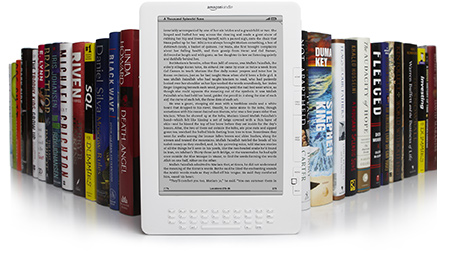
Library books are free. They’re free to take out, and they’re free to steal, if you can get away with it. But for those without a crippling sense of kleptomania, the Kindle’s biggest downfall for the student market is the ‘top up fees’: where one has to buy books to read them.

It sounds simple enough, and why should one argue with that? You buy books, and you draw research from them. But university students don’t want to buy wherever possible. This is why the library is still key in studying for a degree.

However, the question here should be, will the initial cheaper cost of a Kindle entice in students who will then need to go on to top up their device with for-fee content?

Frankly, it won’t. Until library books are somehow available in e-book format, then e-readers have a chance. But, for that, it would come at great expense to the university itself, and the Kindle would be a far more expensive option as the key functionality would be in essence, entirely negated.

Related content:

Kick off your day with ZDNet's daily e-mail newsletter. It's the freshest tech news and opinion, served hot. Get it.

Topics

Zack Whittaker, a criminologist who studied at the University of Kent, Canterbury, is a journalist, writer and broadcaster.

Disclosure

Zack Whittaker

I worked briefly with Microsoft UK in 2006 but no longer have any connection with the company. Regardless, I remain impartial and unbiased in my views.

I don't hold any stock or shares, investments or industrial secrets in any company, but have signed confidentiality agreements with a number of UK and U.S. organisations, whose names I am not at liberty to disclose.

I was involved with Kent Union, the University of Kent's student union, undertaking voluntary, non-salaried, elected positions between early 2009 and mid-2010.

No other company, body, government department, non-governmental organisation or third sector organisation employs me or pays me a salary in any capacity whatsoever.

As a freelance journalist, whenever expenses are given and taken by a company that is not CBS Interactive, these will be disclosed in each relevant post to ensure transparency.

I currently work with a UK law enforcement unit, but this is an entirely separate position which bears no connection to other work.

(Updated: 23rd October 2011)

Biography

Zack Whittaker

Zack Whittaker, criminologist who studied at the University of Kent, UK, is a journalist, writer and broadcaster.

After studying criminology at university, though still in his early-20's, he has already had a series unconventional work and voluntary positions. He has worked with researchers studying neurological illnesses like Tourette's syndrome (which he suffers from), has given lectures on the nature of disabilities in the public community, and occasionally ends up speaking on television and radio discussing the events of the day.

He first had academic work published at the age of 22, then still an undergraduate, and has been cited by a wide range of publications: from the Huffington Post, Business Insider, AllThingsDigital, The Atlantic Wire and CBS News.

8
Comments

Join the conversation!

Just In

RE: Cheaper ad-supported Kindle may be the student dealmaker (or not)
eak2000 13th Apr 2011
@zwhittaker

Here in the US... or at least in Seattle... Our public library system has pretty much every book I've wanted to read as an eBook. But, they're in ePub format and use the ADE encryption system so they don't work with the Kindle. Ironic since Amazon is headquartered here.

Then again, the Kindle is generally the most piss-poor eBook reader on the market. My Sony Reader works with libraries and Google Books just fine.... and so does my friend's Nook.
Here in the U.S. at least, some e-books are available at libraries now, to be checked out to your e-reader. However, publishers are limiting them to a certain number of check-outs, assuming they get wear-and-tear like physical books do. (A typical limit is 26 check-outs for a best seller.) This obviously would be a problem with research resources, if they could only be checked out and read by 26 people! Thus research libraries are unlikely to offer e-books for checkout under those conditions.
0 Votes
+ -
Contributr
@pwoodruff@... Very true. My university's library offers some books in e-book (PDF) format, and journal articles online are by very nature in PDF document too. So, if it's only 'free' e-books that one is downloading, who needs an expensive Kindle? Surely one would simply get a cheap e-book reader instead.
@zwhittaker

Here in the US... or at least in Seattle... Our public library system has pretty much every book I've wanted to read as an eBook. But, they're in ePub format and use the ADE encryption system so they don't work with the Kindle. Ironic since Amazon is headquartered here.

Then again, the Kindle is generally the most piss-poor eBook reader on the market. My Sony Reader works with libraries and Google Books just fine.... and so does my friend's Nook.
$25 off is not worth what will become an ad invested device over time. Say 50% off the device would make a difference
Who in the world would opt for an ad supported Kindle just to save $25? Plus, how does it get the ads? Do you have to go 3g to do that? I've never understood why on a dedicated e-reader you would need or want 3g when wifi is so available.
0 Votes
+ -
Kindle Fun
kjrider@... 12th Apr 2011
I have been unwell with a nasty bout of flu that laid me down for two weeks.

It was great having the Kindle. I was too ill to go out. When I ran out of books to read, I could get a new one in 30 seconds from Amazon - some free, some paid for.

KJR
0 Votes
+ -
Luggability for Commuters
sr2594@... 12th Apr 2011
I doubt many students will opt for paid leisure reading. But, given the weight of texts, a Kindle like device would be especially useful for commuting students, who may need to take all the texts they may use during the day and have them handy in intervals between classes.
Let's see if I have this one right?

Amazon loses $25 in sales revenue, but gains $25 million in ad revenue?
I save $25, but get 25 trillion ads?
$25 savings + too many ads = Not this guy.

Join the conversation!

Formatting +
BB Codes - Note: HTML is not supported in forums
  • [b] Bold [/b]
  • [i] Italic [/i]
  • [u] Underline [/u]
  • [s] Strikethrough [/s]
  • [q] "Quote" [/q]
  • [ol][*] 1. Ordered List [/ol]
  • [ul][*] · Unordered List [/ul]
  • [pre] Preformat [/pre]
  • [quote] "Blockquote" [/quote]
ie8 fix

The best of ZDNet, delivered

ZDNet Newsletters

Get the best of ZDNet delivered straight to your inbox

Facebook Activity

White Papers, Webcasts, & Resources
ie8 fix