Google Latitude: students beware

By | February 5, 2009, 11:23am PST

We, the ZDNet bloggers, do indeed practice what we preach. Over the last couple of days, we’ve been playing around with Google Latitude as a group. As a student, I can see both the upsides and the downsides to this service. But my colleague and friend, Jen Leggio, the so-called “princess of all things social-media”, has already expressed her “grumbling nature” at such as service.

As Larry has already explained on Between the Lines, this is another way for Google getting social… but at what cost?

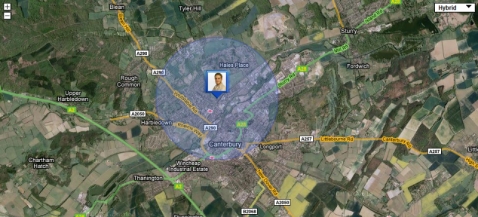
The concept is simple. You can have Google Maps running on your phone, which connects to your mobile network operator and, with your permission, uploads and projects to the world or your close-knit group of friends, either exactly where you are (via GPS) or roughly via the cell tower triangulation.

But would you really want do disclose your precise location to Google and the world?

Knowing that you are not at home for an undisclosed amount of time can lead to security issues within your own house. Not only that, students from time to time like a bit of privacy, and don’t want to be disturbed, especially when studying.

But on the other hand, knowing where your friends are if you’re on a holiday and lost in a big city would be essential. It’s also great for nights out; seeing groups of friends in one area of the city, whilst another group over the other side.

One of the main problems I’ve seen so far is the data connectivity. To get an accurate location without GPS is to use the in-house mobile triangulation. This requires a data, 3G or GPRS connection to your service provider, which then downloads images to Google Maps on your phone. As you can imagine, this’ll cost you quite a bit in the long run.

To keep Latitude running, it’ll slowly eat away at your monthly contract and end up costing you your left arm and your first born child.

Do we need another social network, if you could class this as one? Would you concern yourself with the privacy issues? Will this take off, or just add to the Big Brother society? Let me know.

Kick off your day with ZDNet's daily e-mail newsletter. It's the freshest tech news and opinion, served hot. Get it.

Topics

Zack Whittaker, a criminologist who studied at the University of Kent, Canterbury, is a journalist, writer and broadcaster.

Disclosure

Zack Whittaker

I worked briefly with Microsoft UK in 2006 but no longer have any connection with the company. Regardless, I remain impartial and unbiased in my views.

I don't hold any stock or shares, investments or industrial secrets in any company, but have signed confidentiality agreements with a number of UK and U.S. organisations, whose names I am not at liberty to disclose.

I was involved with Kent Union, the University of Kent's student union, undertaking voluntary, non-salaried, elected positions between early 2009 and mid-2010.

No other company, body, government department, non-governmental organisation or third sector organisation employs me or pays me a salary in any capacity whatsoever.

As a freelance journalist, whenever expenses are given and taken by a company that is not CBS Interactive, these will be disclosed in each relevant post to ensure transparency.

I currently work with a UK law enforcement unit, but this is an entirely separate position which bears no connection to other work.

(Updated: 23rd October 2011)

Biography

Zack Whittaker

Zack Whittaker, criminologist who studied at the University of Kent, UK, is a journalist, writer and broadcaster.

After studying criminology at university, though still in his early-20's, he has already had a series unconventional work and voluntary positions. He has worked with researchers studying neurological illnesses like Tourette's syndrome (which he suffers from), has given lectures on the nature of disabilities in the public community, and occasionally ends up speaking on television and radio discussing the events of the day.

He first had academic work published at the age of 22, then still an undergraduate, and has been cited by a wide range of publications: from the Huffington Post, Business Insider, AllThingsDigital, The Atlantic Wire and CBS News.

8
Comments

Join the conversation!

Just In

Yes, and let's just get rid of that stupid email thing too
daboochmeister 9th Feb 2009
You've never sent an email or IMed while in a telecon?

Texting can be done while engaged in other activities, and doesn't require the recipient to be online to succeed. It's just email. The morse-codey thing fades as you A) get used to it, B) get better at entering text.
0 Votes
+ -
None of your concerns make any sense
NonZealot 5th Feb 2009
If it was being forced on us or was an "all or nothing" type of service, I could understand your concern but since you have an incredible amount of control over exactly how your location is determined and who gets access to it, I really don't see how you can justify your point that this is a bad thing?

But would you really want do disclose your precise location to Google and the world?

Then don't use it! It would be like saying the phone is bad because do you really want to give others the ability to ring your phone any time they dial your number?

Knowing that you are not at home for an undisclosed amount of time can lead to security issues within your own house.

I guess that's a problem if you are worried that one or more of your friends are likely to break into your house and steal your stuff. If that's the case, you have bigger problems than Latitude.

Not only that, students from time to time like a bit of privacy, and don?t want to be disturbed, especially when studying.

Then turn it off while you are studying? Besides, Latitude can't be used to actually bother you, it can only tell your friends where you are. They still have to call / email / drop by, any of which they can do without Latitude. Finally, Latitude does give you the ability to set a status. Set it to "I'm studying, leave me alone." and, if your friends care at all about you, they will leave you alone. If anything, this will help with your studying because without that status message, your friends might call you and disturb you.

One of the main problems I?ve seen so far is the data connectivity. To get an accurate location without GPS is to use the in-house mobile triangulation. This requires a data, 3G or GPRS connection to your service provider, which then downloads images to Google Maps on your phone. As you can imagine, this'll cost you quite a bit in the long run.

Google Maps all by itself requires a lot of data. While I don't have actual numbers, I would guess that the size of the maps that Google Maps downloads to your phone would dwarf the amount of data required for triangulation. However, if it is a really big concern, Latitude allows you to turn off automatic location (I believe by default it is off) and set your position manually. There. Now you have all the functionality of Latitude without any of the triangulation.

Finally, none of this is a concern for any of us who have unlimited (or near unlimited) monthly data plans.
0 Votes
+ -
The system doesn't use triangulation
Fred Fredrickson 5th Feb 2009
The technology for determining position from cell towers is trilateration, not triangulation.

Triangulation uses angles, typically bearings based on some datum such as true or magnetic north. Mobile phones and towers can't measure bearings (or angles or azimuths, whatever), so they can't use triangulation.

Trilateration uses distances that are measured based on the time the signal takes to get from a number of different towers to the phone.
0 Votes
+ -
RE: Google Latitude: students beware
zclayton2 6th Feb 2009
If you can turn it off, it seems ok. If it is factory set as always on, its a non-starter.
0 Votes
+ -
do I want to be tracked?
ca1ic0cat 6th Feb 2009
do I want to pay to be tracked? I don't think so. Letting burglars know you're not home isn't a good idea either. That's a possibility if you have a lot of "friends" or the guy at the Jiffy Lube got your cell number.

I can't imagine why I would turn this on but I'm sure a lot of people will until the scammers start to take advantage of it. I'm sure there will be any number of creative ways to abuse the system. Can't wait to read about them.

Why argue for privacy rights when so many sheeple give them away?
0 Votes
+ -
RE: Google Latitude: students beware
Posthoff 6th Feb 2009
But if You turn it off, maybe Your girlfriend asks You next time Why.
0 Votes
+ -
RE: Google Latitude: students beware
bjpepper 6th Feb 2009
'But on the other hand, knowing where your friends are if you?re on a holiday and lost in a big city would be essential.'

Why not just send a text msg to your friends and ask them where they are or tell them where you are? I find it amazing that people are holding a vocal communication device in their hand, but don't want to actually call someone and have a conversation.
0 Votes
+ -
What the ...?
jemd@... 6th Feb 2009
I agree. I just don't get texting. It's almost like going back to Morse code when you can just dial or speeddial a number and TALK TO SOMEBODY!
BTW the obvious concern for your location being so available isn't about your friends. It's about people who aren't your friends. Getting access to this kind of system is trivial for skilled hackers.
0 Votes
+ -
You've never sent an email or IMed while in a telecon?

Texting can be done while engaged in other activities, and doesn't require the recipient to be online to succeed. It's just email. The morse-codey thing fades as you A) get used to it, B) get better at entering text.

Join the conversation!

Formatting +
BB Codes - Note: HTML is not supported in forums
  • [b] Bold [/b]
  • [i] Italic [/i]
  • [u] Underline [/u]
  • [s] Strikethrough [/s]
  • [q] "Quote" [/q]
  • [ol][*] 1. Ordered List [/ol]
  • [ul][*] · Unordered List [/ul]
  • [pre] Preformat [/pre]
  • [quote] "Blockquote" [/quote]
ie8 fix

The best of ZDNet, delivered

ZDNet Newsletters

Get the best of ZDNet delivered straight to your inbox

Facebook Activity

White Papers, Webcasts, & Resources
ie8 fix