Next-generation on-demand 'social television' in the works

The BBC are working on a new beta version of their popular, trend-setting on-demand television service, iPlayer. With a changing online environment, the BBC - a semi-public organisation which relies heavily on the tax payer - is setting new trends by opening up 'social viewing'.
Using Javascript and client-side coding - it allows users to communicate with each other using Windows Live Messenger whilst watching on-demand programmes.
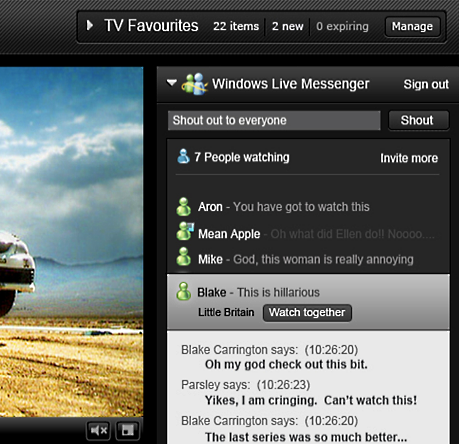
In a few weeks once the site fully works and the 'social controls' are in place, users will be able to log into their Windows Live Messenger account and speak with each other, whilst watching a synchronised programme on the site. You can invite more than one person, and 'shout out' to everyone on your friends list who are also watching the programme - like when a particularly exciting moment happens.
The BBC are clearly weary of privacy, and with these Windows Live controls it allows users to communicate with each other directly through the Messenger service, and the BBC does not see any content you post, nor can it archive it.
Using Facebook in this method may have been considered, but as the BBC is a public body with responsibilities to the tax payer, it seems they opted to use another popular service in light with the various privacy issues highlighted with the social network. The BBC and Microsoft have worked together closely before, so this 'partnership' doesn't surprise me at all.
Update (3:58pm BST): The BBC confirmed that the Facebook 'privacy issues' that have been in the news were not a reason to not use the service directly. Facebook chat which doesn't have a client-side base as such is more difficult and less dynamic to integrate. With over 450 million worldwide Windows Live Messenger users, it was easier, more efficient and better suited to use the Messenger network. It isn't to say that others won't be used in the future, nor is it locking down to just one network - but to start off, it is a wise and justified reason.
However, Neowin report (so do take with a pinch of salt) that iPlayer videos will be able to be shared properly over Facebook and Twitter, which as of yet has not been restricted as such, just not really thought about. With this in mind, the BBC have confirmed that they will not be seeking to 'create' their own social network, rather build on the infrastructure already in place by harnessing third-party sites such as Facebook and Twitter.
The 'social viewing' development in my eyes is very significant. The iPlayer started the online on-demand revolution in the UK and has had a deeply positive and trend-setting impact on the rest of the web.
Some interesting iPlayer stats:
- In April 2010, one of the strongest months for the on-demand service, 123 million requests were made across all online platforms and devices.
- iPlayer is not just available on the web, but across all desktop operating systems, dozens of mobile phones and in download and streaming form - even across some 3G networks.
- "Doctor Who" is one of the most popular programmes on the entire network (pg. 13).
- A large majority of the Generation Y use the BBC on-demand service, favouring the iPlayer desktop application and streaming from the website (pg. 18), with many accessing through games consoles such as the PlayStation 3.Source: BBC iStats
But now as students being a popular user of the iPlayer and similar services - because there is no need to buy a TV licence to watch on-demand broadcasts, this engages the younger generation on a far more substantial level and is a major step towards the next evolutionary step of television, something I have doubted before.
I spoke to Rory Cellan-Jones, the BBC technology correspodent last night, to get his personal views on how 'social television' could be a natural progression of the next-generation television experience:
"This step is more significant than say 3DTV. On-demand broadcasts in the wider context of the broadcasting industry allow users to build our own television schedules. And with the sharing web, there is a prominent socialisation around TV - sharing our likes and dislikes, and there's an infrastructure already in place to allow this to happen now.
On-demand television won't replace ordinary broadcasts. But there will be a tipping point for the younger generation where on-demand becomes more popular, but there is no time limit on when this could be."
Instead of lounging around at a friend's house to watch the latest Top Gear episode, for example, doesn't have to be a thing of the past. But in this new development, it allows the very social younger generation to do exactly this in a virtual but secure setting.