One Laptop per Child: Disappointing results?

Summary: Is the One Laptop per Child scheme producing the results we expected?
Simply purchasing a device such as a laptop and handing it to a child is unlikely to turn them into the next Zuckerburg. However, it can teach them basic, valuable skills that will assist them when it is time to leave education and support themselves by joining the work force.
At least, this is the view from Peru, where the largest program involving One Laptop per Child, an American charity's scheme currently operates. Active in more than 30 developing countries across the globe, the aim of the project is to provide children with access to a laptop for educational purposes.
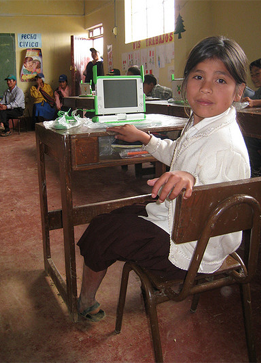
However, according to an evaluation of the scheme's success by the Inter-American Development Bank (IDB), the results may not be as promising as we may have hoped.
Peru is one of the few places that is currently enjoying an economic boom -- but it has one of Latin America's lowest-ranking educational systems, which no doubt hampers its economic capabilities in a global setting.
After spending $225 million to provide 850,000 laptops across the country, it was hoped that test scores in basic education, such as math and literacy, would improve.
It has not been successful. According to a report released by Peru's education ministry last month, only 13 percent of those under ten achieve a basic standard in math, and only 30 percent in literacy.
The IDB's evaluation, a study of 319 primary schools in Peru conducted over a period of 15 months, found that the children who received the laptops showed no improvement, and nor did access to such devices lead to increased motivation to learn or more time spent studying.
Why such results? The IDB concluded that OLPC does not provide enough guidance for teachers to show students how to effectively use the computers in class -- and so the next item on the agenda should be improving teacher training.
However, the report does congratulate the Peruvian government for providing the computers, as less than 25 percent of households had access to a computer in 2010.
Now, far more students and households have access to such devices -- the ratio of computers to students rising from 0.28 to 1.18 -- and it will help students become more comfortable with basic tasks, even if that is not reflected in test scores for general education.
It is not surprising that simply having access to such devices becomes a catalyst for improved education. Instead, technology has to be carefully integrated into courses as a supplementary means of improving learning environments -- and teachers must be trained properly in its use.
Image credit: One laptop per child
Related:
- Student skills: Are we doing enough?
- Kindergarten kids: A pencil, eraser and an iPad
- 'Boring' IT classes face being axed
- How we really teach with tech in 21st century classrooms
- 27,000 Google Chromebooks coming to a school near you
Kick off your day with ZDNet's daily email newsletter. It's the freshest tech news and opinion, served hot. Get it.
Talkback
Schoolchildren?
... and improve cognitive skills
oh god...
Luckily not
Someone just Pocketed $100 Million Dollars...all in one government project.
" I think I speak for all of us when I say, garbage in and garbage out."
( To validate my logistics that 5" screen flipped open from what appears to be a so called laptop would have to cost $250 per stupid; sorry, I mean to say student.)
This happens (EVEN MORE) in the U.S.A.
Technology is not the savior of education
Countries with far less tech in the classrooms like India or China can still score better than the US which have far more tech in the classrooms.
http://www.bloomberg.com/news/2010-12-07/teens-in-u-s-rank-25th-on-math-test-trail-in-science-reading.html
US spends on-average 6-10K per student compared to less than 1-2K in India and China.
Parachuting in tons of OLPC to Peru is a noble effort, but unfortunately wasted if the $225 mil can not raise the Peru's average income of $200/month.
Peru average income
It's still a great idea and a noble charity
Here is a simple fact ....
In the case of the OLPC, you have a great product that delivers the features and functionality it promised. But like a house without a solid foundation, the product is crumbling in its own weight ... because there is no infrastructure to support it.
Every time I read about the OLPC, I always look for what is the infrastructure being build around the product. Things like training for teachers, software tailored to the class, IT support (even if it is student based) .... nothing mayor. But every time you read about it, all you hear is about numbers and nothing about how it will achieve the target results.
So in the end, the great product that can deliver when used right, is failing because the people who made the decision did not take into account the fact that the product does not do anything on its own. It requires additional work by others. Work that is never done or even funded.
Technology in Early Childhood Education
"Charlie, More people are coming to understand the inappropriateness of technology for technologys sake. I've been in early learning for many years, and now conduct research in the development and testing of educational technology. It is critical to have quality research-based content to use with kids in order to meet specific educational expectations. You make some great points in this post about the need to integrate technology in classrooms appropriately and effectively. Teachers must have strong professional development to successfully use technology in their classrooms to meet learning goals. This is one of the fundamental premises in the recently released technology position statement by the National Association for the Education of Young Children and the Fred Rogers Center (http://www.naeyc.org/content/technology-and-young-children) and in the US Office of Educational Technology National Technology Plan (http://www.ed.gov/technology/netp-2010). Recently, Brian Puerling, PBS Teachers Choice Award Winner and the author of Teaching in the Digital Age: Smart Tools for Age 3 to Grade 3, presented a Webinar hosted by our organization in which he discussed and showed many best practices examples of using technology in an integrated manner to provide meaningful learning experiences to young children (http://www.hatchearlychildhood.com/pages/webinar-feb-2012-brian-puerling ). As are many, we're extremely interested in discussing these kinds of topics in our papers and through our social media efforts. Resources available on our blog at www.Blog.HatchEarlyChildhood.com"
Dr. Dale McManis
Research Director
Hatch Early Learning
@HatchEarlyChild
Educational outcome = Improved test scores ? I don't agree
ONE LAPTOP PER CHILD
good questions, some answers
OLPC Idiocy
What kind of screwball world view does one have to have to think that giving someone a computer will increase their basic test scores?
Giving someone a computer has very little, if anything, to do with increasing someone's math or literacy skills, and may contribute to reducing those skills due to time spent persuing other computer-related activities.
I scored 99% in math skills in the the 8th grade, and personal computers hadn't been invented yet.
When my 21 y/o daughter showed up in her high school Algebra class, she was the only one in the class who didn't have a calculator. The other kids said, "How can you do math without a calculator?" to which my daughter responded, "What do you need a calculator for to do math?" She's not a math wiz, btw, English and communications are her strengths.
Improve test scores was not a goal of the project
The study showed your estimate of scores reduction did not happen.
Improve test scores does not equals improving education
1. The IADB study reports three major findings: Dramatic improvement in ICT access and basic ICT skills (like use of word processing and others); no improvement in Math and Language test scores; and moderate improvement in cognitive skills. It is important to stress, improvement of test scores was not one of the project's objectives because we knew we lacked well educated teachers (not a matter of training) and it seems there is no way to improve scores without good teachers and in short periods of time.
2. The study mentions the motivation towards homework or school attendance did not improve. That is different than saying motivation towards learning has not improved. There are lots of other ways of learning apart from doing homework or attending schools where 92% of teachers lack basic math skills and 62% of them does not read at elementary school level (based on a MoE census evaluation of Jan 2007)
I hope the improved cognitive skills (5.8 months advantage after 15 months is more than moderate IMHO) will show up later in life as improved test scores once teachers' quality improves.