ie8 fix

Should universities become open source tech democracies?

By | June 9, 2010, 6:40pm PDT

Summary: Is it not about time that education institutions opened up their technology provisions to the student electorate to choose their applications, potentially moving away from ‘normal’ Office and Windows?

Zack Whittaker is in New York City.

Democracy is a strange concept in today’s society, as something nations, states and ideologies will invade to promote the idea. Within the typical university environment, you will find a hotbed of student radicalisation and empowerment by which often means the promoting of one’s beliefs and opinions onto others.

With universities all over the world suffering still from economic hardship after the deep cutting global financial crisis, open source technology and outsourcing services have been a major playing field for those in the education industry; cutting down costs to cheaper alternatives is vital in restoring the balance books.
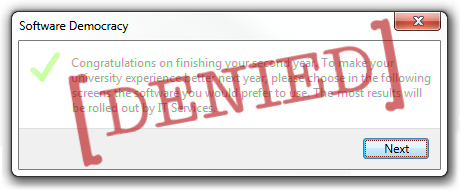
But when the two come together, often they don’t see eye to eye. My thought is this. Seeing as students pay their way through college and the higher education system, why not give us a say in their IT surroundings and allow us the decision to decide what technologies, products and services to use?

Many applications are niche and practically irreplaceable: SPSS for statistical analysis, used highly in psychology and mathematics, and AutoCAD for another example, used to render 3D drawings and the like. These are almost bog-standard in any university library public PC.

But for those finishing their first, second and anywhere up to and including their penultimate year of study, students should be given the chance to vote on the software they use.

The best example is the good old Google Apps for Education vs. Microsoft Live@edu outsourced email and collaboration suites. They both rival each other and Microsoft is winning the competition. But it would be an unprecedented move to actually consult and ask the students directly which they would prefer. Pilots have been successful and unsuccessful and based vastly on student opinion, but the final say-so rests with those with the chequebooks.

Though the infrastructure would logically need to be addressed by those who were qualified to understand such complex workings, but the software available to use as customisable to the person in hand is crucial to opening the desktop application market to the more marginalised programs. Open source programs and services could be allowed to flourish, though it could lead to the more typical suite of applications reigning through sheer student ignorance.

My question is simple. Why not?

Kick off your day with ZDNet's daily e-mail newsletter. It's the freshest tech news and opinion, served hot. Get it.

Topics

Zack Whittaker, a criminologist who studied at the University of Kent, Canterbury, is a journalist, writer and broadcaster.

Disclosure

Zack Whittaker

I worked briefly with Microsoft UK in 2006 but no longer have any connection with the company. Regardless, I remain impartial and unbiased in my views.

I don't hold any stock or shares, investments or industrial secrets in any company, but have signed confidentiality agreements with a number of UK and U.S. organisations, whose names I am not at liberty to disclose.

I was involved with Kent Union, the University of Kent's student union, undertaking voluntary, non-salaried, elected positions between early 2009 and mid-2010.

No other company, body, government department, non-governmental organisation or third sector organisation employs me or pays me a salary in any capacity whatsoever.

As a freelance journalist, whenever expenses are given and taken by a company that is not CBS Interactive, these will be disclosed in each relevant post to ensure transparency.

I currently work with a UK law enforcement unit, but this is an entirely separate position which bears no connection to other work.

(Updated: 23rd October 2011)

Biography

Zack Whittaker

Zack Whittaker, criminologist who studied at the University of Kent, UK, is a journalist, writer and broadcaster.

After studying criminology at university, though still in his early-20's, he has already had a series unconventional work and voluntary positions. He has worked with researchers studying neurological illnesses like Tourette's syndrome (which he suffers from), has given lectures on the nature of disabilities in the public community, and occasionally ends up speaking on television and radio discussing the events of the day.

He first had academic work published at the age of 22, then still an undergraduate, and has been cited by a wide range of publications: from the Huffington Post, Business Insider, AllThingsDigital, The Atlantic Wire and CBS News.

32
Comments

Join the conversation!

Just In

RE: Should universities become open source tech democracies?
FAULKNE 13th Oct
Good day to confirm this comment I would appreciate T h e b e s t o f Z D N e t d e l i v e r e d your website very nice to everyone Yes, Oracle is the only one with shared-disk architecture, but that is there advantage. It means you can add or remove nodes and the database lives on. In a shared nothing architecture, if you lose a node, you lose the system. I'm sure Oracle appreciates EMC highlighting their advantage.I also desire to signal in your RSS feeds. Thank you as soon as once again and maintain up the great operate Awesome post! Thank you very much || thanks for nice content this is really benefit to me.
0 Votes
+ -
Yes and the insane should run asylums
tonymcs@... Updated - 9th Jun 2010
Universities are the last refuge for the *nix fanbois and Open Source cultists. If you wonder why the university wide mail system isn't working, why no-one can read each other's attachments and why the apps go down regularly, it can always be traced to some starry eyed IT functionary who believes that using OSS and an OS that less than 1% of the world use, is somehow a step foward.

In business IT departments, these people wouldn't even have a job, but academia provides their elephants' graveyard.

But you've gone one step further Zach, you want decisions made by the great uniformed mass of students. As it's been said the road to hell is paved with good intentions You also have to appreciate that the point of the university is to educate, not grant the students wishes or uphold some political system. Standard UI, security, standard formats and standard apps will make the whole process work and keep the size of the help desk reasonable.

While I see the use of OSS as forcing students to use bad clones of trailing edge software, it would still be preferable to use a standard suite of OSS, than let the students choose. The same with Google versus MS cloud tools. MS is obviously superior and has the best integration with modern software, but standardising on Google is still better than student anarchy.

Next you'll be suggesting the students vote on which learning topics should be included in a course

Finally, you seem to suggest universities have a part to play in promulgating OSS software. I would suggest OSS lives and dies by being useful and does not require a holy crusade.
@tonymcs@... yawn MS fanboi
You also have to appreciate that the point of the university is to educate (not possible with closed software), not grant the students wishes or uphold some proprietary system. Standard UI, security, standard formats and standard apps will make the whole process work (not possible with MS softare) and keep the size of the help desk reasonable (definitely not possible with MS software).
0 Votes
+ -
To deaf_e_kate...
"Not possible?" Are you actually claiming that open vs. closed software determines the success or failure of a university education? That's akin to claiming that education is only possible when students use recycled-paper notebooks. (On second thought, given the left-wing blather that has displaced teaching at most universities, software and notebooks might indeed be better teachers than the profs.)

The "whole process" fails with MS software? (How?) OSS software requires little or no help desk/support? (And this conclusion arises from exactly what experience?)

My friend, you haven't just drunk the Kool-Aid ... you're drowning in it.
@Churlish
deaf_e_kate is right. With OSS the software kernel and any other aspect of the applications can be seen, studied and analyzed. With M$, they learn only how to use it. Nothing more is allowed. MSCEs are already common as pig tracks. Why would we need a bunch more?
software from the last century. Bloated all-in-one locally-installed-binary, Office Suites are on the way out, and are not modern in any sense.

For schools that wish to teach legacy office suites for the transition, Open Office works just fine.
0 Votes
+ -
Relying on Microsoft proprietary formats not only costs the universities money, but also costs students money, because it forces them into buying the Windows OS as well as applications such as MS Office.

Often there is not reason for it, except that the university's IT manager is knowledgeable about Microsoft products, but not open-source products, and it fits his/her comfort zone.
0 Votes
+ -
Not necessarily true ...
mwagner@... 11th Jun 2010
@Market Analyst ... most universities (and their students) enjoy free, or nearly free, access to the most popular Microsoft products.

Instructors choose what intructional software they use (and it is very often open-source software) but ultimately, student usage dictates what personal productivity software is found in student computing labs. Windows and MS Office remains the overwhelming choice of students. Internet Explorer is being given a run for its money by Foxfire but still beats it out.

On the infrastructure side, we see both Linux and Windows servers but when it comes to the tools needed to run the institution, there is always some standard adopted to insure compatibility.

Without standards, communication breaks down.
0 Votes
+ -
The problem is today's students will be voting for the software for tomorrow's users.
0 Votes
+ -
The problem is also that, comparatively speaking, students are naive and uninformed. Allowing them decide what's best for themselves makes as much sense as allowing a toddler to decide whether or not he should play in traffic.

Of course, there's probably a good deal of overlap between OSS zealots and those who believe that ["young and idealistic" == "correct"] students are wiser than than their elders.
@computerguydave Instructors choose what intructional software they use (and it is very often open-source software) but ultimately, student usage dictates what personal productivity software is found in student computing labs. Windows and MS Office remains the overwhelming choice of students. Internet Explorer is being given a run for its money by Foxfire but still beats it out. seattle plumber |
seattle locksmith
0 Votes
+ -
Two kinds of software
s_souche 10th Jun 2010
You have mere utility software, and you have profesionnal software.

As far as utility software ae concerned, they are merely interchangeable, and commercial software sell univerty packages that are not so expensive on a per seat basis. For those the choice should be purely technical and financial, made by university administration on public criteria and call for tenders.

For professional software, as you mentioned statistical analysis and CAD, student attending general courses can use any provided it offer required level of functionnality, but for advanced courses, students should be introduced to different alternative, as their future employer will not base its choice of software on decision made on palotical or philosophical ground by Universities.

Open source alternatives should be presented to student, as knowledge of the OOS offer, al well as the commercial offer, is a requirement for many future professionals that might be involved in decision making...
0 Votes
+ -
Basically going to university is about learning about your future profession or expanding you mental tools. Really, democracy would pretty much get in the way of this process. By the time you get to university level, you should choose the institution that is right for you. If you want "choice" go to a university with more open IT standards.
0 Votes
+ -
Not at all. Students are there to learn. Decisions on technology should be made by administrators that presumably have better knowledge on what systems are appropriate for students to learn. Frankly, you're missing the whole point of education here anyway. School doesn't prepare you to work in the real world, it prepares you to be able to LEARN how to work in the real world. The point is to make sure that when you get to your future job, they'll be able to train you on what you need to know, but you'll be better able to pick up on things, and have the problem solving skill set to handle the business world.
0 Votes
+ -
(in case any of you are not familiar; thats free as in speech not free as in beer)

anyways, i might not have graduated with my degree yet, but i've had plenty of internships....and not once have i had to work with Windows, all of it was either Linux, BSD or Solaris.
the age of DOS is over (despite the ugly archaic beast running our banking systems) being in IT is being familiar with more then one operating system, more then one way to do something, and that means FOSS OSS and all that good stuff too. you won't always be dealing with proprietary software, and why would you want to limit your skill set to that?

if i could take a formal class on Linux System Administration at my college, that would be awesome. the few there are all treat you like its your first time using it and don't teach anything you don't already know.
0 Votes
+ -
I think you're missing the point of a university education. The goal isn't (or shouldn't be, at least) to train you in a particular technology. There are cert programs and other focused training avenues for that.

As other people have stated here, a university degree should give you the knowledge base to approach a wide range of problems competently. You're there to learn how to fish, not to be given a (single) fish.

That said, universities should standardize on a toolset that makes sense for them, be it open, proprietary, or a mix of both. Encouraging "anything goes" student choice of tools would produce a veritable Tower of Babel: a multitude of file formats and software requirements would erect unnecessary barriers to information interchange.

This is not to say that students aren't free to learn and explore alternate tools in their own time and on their own machines. I'm just arguing that university IT departments -- most of which already operate at or beyond capacity supporting one official toolset -- wouldn't be able to handle the added burden of supporting every random freeware/shareware/commercial app (of unknown quality and security) that students might stumble upon.
locally installed word processors, spread sheets, presentations.

Of course, more important is teaching online colabration tools that do not require a locally installed component.
0 Votes
+ -
Why Not Indeed?
lkeppel@... 10th Jun 2010
I hate to be catty, but I've read a number of your articles and your grammar and prose irks. So, as you've asked, Why Not?

Do you proof your articles? If not, please start.
Do you own a dictionary? If not, buy one or use an on-line reference site.

Now that I?ve gotten that off my chest, let?s look at the substance of your article.

Your statement ??why not give us a say in their [sic] IT surroundings and allow us the decision to decide what technologies, products and services to use??, falsely implies that these institutions do not allow personal choices. Universities, at least here in the U.S., do not disallow what a student uses on his or her personal computer. These organizations typically settle on one product, and yes, that usually is the Microsoft line, in order to standardize support. Can you imagine the nightmare it would be to have to support multiple platforms?

I can tell you from firsthand experience that most students only know how to use the most basic of functions on a computer. If something goes wrong, they have no clue as to how to fix the issue. So who will step in to assist these students if they are using one of these open source applications?

Do you have the foggiest as to what it takes to make an entire enterprise--hardware, software, policies, protocols, etc.--run? Or better yet, run smoothly? I love the idea of open source; it?s the execution that remains buggy.

Another issue I have is that you feel that the final decision as to what technology Universities use should rest with "those with the checkbooks." Are you kidding? I mean, really? Because a nineteen year old who can barely make it to class has the knowledge, skills and experience to make that decisision? Wait, let's say the student body is approximately 5,000. Do we take a vote each year? So each year could be a different technology? I bet that would be fun to roll-out and implement...
software as well. So, for instance, it would not cost any more to support Open Office that MS Office, but, with MS Office, you have the license expeses as well.
@lkeppel@...

" Can you imagine the nightmare it would be to have to support multiple platforms?"

There have been relevant studies that adding Macs to a Windows environment doesn't add any cost.

I can't speak for Linux.
0 Votes
+ -
I'll tell you why not ...
mwagner@... 11th Jun 2010
Open source software is already available to any student who wants to use it and t any professor who wants to teach with it.

The problem as I see it is that relatively few college graduates are all that computer literate so much of the open-source world is just inaccessible.

More importantly, most college graduates are going to be working in the business world. If the business world prefers to use a commercial software product, that college student is at a considerable disadvantage if they are not already familiar with those commercial tools.

In the end, the decision on which tools to use for instructing our college students needs to be left of to the professor teaching the course - because only they are well-qualified to address the question of which software students will be exposed too once they are gainfully employed.
lkeppel, I couldn't agree with you more. The other thing that many people over look is that these schools are supposed to be training and educating it's students for careers in the real world. I think it is safe to say that a majority of companies in the real world are using nearly all Microsoft products on the client side as well as the server side. When all of these open source applications and OS's start to create industry standards that can be adopted by companies then maybe schools and their students can consider making changes in the direction of open source. If I wasn't educated in C# in addition to Java I wouldn't have a job doing what I do. If I wasn't trained in SQL Server and Server NT I wouldn?t have the job I have now... Yeah, I have learned non-MS stuff like Java, but only because there was a need for it; otherwise, I was taught nearly all MS technologies... It makes sense...
"But for those finishing their first, second and anywhere up to and including their penultimate year of study, students should be given the chance to vote on the software they use."

Why only up to their next-to last (penultimate) year? Why not the last year also?
0 Votes
+ -
education in general
Hobyx 11th Jun 2010
Education in general should become more democratic as the grades progress. By college it should be "very".
0 Votes
+ -
Build a toolbox
lars626 23rd Jun 2010
You can usually do a better job if you have a variety of tools in your toolbox.
Any environment should allow for variation in the tools used. It won't matter if a student paper is written using MS-Word or OpenOffice. They can both store to the same formats. Define the outcome not the tool used to build it.
There may be some classes that require specialized tools, like SPSS. That should be the exception not the rule.

The democracy suggestion is bull. Democracy for things like this lead to the tyranny of the majority. The students will vote for their individual comfort zone, or for whoever scares them less. The United States is a Republic not a democracy for exactly this reason.
I also desire to signal in your RSS feeds. Thank you as soon as once again and maintain up the great operate! nccma cooler
I used to be more than happy to seek out this internet-site.I wanted to thanks in your time for this glorious read!! I positively enjoying each little bit of it and I have you bookmarked to check out new stuff you weblog post. this thread is amazing i like your work and i appreciate you that you have share a useful stuff thanks for sharing the i shop abatwa
I used to be more than happy to seek out this internet-site.I wanted to thanks in your time for this glorious read!! I positively enjoying each little bit of it and I have you bookmarked to check out new stuff you weblog post.Bookmarking now thanks please consider a follow up post. power sa shop
I think the representation of this article is actually superb one. This is my first visit to your site. Thanks a lot and keep sharing the information. Keep updating the information for all of us. Thanks ZDNet Government was launched as the brand's first industry vertical, with a mission to cater to IT professionals in the public secto I agree with your post. However, do you have any sources I can cite for my paper wheel car com bury
Well welcome, hopefully you can become a vital member of the community and really help to push far ahead of google. Which Im sure the development team would love. This will of course earn you alot points too and get you on the leaders board. z d n e t t h a n k Im not sure i come to an agreement with you on every level, howevor it absolutely was a good posting, many thanks for taking the time to put up your ideas.
This is my first visit to z d n e t site. Thanks a lot and keep sharing the information. Keep updating the information for all of us.how can i clean up, because i don???t know why it seems my skeen has to fat i get the glasses dirty every day.i search y a h o o Very good quality indeed. I surely recommend it. The template used in their site is also great.
Fantastic news about the new release.I positively enjoying each little bit of it and I have you b o o k m a r k e d to check out new stuff you weblog post.Im not sure i come to an agreement with you on every level, howevor it absolutely was a good posting, many thanks for taking the time to put up your ideas
Good day to confirm this comment I would appreciate T h e b e s t o f Z D N e t d e l i v e r e d your website very nice to everyone Yes, Oracle is the only one with shared-disk architecture, but that is there advantage. It means you can add or remove nodes and the database lives on. In a shared nothing architecture, if you lose a node, you lose the system. I'm sure Oracle appreciates EMC highlighting their advantage.I also desire to signal in your RSS feeds. Thank you as soon as once again and maintain up the great operate Awesome post! Thank you very much || thanks for nice content this is really benefit to me.

Join the conversation!

Formatting +
BB Codes - Note: HTML is not supported in forums
  • [b] Bold [/b]
  • [i] Italic [/i]
  • [u] Underline [/u]
  • [s] Strikethrough [/s]
  • [q] "Quote" [/q]
  • [ol][*] 1. Ordered List [/ol]
  • [ul][*] · Unordered List [/ul]
  • [pre] Preformat [/pre]
  • [quote] "Blockquote" [/quote]
ie8 fix

The best of ZDNet, delivered

ZDNet Newsletters

Get the best of ZDNet delivered straight to your inbox

Facebook Activity

White Papers, Webcasts, & Resources
ie8 fix