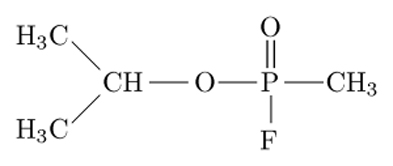
Sarin as a weapon
In mid-1939, the formula for the agent was passed to the chemical warfare section of the German Army Weapons Office, which ordered that it be brought into mass production for wartime use. A number of pilot plants were built, and a high-production facility was under construction (but was not finished) by the end of World War II. Estimates for total sarin production by Nazi Germany range from 500 kg to 10 tons. [citation needed] Though sarin, tabun and soman were incorporated into artillery shells, Germany ultimately decided not to use nerve agents against Allied targets.
U.S. Honest John missile warhead cutaway, showing M134 Sarin bomblets (c. 1960)
1950s (early): NATO adopted sarin as a standard chemical weapon, and both the U.S.S.R and the United States produced sarin for military purposes.
1953: 20-year-old Ronald Maddison, a Royal Air Force engineer from Consett, County Durham, died in human testing of sarin at the Porton Down chemical warfare testing facility in Wiltshire. Maddison had been told that he was participating in a test to "cure the common cold." Ten days after his death an inquest was held in secret which returned a verdict of "misadventure". In 2004 the inquest was reopened and, after a 64-day inquest hearing, the jury ruled that Maddison had been unlawfully killed by the "application of a nerve agent in a non-therapeutic experiment."[14]
1956: Regular production of sarin ceased in the United States, though existing stocks of bulk sarin were re-distilled until 1970.
1960s (developing): The US unsuccessfully sought Australian permission to test Sarin and VX gas on 200 "mainly Australian" troops, probably in the Iron Range rainforest near Lockhart River, Queensland. While this never actually took place, the planning was in advanced stages.[15]
1978: Michael Townley in a sworn declaration indicated that sarin was produced by the secret police of Chile's Pinochet regime DINA, by Eugenio Berr?os, it indicated that it was used to assassinate the state archives custodian Renato Le?n Zenteno and the Army Corporal Manuel Leyton.[16]
1980?1988: Iraq used sarin against Iran during the 1980?88 war. During the 1990?91 Gulf War, Iraq still had large stockpiles available which were found as coalition forces advanced north.[citation needed]
1988: Over the span of two days in March, the ethnic Kurd city of Halabja in northern Iraq (population 70,000) was bombarded with chemical and cluster bombs, which included sarin, in the Halabja poison gas attack. An estimated 5,000 people died.
1991: UN Resolution 687 established the term "weapon of mass destruction" and called for the immediate destruction of chemical weapons in Iraq, and eventual destruction of all chemical weapons globally.[17]
1993: The United Nations Chemical Weapons Convention was signed by 162 member countries, banning the production and stockpiling of many chemical weapons, including sarin. It went into effect on 29 April 1997, and called for the complete destruction of all specified stockpiles of chemical weapons by April 2007.[18]
1994: The Japanese religious sect Aum Shinrikyo released an impure form of sarin in Matsumoto, Nagano. (see Matsumoto incident)
1995: Aum Shinrikyo sect released an impure form of sarin in the Tokyo Subway. Thirteen people died. (see Sarin gas attack on the Tokyo subway)
1998: In the US, Time Magazine and CNN ran news stories alleging that in 1970 U.S. Air Force A-1E Skyraiders engaged in a covert operation called Operation Tailwind, in which they deliberately dropped sarin-containing weapons on U.S. troops who had defected in Laos. CNN and Time Magazine later retracted the stories and fired the producers responsible.[19]
2004: On May 14 Iraqi insurgency fighters in Iraq detonated a 155 mm shell containing several litres of binary precursors for sarin. The shell was designed to mix the chemicals as it spins during flight. The detonated shell released only a small amount of sarin gas, either because the explosion failed to mix the binary agents properly or because the chemicals inside the shell had degraded significantly with age. Two United States soldiers were treated after displaying the early symptoms of exposure to sarin.[20]