The cheapest way to do VoIP is still analog

Summary: What happens when you want to just want a bunch of phones in your business, hotel, or organization and you don't need a bunch of fancy and complicated features on the phone? It's simple, just get a bunch of cheap analog phones.
What happens when you want to just want a bunch of phones in your business, hotel, or organization and you don't need a bunch of fancy and complicated features on the phone? It's simple, just get a bunch of cheap analog phones. But how do you build a phone system to support a bunch of analog phones? It's simple, just get a PBX (Private Branch Exchange) with a few FXS interfaces to plug in the phones. Just to rehash what an FXO and FXS phone port is and what the differences are, here's a text representation how these devices are connected:
- Phone (FXO) - (FXS) Channel bank (FXO) - (FXS) Telco
- Phone (FXO) - (FXS) Telco
But this is where the tricky part comes in since your typical IP PBX which is essentially a computer doesn't have any FXS interfaces so that's where channel banks come in. A channel bank traditionally converts a T1 PRI interface in to 24 separate channels for 24 phone lines. The problem with traditional channel bank is not that they're all that expensive, but the fact that they require a T1 PRI interface on the PBX for every 24 phone lines which are very expensive and cumbersome.
To get around this problem of having to use expensive T1 cards that are tied to a single server, Xorcom shuns T1 cards and uses good old USB 2.0 for its interface to the PC. Pictured below are some Astribank products with FXO or FXS ports along with the option for PRI ports. You just plug in your TBX to one of the Astribanks via one of the abundant USB 2.0 ports and you're done. Simply plug it in to a USB 2.0 switch and two cheap open-source PBX appliances and you can instantly flip between the two servers in case one of them goes down for whatever reason. Any problems with one PBX server and you simply need to flip the USB switch and the other PBX is instantly lit up with all of its FXO and FXS ports. Trying to swap a PCI card with a T1 interface is far more difficult.
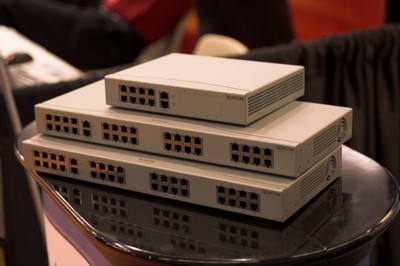
Pictured above is the front view of three Xorcom Astribank models ranging from 8 to 32 ports with any mixture of FXO and FXS ports. Pictured below is the back of the units showing the power and USB port in the back. The larger models also have 50 pin breakout ports so you can use your existing breakout box if you chose to do it that way.
The next two photos show all-in-one appliances designed to run Asterisk or Asterisk distributions from popular vendors like Trixbox or some other Asterisk derivative.
Kick off your day with ZDNet's daily email newsletter. It's the freshest tech news and opinion, served hot. Get it.
Talkback
Very interesting!
Thanks George for a good topic!
Not unless you need 8 analog phone ports :)
Just a minor nit - otherwise, great job!
"A channel bank traditionally converts a T1 PRI interface in to 24 separate channels for 24 phone lines. The problem with traditional channel bank is not that they???re all that expensive, but the fact that they require a T1 PRI interface on the PBX for every 24 phone lines which are very expensive and cumbersome."
A T1 PRI can only support 23 voice channels, not 24. A standard non-ISDN T1 can, though. Consequence of common-channel signaling versus the old channel-associated signaling.
And if you went to the trouble to define what PBX stands for, some readers without Newton's Telecom Dictionary may be scratching their heads over FXS (foreign exchange station) and FXO (foreign exchange office). :)
But seriously, Xorcom's products here show the sheer utility of the "Universal" Serial Bus - a dozen years ago, who would have had the foresight to predict what interface it would supplant, and what mini-industries it would spawn? All from some "lowly" PC interface!
TLAs
I think I can live with terms like "JAVA", "AJAX", and "Wi-Fi", but less common TLAs (three letter acronyms) ought to be defined when first referenced unless you're only writing to those who already know what you're writing about.
Good points
Wiring
In many cases the cost of wiring is equal to the cost of a good IP phone. Plus, with an IP phone moves are so much easier.
Per port cost
Need to setup a small call center on the other side of the building? All you need is a single network connection as opposed to a dozen or two wiring pairs for analog.
Small works for IP.
You should have heard me laughing at the Cisco rep who tried selling me a $300,000 VoIP system for my 120 phone headquarters office.
We went with a Mitel IP conversion that allowed us to keep all of our analog phones and still have IP connectivity to our new VoIP branch offices. $23,000 for the Headquarters setup and $10,000 per branch.
Every situation has its own cost/benefit
It all comes down to what pieces you are adding or changing -- trunks, pbx, phones. In your case it looks like VOIP made sense for connecting your remote locations. For us, it made sense internally and between our two local locations.
Cisco, Nortel, Avaya, they're all expensive
Not a fair comparison
In fact Cisco 2941G's that work great with Asterisk/FreePBX are only $200.00. Many inexpensive, managed PoE switches are on the market.
If somebody at Cisco is selling you a 6000 series switch for desktop ports then you need a new reseller.
And $120k for is crazy. Just had a customer with 450 phones, 100 seats of advanced call manager and IP Unity go out the door configured for $250k.
Our favorite sell though is Cisco phones on Asterisk/FreePBX, an extreme bargain.
Wiring could be CAT-5 or 2-pair for the analog phone
That's a separate case
So, when setting up a call center the scenario changes significantly and other solutions exist for that purpose.
So, these devices provide with an elegant solution to a classical problem.
My solution
Ya tht is cheap
Major Issues with VoIP deployments
Also, 911 services need to be routed/programmed correctly... in an implementation between branch buildings within Seattle, a non-profit failed to take these things into account... and had to install at least 1 analog phone line per building to support emergency communication needs...
That's not all.
Power concerns are legit, but manageable.
That spread some of the project cost out over 2 budget years and has given us over 4 hours of run time for our IP phones, LAN switch, router, AD file server and Mitel box. This was proven in our second largest branch when they at least had usable phones for a 4 ? hour power outage.
As a backup in case of a PoE switch failure we have a standard 48-port Cisco switch we removed from an office while upgrading to the PoE switches. To provide power for the IP phones we have inline power adapters that go on the phones LAN cables. It was far cheaper than buying another PoE switch to sit on a shelf.
We are not worried about not having a spare PoE switch. If a severe spike frying the PoE switch preceded an extended power outage it likely fired other equipment and the office will be closed until everything is repaired.
It's easier to power dumb analog phones
Re:It's easier to power dumb analog phones.