Tech Broiler

Jason Perlow and Scott Raymond

Exaflop computing: Moore's Law isn't dead, It's Moved to Warp Speed

By | December 2, 2010, 1:40pm PST

Summary: Silicon Nanophotonics will usher in a completely new age of computing and power applications that we’ve only seen on Star Trek.

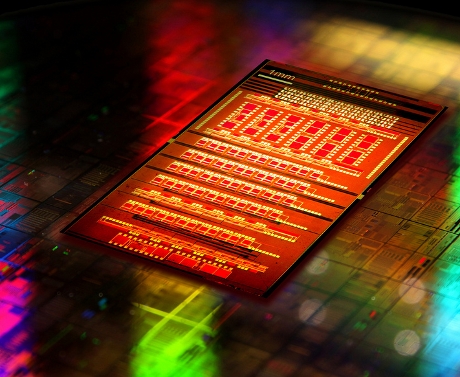
Silicon Nanophotonics will usher in a completely new age of computing and power applications that we’ve only seen on Star Trek (image: IBM)

The universe has a funny way of playing karma tricks on us writers that follow the tech industry and dare to make sweeping prognostications about future trends.

For example, yesterday, my ZDNet Storage Bits blogging colleague Robin Harris wrote that the industry may have hit the wall in terms of increasing computing performance.

Then on the same day my employer, IBM, pulled the rug out from under him. Sorry Robin. It happens to the best of us. Seriously, I feel for you man.

The funny thing about Moore’s Law is that every single time the industry calls for its inevitable demise, the Gods of Technology come and knock you on your ass. When we think we’ve pushed lithography and compacting transistors to their absolute limit, an advance in technology allows the trend to continue as it always has been.

This time, however, instead of just proving itself consistently correct, Moore’s Law is going to have to be completely re-written — instead of microprocessor technology doubling its performance every two years, we’ll be looking forward to ten to twenty fold increases in computational power, at a bare minimum, every five years.

This increase in performance is so significant that the math itself is mind-boggling and it becomes difficult to actually relate to it in conventional terms, or even express it in a quantifiable fashion that makes sense to information technology practitioners outside of very high-end scientific research.

Today, advances in microprocessors are built on the premise of cramming as many transistors onto a piece of silicon as possible. Over the last four decades, we’ve continued to advance processing power by using different lithography techniques that allow semiconductors to be manufactured in densities of continually decreasing nanometers in width.

Robin may indeed be correct that we may have hit the wall with this approach and advances using conventional microprocessor design may only result in very small incremental improvements. Eleven nanometers may be the practical limit as to how small we can go before we hit the physical limits of what can be done using current semiconductor technology.

However, what IBM showed to the public on December 1, 2010 changes the game dramatically, especially for supercomputing applications. Eventually, these advances will filter down to the enterprise systems and even consumers.

Artist’s conception of the future application of photonic routing elements onto a silicon wafer (IBM)

This technology — with a name pulled seemingly right out of Star Trek is called CMOS Integrated Silicon Nanophotonics.

Without getting too intergalactic and too technical of a description of how it actually works, it is essentially the fusion of optical technology with semiconductor technology. Instead of using semiconductor pathways to route data and for the processor interconnects, light pulses are being used instead, using components called Silicon Nanoscale Photonic and Electronic Transceivers, or SNIPERS.

Next Page: The Age of Exaflops

Topics

Jason Perlow, Sr. Technology Editor at ZDNet, is a technologist with over two decades of experience integrating large heterogeneous multi-vendor computing environments in Fortune 500 companies.

Disclosure

Jason Perlow

My Full-Time Employer is IBM. I write as a freelancer for ZDNet.

Disclaimer: The postings and opinions on this blog are my own and don't necessarily represent IBM's positions, strategies or opinions.

I own no investments or direct financial instruments in the companies I write about.

Biography

Jason Perlow

Jason Perlow, Sr. Technology Editor at ZDNet is a technologist with over two decades of experience with integrating large heterogeneous multi-vendor computing environments in Fortune 500 companies. A long-time computer enthusiast starting the age of 13 with his first Apple ][ personal computer, he began his freelance writing career starting at ZD Sm@rt Reseller in 1996 and has since authored numerous guest columns for ZDNet Enterprise and Ziff-Davis Internet. Jason was previously Senior Technology Editor for Linux Magazine, where he wrote about Open Source issues from 1999 to 2008.

In his spare time, Jason is an avid amateur chef and food writer, where his work reviewing New Jersey restaurants has appeared in The New York Times. He is also the founder of the popular food web site eGullet and blogs about restaurants and cooking at OffTheBroiler.com.

53
Comments

Join the conversation!

Just In

RE: Exaflop computing: Moore's Law isn't dead, It's Moved to Warp Speed
johnny48 18th Oct
@johnny48 Thanks for sharing. i really appreciate it that you shared with us such a informative post..
Custom Dissertation
Custom Thesis
Very cool stuff.

I look forward to seeing an exaflop sitting on my desk! grin
@SlithyTove I look forward to understanding what Jason wrote. Maybe he should write two columns for two levels of technical comprehension.
@barak88 Thank you for this very useful information.
Custom Essay
GCSE Coursework
Custom Assignment
@johnny48 Thanks for sharing. i really appreciate it that you shared with us such a informative post..
Custom Dissertation
Custom Thesis
Well written article.
@adornoe If there's something wrong with the sentence structure I'm certainly open to suggestions. In the meantime, you can complain to my Editor-in-Chief about my lack of proper grammar in my posts, maybe we'll hire a copy editor happy
0 Votes
+ -
jperlow: Here'a an example:
adornoe@... Updated - 3rd Dec 2010
Better sentence construction could have made the following a bit clearer from the outset (I had to re-read it before I understood what you were trying to say):

Well, with Exaflop/s, you can do the sort of things that take current supercomputers weeks or years to do in only minutes or days.

The better sentence could have been as below:

Well, with Exaflop/s, you can do, in only minutes or days, the sort of things that take current supercomputers weeks or years to do.

There are also a few instances where punctuation is lacking, such as when a "So", or an "And", should be followed by a comma, especially at the beginning of a sentence.
Another example is using the word "instead" twice in the same sentence. You had:

"Instead of using semiconductor pathways to route data and for the processor interconnects, light pulses are being used instead, using components"

The second instead is extraneous and should be dropped.
At least that is what they said in the '80s.

Time will tell how this interconnect tech works out but predicting an order of magnitude improvement every 5 years is a bit optimistic IMO.
@Bruizer
Doubling every twp years is the same as an order of magnitude every three and a half years (roughly) anyway...
@jperlow

Yeah, I loved that. Doubling every two years is so much worse that an order of magnitude every 5. I was wondering if you buy 6 eggs because its more than half a dozen, too.

BTW, everyone confuses cause and effect with Moore's "Law". Processor performance doubled every 2 years because Intel drove their projects to do that, not the other way around.
@Bookmark71 I'm sure with virtualization you'll still be able to run Office 2003 in 2030.
@jperlow Yes, & it probably won't work in 2030 either. I look forward to understanding what you wrote. Try writing two columns for two levels of technical comprehension.
@Bookmark71 Careful, don't bite your tongue.
0 Votes
+ -
OS2 first , then maybe XP
Telexer 3rd Dec 2010
@Bookmark71
C'mon, consider the source. wink
Will that run in Windows XP? It'd be great to know if it will.

http://myinternettvsoftware.com/
@seangreyhanson Easily but Vista is a other matter.
0 Votes
+ -
Hm... "...instead of microprocessor technology doubling its performance every two years, we?ll be looking forward to ten fold increases in computational power, at a bare minimum, every five years."

so... How exactly is that so different than what Moore's Law would predict? Doubling performance every 18 months would get me over 8x in 5 years. Seems like a lot of hype for what is probably only a period of being on the optimistic side of Moore's Law. Which beats hitting the wall by a long shot, but photonics is probably just another advance like we have seen in the past.
-b
@bob@
Photonics isn't exactly like what we have seen in the past. Considering that we are just now building the first components to create analogs for silicon systems in fiberoptics I would say we have never been here before. What is currently being done with light is completely ridiculous. We are on the edge of figuring out the mechanics of transistors and logic gates for light. This is something that was UNTHINKABLE 15 years ago. Star Trek writers all postulated that was a technology that would come along around 150-300 years from now.
Factually, this is...flawed.

You say:

"It would permit our various government intelligence agencies, such as the National Security Agency and well as the National Reconnaissance Office to break the largest cyphers that exist today and in the future..."

Sorry, Jason, that's just not true. The number of computations required to break a symmetric key cryptosystem grows exponentially in the length of the key. As a result AES with a 256-bit key is immune to brute force attack, even in a world with computers 10^6 or 10^9...or 10^30...times as fast as modern hardware.
0 Votes
+ -
Contributr
@probabilist If 256-bit key encryption is that good, then explain why the National Institute of Standards has for years been calling for organizations to switch to 2048-bit keys next month.

EDIT: I've removed this reference from the copy from the time being. Thanks for the explanation, I guess personal gene sequencing is a lot easier than breaking symmettric key encryption.
@jperlow -- because the call for 2048-bit keys applies to RSA (an asymmetric, public-key system), and AES is a symmetric shared-key system. RSA keys are "weaker-per-bit" than AES is.

ETA -- sorry, this was too snarky. With a better attitude...RSA keys have inner structure which arises from the way they're put together (from the product of a pair of large primes). Since there are relatively fewer primes than there are numbers in any given interval, this means that there's "less information" in an RSA key pair than the length would indicate.
0 Votes
+ -
Photonics scientist
Photonics phd 3rd Dec 2010
Hi, i am a silicon photonics scientist and feel the need to weigh in here. This new technology is only an interconnect and not a logic technology. I.e it cannot do what the transistor does. Infact it can be shown that electronic transistor is always smaller than a photonic transistor ( this isn't opinion but scientific fact dictated by wavelength of light) . I think its at best immature to say this lEads to exa flop computing. This was the basis of my thesis research and I can give you reams of published work to prove this point. Yes, interconnect are important but are not the only problem to be handled for exascale computing. Even if the wildest dreams of silicon nano photonics come true it will not be the key enabling technology for exa computing. What is shown so far doesn't stand scientific scrutiny to the level needed to say if it affects moored law at all.
Sorry for the typos above , still getting used to typing on ipad
0 Votes
+ -
This is why ...
davidr69 3rd Dec 2010
@Photonics phd This is why we should be getting news from scientists and not reporters. Not only are reporters biased, they can be misinformed.
0 Votes
+ -
Perlow is a blogger, not a journalist.
Snooki_smoosh_smoosh 3rd Dec 2010
@davidr69. A true journalist only reports the facts without opinion, which is why Fox News isn't news, it is an over-glorified televised blog, featuring the incoherent tweets of Sarah Palin, and why CNN is probably the closest thing to journalism one can find in the states.
@Photonicsphd I would not expect photonics to be the only enabling technology that brings us to exascale. However, I am only going by the projected target speeds by 2020 that IBM is reporting in their presentation which they made this week in Japan at SEMICON.

http://www.research.ibm.com/photonics/publications/SEMICON_Tokyo_12_1_2010.pdf
@jperlow I have seen the above ppt and with other colleagues served as, reviewers for similar work. We are closely involved in this area and study and often times provide scientific peer review for contemporary optics groups.

Here are the facts : The roadmaps are set by the ITRS (http://www.itrs.net/Links/2009ITRS/2009Chapters_2009Tables/2009_Interconnect.pdf) which is a well researched consortium of first hand experts. $100B-$300B is invested worldwide in response to the document from ITRS every 2 years. And the ITRS projection for 2020 makes very guarded comments about the optical interconnects let alone silicon based. I think, as far as scientific argument goes I do not think I need to make more comments.

I believe, great science journalism can provide educating commentry. But, knowing the details of this area, I had to point out the factual errors in the projections I have seen on Internet. I think,
0 Votes
+ -
@jperlow
1. One more thing: http://www.itrs.net/Links/2009ITRS/2009Chapters_2009Tables/2009_Interconnect.pdf

There is more, if you see page 50 of the above pdf, you can see why Intel's approach (disclaimer: I am not with Intel !) is accurate. Packaging the off chip lasers is much more expensive.

You may also want to check with someone with Finisar or JDSU for the cost of coupling a laser to a chip. 30-50% of the cost of optics today is off chip laser coupling.

2. I must point out the work from Luxtera (again I am not affliated to any industry), who implemented this technology in 2005. They have products that you can use today. The performance is by far the best for any group in the world.
@jperlow Well, I am aware of this work and have reviewed similar works before. The roadmap is set by ITRS which is a consortium of experts in the area. In agiven year, almost $100B investment is done in repsone to ITRS.

http://www.itrs.net/Links/2009ITRS/2009Chapters_2009Tables/2009_Interconnect.pdf .

This is the interconnect road map for next many years & is followed very closely. As you can see silicon photonics is not mentioned here. and infact it says, coupling light is costly. This is the reason why Intel and Luxtera are doing direct laser integration.

I am afraid, you may have taken the above .ppt out of context. Infact, Infinera or Luxtera could have claimed this performance 5 years back. Becareful when making projections happy
0 Votes
+ -
@jperlow @jperlow Well, I am aware of this work and have reviewed similar works before. The roadmap is set by ITRS which is a consortium of experts in the area. In agiven year, almost $100B investment is done in repsone to ITRS.

http://www.itrs.net/Links/2009ITRS/2009Chapters_2009Tables/2009_Interconnect.pdf .

This is the interconnect road map for next many years & is followed very closely. As you can see silicon photonics is not mentioned here. and infact it says, coupling light is costly (page 50). This is the reason why Intel and Luxtera are doing direct laser integration.

I am afraid, you may have taken the above .ppt out of context. Infact, Infinera or Luxtera could have claimed this performance 5 years back. Becareful when making projections
0 Votes
+ -
Moore's law isn't about performance.
ImRaptor 3rd Dec 2010
"This time, however, instead of just proving itself consistently correct, Moore?s Law is going to have to be completely re-written ? instead of microprocessor technology doubling its performance every two years..."

Moore's law is transistor count on an IC doubling every two years; not performance.
Transistor count doesn't scale the same rates as performance and the only time I see people declaring Moore's law as outdated they are incorrectly thinking in terms of performance.
I don't see how amazingly fast supercomputers will get better answers out of flawed weather models. The model problems are not the result of horsepower. The issue is still centered on our lack of understanding how the various components actually interrelate.
I just ordered mine from Tiger Direct ".... shipping soon."
Great article this is very exciting, and something to watch.
0 Votes
+ -
not quite...
josephmartins 3rd Dec 2010
Computing is only as good (performance, scalability, efficiency, etc) as its weakest link.

Setting aside the fact that this is a looooong way from commercialization, it's one tiny piece of a much larger collection of interdependent technologies.
0 Votes
+ -
I agree completely with "Photonics phd".

Just by using 10000000 times more speedy connection wire doesn't make a logic circuit fast...

According to Amdahl's law... : Now matter how fast you make some portion of ur system ... the speed up will be limited to the slowest running subsystems (here the transistors) .....


So just using a 1Tbps wire to connect a 3Ghz Ga-As transistor won't make any difference unless you are making the transistor to run at Thz speed.
@thandermax You can have multiple (hundreds or thousands of) CPUs on board, and the interconnect will synchronize their actions. How much processing time is spent just scheduling CPU time?
@William_P That is same as putting more transistor on a chip .. the traditional way of increasing performance... not a RADICAL change...
[more core == more transistor on a chip]


Lithography will cease to improve the IC manufacturing after it reaches 16nm pitch (currently at 32nm) .... After that ?
And next up should be computing based on Quantum Mechanics principals...we're just in the infancy of technology
"The funny thing about Moore?s Law is that every single time the industry calls for its inevitable demise, the Gods of Technology come and knock you on your ass."

For now, yeah. But we're not down to the atomic level yet, nor are we stacking 3D on a large scale yet. We still have a ways to go before we hit all of the barriers. The laws of physics are the laws of physics, however: Moore's law won't last forever. We can't keep up exponential growth forever.

And to be honest, it *did* seem to plateau for a bit there - after the Core 2s, it didn't really look that good. If we can get back into new techs and keep going for a while, great. But limits are limits, and I really don't see Moore's "law" as firm law. If we can do it for another 10-20 years with exotic tech, great, but even that will eventually start hitting limits as well.

The nature of technology is unpredictable - breakthroughs are truly great things when they happen - but they can't be counted on, as they are unpredictable. They're great when they happen, but I wouldn't stake long term plans on breakthroughs that may or may not happen.
"Beyond brute force computational applications, Exaflop and commodity Petaflop computing will almost certainly allow for the creation of intelligent robots and software agents"

I've heard that before. With pretty much every major jump in computational power we've seen.

Sorry, IMO the problem isn't the amount of power we have, The problem is that we really don't understand the nature of intelligence yet.
"It would allow for the real-time rendering of computer-generated imagery from today?s biggest and most expensive Hollywood blockbuster films (or even better) in virtual reality or virtual worlds for the average citizen. "

We're actually quite close to that with conventional silicon. Today's top GPUs are quite amazing in terms of how realistic they can get, if pushed to the limits.

The problem right now is hiring enough artists to make hyper-realistic stuff. It's expensive to hire the manpower to do that.

"These types of games and fully-immersive artificial realities would make the most advanced XBOX 360 or Playstation 3 first-person game look about as sophisticated as PONG."

PCs already do that - the consoles are very long overdue for the next upgrade.
0 Votes
+ -
Would you please not interject crude sexual terms such as "wet dreams" into your Tech Broiler blog? It detracts from the facts you are describing so effectively. There is nothing wrong with referring to a computer scientist's dreams; you don't need the adjective in front. It is not professional in either science or journalism. I understand you wish to write in an entertaining style, but inappropriate language breaks that too.
@john@... Try some male hormone pills, it might help you out.
@john@... I agree. I wanted to share this with my Intro to Computers class, but that (and the 4th paragraph "knock you on your ...") does not present a very professional article.
Didn't Moore's Law say processing power would double every 18 months, not every 2 years?

Join the conversation!

Formatting +
BB Codes - Note: HTML is not supported in forums
  • [b] Bold [/b]
  • [i] Italic [/i]
  • [u] Underline [/u]
  • [s] Strikethrough [/s]
  • [q] "Quote" [/q]
  • [ol][*] 1. Ordered List [/ol]
  • [ul][*] · Unordered List [/ul]
  • [pre] Preformat [/pre]
  • [quote] "Blockquote" [/quote]
ie8 fix

The best of ZDNet, delivered

ZDNet Newsletters

Get the best of ZDNet delivered straight to your inbox

Facebook Activity

White Papers, Webcasts, & Resources
ie8 fix