Tech Broiler
Jason PerlowLimelight Networks: Why the Olympics didn't 'Melt' the Internet

Summary
I admit it, even I was skeptical. When I received the first demonstration of the Silverlight plugin and the NBCOlympics.com web site back in March of this year at the 2008 Microsoft Technology Summit, where a group of Open Source experts gathered from around the world were asked for feedback on various aspects of Microsoft’s [...]
Topics
Blogger Info
Jason Perlow
Biography
Jason Perlow
In his spare time, Jason is an avid amateur chef and food writer, where his work reviewing New Jersey restaurants has appeared in The New York Times. He is also the founder of the popular food web site eGullet and blogs about restaurants and cooking at OffTheBroiler.com.
I admit it, even I was skeptical. When I received the first demonstration of the Silverlight plugin and the NBCOlympics.com web site back in March of this year at the 2008 Microsoft Technology Summit, where a group of Open Source experts gathered from around the world were asked for feedback on various aspects of Microsoft’s emerging technologies, I truly believed that when they finally rolled that website out, that NBC was going to be overwhelmed with traffic and the site would come to a screeching halt, resulting in a catastrophic embarrassment for Microsoft and NBC.
At the time, the content caching partner for the Olympics that was disclosed to us was Akamai, which is what Microsoft currently uses for hosting its own downloads from MSDN and Microsoft Update. Akamai uses a centralized data hosting infrastructure with big Internet pipes that mirrors content that is hosted on a customer’s own servers. Usually with the aid of a special caching appliance installed at the customer’s ISP or edge network, the request to download that content is re-directed to Akamai’s own servers and fat Internet pipes. When you download big ISO CD and DVD images from MSDN, its going right to Akamai’s data centers over the public Internet. As fat as Akamai’s pipes are, I’ve seen MSDN’s downloads slow to a crawl during peak download periods, such as the days following Windows XP SP3 and Windows Vista SP1’s release. So like my colleagues here at ZDNet, I was expecting the worst.
As it turns out, Akamai is actually used for some, but not all of the cached content used on NBCOlympics.com — it hosts the “static” content such as the .JPG files and HTML. However, for all the heavy lifting, such as the streaming video, it’s all going through infrastructure hosted by Limelight Networks.
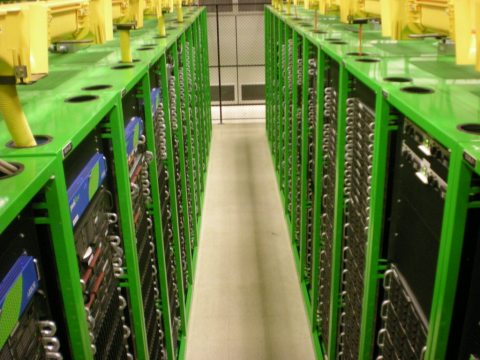
Above: Limelight Networks’ Operations Center in Tempe, AZ.
Click on the “Read the rest of this entry” link below for more.
Who are these Limelight guys, anyway? They are a Tempe, Arizona-based company which operates a global network of fiber-optic interconnected datacenters. Their backbone is capable of 2 Terabits (Tbps) per second of sustained data transfers and they globally replicate approximately 5 Petabytes of data on their storage network, which utilize a mix of proprietary vendor SAN replication technology such as EMC SRDF and Open Source-based technology developed by Limelight itself. Surprise! There’s some Linux back-ending all that Windows Media.
Back in late July of this year, NBC finally announced that Limelight would be the primary supplier of content caching services for the Olympics. Where Limelight differs from Akamai and why the Internet didn’t “melt” is quite simple — they are completely “off the cloud”. In other words, unlike Akamai and similar content caching providers, their system isn’t deployed over the public Internet.
Also See: Limelight Networks Operations Center Photo Gallery
Say what? Let me explain. When you download videos from NBCOlympics.com, your computer isn’t actually going to the Internet to get content. In fact, the content is usually no more than 2 router hops away from your ISP. Limelight has partnered with over 800 broadband Internet providers worldwide (such as Verizon, Comcast, Road Runner and Optimum Online/Cablevision) so that the content is either co-located in the same facility as your ISP’s main communications infrastructure, or it leases a dedicated Optical Carrier line so that it actually appears as part of your ISP’s internal network. In most cases, you’re never even leaving your Tier 1 provider to get the video. Slick, isn’t it?
So how does all that content get there? Live HD video feeds from the Olympics venues are delivered via optical link to NBC’s International Broadcast Centre in Beijing. The Hi-Def signal is then transcoded/downgraded to 480i video resolution using a special CISCO Scientific Atlanta video encoding appliance solution and sent over trans-continental Optical Carrier to NBC Studios in Los Angeles, and then to NBC’s broadcast center in 30 Rockefeller Plaza (”30 Rock”) in New York City where the encoding to Windows Media Format (WMF) takes place. Via short haul Optical Carrier connection, the Windows Media files are then distributed to Limelight Networks’ primary East Coast replicated data center in New York, and then on to the operations center in Tempe, which replicates all 3000+ hours of Olympics video to its global network of ISP co-located data centers and is queued for media streaming at the very edge your local ISP’s network (see network trace screen shot above). To the end user, this is all transparent, and it just plain works.
Localized content caching is going to be the wave of the future, especially when we start seeing lots of “On Demand” content being offered from next-generation media delivery services. If we truly expect stuff like 3G/4G/5G video to be delivered without any hiccups to next generation cell phones and other wireless devices, services like Limelight are going to become increasingly important.
The near-flawless operation of the live video streaming from NBCOlympics.com over the last week is proof that localized content caching technology works.
Will you be implementing localized content caching for your own rich media based sites? Talk Back and let me know.
Jason Perlow is a technologist with over two decades of experience integrating large heterogeneous multi-vendor computing environments in Fortune 500 companies.
Disclosure
Jason Perlow
My Full-Time Employer is IBM. I write as a freelancer for ZDNet.
Disclaimer: The postings and opinions on this blog are my own and don't necessarily represent IBM's positions, strategies or opinions.
I own no investments or direct financial instruments in the companies I write about.
Biography
Jason Perlow
In his spare time, Jason is an avid amateur chef and food writer, where his work reviewing New Jersey restaurants has appeared in The New York Times. He is also the founder of the popular food web site eGullet and blogs about restaurants and cooking at OffTheBroiler.com.
More from “Tech Broiler”
Related Discussions on TechRepublic
Did you know you can take part in these discussions with your ZDNet membership?Talkback Most Recent of 64 Talkback(s)
-
bjbrock08/17/2008 09:49 AM -
RE: Limelight Networks: Why the Olympics didn't 'Melt' the Internet
Cali Lewis mentioned her disappointment with the coverage for two reasons on her video podcasts. First, Silverlight does not work on Linux, which is a bummer for the more geeky members of the audience. Second, if any event is popular, meaning ratings and Ad revenue, it is not shown on the web, it is heald for prime time coverage.
I would like to know if any limelight customers were impacted by all this. I guess it would be hard to find that out...
Thanks
zdnetfanuno08/17/2008 02:08 PM -
All those bits flying around makes my head spin...
I want to subscribe to a video service that has a giant TiVo that will store at least a weeks worth of programing from all the broadcast and cable networks. Then I want them to dish out a program to me on-demand over the net. I could sacrifice quality for convenience. Local and foreign programing would be a nice touch. I think it's doable but all the content providers would have to sign up.
Mac Hosehead08/17/2008 02:43 PM -
ZDNet Blogger
Could be achieved in distributed form
What I want more than what you describe is the ability for me to stream a "missed" recording from someone else's DVR in the middle of the night to my DVR when it is idle. Or download anything that is on someone else's DVR via a peer to peer content sharing network.
I use DIRECTV's HD DVR service. They all are also capable of "On Demand" video download. But the On Demand content is very limited. In theory, every DVR from DIRECTV or Cablevison or whatever should be all indexed and connected to a central or distributed database, where any customer can find a "missed" or already recorded program on someone else's machine or groups of machines and download that program to their DVR. Not unlike the way Bittorrent works. The problem is not technical, but licensing and rebroadcast rights and all that stuff. NBC in Los Angeles probably doesnt want people in New York viewing pre-recorded primetime material because it has localized commercials and stuff. And some programs such as sporting events are only be licensed to air for a very limited time, they will need expiration windows for the material if it is shareable. They'll also have to figure out how to have generic content feeds (like what you get in a network downlink at a local affiliate before you broadcast) that are cached and how to inject localized advertisements on the fly. Doable, but not that easy to figure out from a legal point of view.
jperlow(Edited: 08/17/2008 03:30 PM) -
We agree about content providers...
But in my fantasy world you would not necessarily need a DVR (you could pay extra for a download) and you could get a stream anywhere with net access.
Mac Hosehead08/17/2008 03:51 PM -
ZDNet Blogger
My fantasy is not different from your fantasy
However, I think what I am proposing is doable with current technology. What you are proposing is doable with technology that will be broadly available within 5 years -- it would need fiber optics to the household. Not unlike what I describe in my Linux in 2016 piece where everything runs on the cloud.
jperlow08/17/2008 04:01 PM -
it's coming
Don't worry. I'm sure in the next year or so you will be able to do that. Just not for free.
Al_nyc08/19/2008 08:18 AM -
georgeou08/17/2008 04:36 PM -
This busts the myth that the Internet works at the same speed for everyone
This busts the myth that the Internet works at the same speed for everyone. The idea that a small mom & pop shop should be able to deliver video just as fast as a major website is simply a nonstarter. Server capacity and caching capacity must be purchased as with anything of value. This is still a ???level playing field??? because the bandwidth and caching capability is available to anyone at the same price for anyone who could pay for it. A level playing field does not mean every content provider ends up with the same speed as some people would suggest and it???s never been that way.
Peer-to-peer is a partial exception because it allows anyone to distribute out-of-order data which can't be viewed or heard until after the entire file is finished. That works great for file distribution or video downloads where people don't care about immediate gratification, but it would never work for high quality in-order on demand content.
There are P2P streaming technologies like TVU but that's limited to the upstream capacity of the typical broadband network and the video streams are very low bit-rate and very low quality. Out-of-order high quality content or in-order low quality content is fine when it???s free (including mostly pirated content), but no commercial content has chosen this free method of distribution. The Olympics were paid for by those Lenovo commercials.
georgeou08/17/2008 05:00 PM -
So - This Somehow Proves You Were Right Opposing Net Neutrality HOW?
You're as bad as John McCain, George Ou - you're getting pummelled, but you insist that means you're "winning" for Big Telco, somehow....
drprodny(Edited: 08/18/2008 08:40 PM) -
Do you define neutrality in outcome or neutrality in treatment?
The deep philosophical debate over Net Neutrality is the meaning of the word ?Neutrality?. Everyone can agree that Neutrality means fairness and equality, but how do we define fairness and equality? Is it about fairness between packets or fairness between people using the network? Is it about ensuring equality in the outcome or ensuring equality in opportunity? Is every website and every consumer entitled to equal performance over the Internet regardless of what they pay, or are they simply entitled to equal opportunity to pay for the same kind of performance? Should one megabit broadband service cost the same as ten megabit broadband service or should everyone be able to buy ten megabit broadband service at the same price?
Some Net Neutrality advocates argue for an equal outcome in the service that each user or company gets on the Internet. Others like Tim Berners-Lee who is the father of the World Wide Web strongly advocates of Net Neutrality and argues for equal opportunity to pay for the kind of service he desires.
?We pay for connection to the Net as though it were a cloud which magically delivers our packets. We may pay for a higher or a lower quality of service. We may pay for a service which has the characteristics of being good for video, or quality audio. But we each pay to connect to the Net, but no one can pay for exclusive access to me.?1
?Net Neutrality is NOT asking for the internet for free. Net Neutrality is NOT saying that one shouldn?t pay more money for high quality of service. We always have, and we always will.?2
1. http://dig.csail.mit.edu/breadcrumbs/node/132
2. http://dig.csail.mit.edu/breadcrumbs/node/144
I completely agree with Tim Berners-Lee and his definition of Neutrality and equality being applied to the opportunity to purchase service and not equality in the outcome. However, his position is actually in opposition to many Net Neutrality advocates and many Net Neutrality bills that would ban the sale of QoS and ban exclusive QoS to those who pay.
If you fundamentally support this type of legislation, then your definition of Neutrality is equality in service regardless of payment or ownership. If that's the case, then you could just as easily argue that LimeLight must equally share its infrastructure to all customers whether they pay a little or a lot.
Are you prepared to defend this ridiculous notion of equality in outcome instead of the equality in opportunity?
George Ou
georgeou08/20/2008 04:49 PM -
Well, not quite
progressive-download (i.e., watch as you stream) P2P TV is on its way... the P2P-Next project (p2p-next.org) project's Swarm Player, currently in development but available for public trials, is proof that realtime, distributed on-demand video is doable.
EZTV, a very large collective of people (and large bittorrent tracker) has just started experimenting with the swarm player and 'tstream' files - backwardly-compatible torrent files which also contain the Swarm Player information required to coordinate the pieces into a progressive download... In short, you can (with a little time to let the show start buffering) actually watch files as they stream over bittorrent. I gave it a go with a couple of TV episodes (Daily Show and Colbert Report) and it worked almost flawlessly.
TVAnts is another example of much smaller-scale bittorrent-based realtime TV streaming, but the P2P-Next's Swarm Player, and the underlying developments and upgrades to the bittorrent technology, finally prove that on-demand, realtime P2P IPTV is actually feasible. In high quality. Available to almost everybody. Of course, the more people who watch and seed after they're done, the more others can enjoy the same content... Share-alike embodied.
The technology is nearly there - given 18-24 months, I'd say it'll still be patiently waiting for the telecommunications industry to catch up! Raw bandwidth to consumers' homes is what we need now, and fewer limits on bandwidth consumption. The ISPs are going to have to rework their business models because this is a real double-edged sword for them, but it's only a good thing for the consumer in the long run.
ChristopherWoods08/20/2008 07:43 PM -
Great article !! A bit worrying though
I've always wonder how limelight network competed against Akamai. Nice.
No wonder Akamai tries so bad to burry that company in law courts with patent violations claims (and apparently is wining most of time).
Most people don't realize how critical those type of companies are for the internet to survive... What worries me a little is that "completely out of the cloud" mixed with "internet provider parternship" solution doesn't sound really like the Internet spirit. What happens to people that don't have an internet provider which partenered with limelight ? Are they still able to see that video ?
Obiwan42108/18/2008 02:09 AM -
Video restricted to viewers within the US
Here is what everybody see when trying to view a video:
"We're sorry, NBC is required to restrict this video to viewers within the United States"
Maybe that explain why they didn't 'melt' the Internet?
lukas408/18/2008 06:47 AM -
NBC restricted to viewers in the US!
NBC is the ONLY provider of olympic content in the US as part of the agreement with the IOC. If you are outside the US then NBC is not for you, annother network paid/agreed with the IOC to deliver the Olympics to you.
johngtimms08/18/2008 09:06 AM
Talkback - Tell Us What You Think
Get it the way you want it
ZDNet Newsletters
Get the best of ZDNet delivered straight to your inbox
Blog Roll
- All About Microsoft
- The Apple Core
- Between the Lines
- BriefingsDirect
- Collaboration 2.0
- Dev Connection
- A Developer's View
- Digital Cameras & Camcorders
- Ed Bott's Microsoft Report
- Emerging Tech
- Enterprise Web 2.0
- Five Nines: The Next Gen Datacenter
- Forrester Research
- Googling Google
- GreenTech Pastures
- Hardware 2.0
- Home Theater
- iGeneration
- India IT
- Irregular Enterprise
- IT Project Failures
- Laptops & Desktops
- Lawgarithms
- Linux and Open Source
- Managing L'unix
- The Mobile Gadgeteer
- On Sustainability
- The Semantic Web
- Service Oriented
- Smartphones and Cell Phones
- Social Business
- Social CRM: The Conversation
- Software & Services Safari
- Software as Services
- Storage Bits
- Team Think
- Tech Broiler
- Tom Foremski: IMHO
- The ToyBox
- Virtually Speaking
- The Web Life
- ZDNet Education
- ZDNet Government
- ZDNet Healthcare
- Zero Day
Blog Archive
White Papers, Webcasts, & Resources
- Ten Things You Should Know about Windows 7There's a lot to Windows 7 - as one might expect, in a 17GB operating ... (Global Knowledge) Download Now
- 77 Features for Windows 7 that Every IT Professional Should Know AboutWindows 7 builds on Windows Vista's positives and eliminates many of the ... (Global Knowledge) Download Now
- The 10 Most Dangerous Risks to Microsoft SecuritySecurity is an important part of any IT infrastructure, but as technology ... (Global Knowledge) Download Now


