The Android Alternative: Amazon's Kindle Tablet

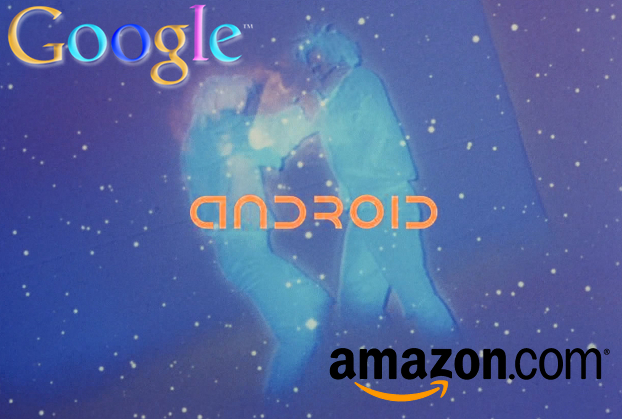
On Wednesday, September 28, 2011, after over a year of speculation and punditry, the Amazon Kindle Tablet will finally make its appearance.
Also Read:
- Kindroid: Two great tastes that would taste great together (October 2008)
- Kindle's Secret Sibling: Amazon's Android Tablet(November 2010)
- Amazon: Is An Android Fork Inevitable? Meet Kindlebread(May 2011)
What do we know about this thing? Well, for starters, it will be cheap -- likely around $249.00 and bundled with incentives and special services. It will be more portable than an iPad, with a 7" screen. It will likely have less built-in storage than an iPad and probably forgo a built-in camera.
[UPDATE: Amazon has priced the device at $199.00]
And according to TechCrunch's MG Siegler, who professes to have actually seen the device in question, the tablet is called the "Kindle Fire."
Other than an extremely competitive price, the main takeaway is that it will run some form of the Android operating system, as well as homegrown Amazon apps and services and the Amazon Appstore for Android.
In other words, an alternate universe to Google's Android Market. Matter versus Antimatter.
I'm sure every 40-something and over geek reading this remembers the classic Star Trek episode,"The Alternative Factor." That would be #27, from the Original Series. You know, the only incarnation anyone really gives a crap about.
If you haven't seen it, here's the episode in a nutshell: The Enterprise crew encounters an erratically-behaving, seemingly insane humanoid alien named Lazarus who claims to have been travelling through time and space to seek out a terrible monster who destroyed his home planet centuries ago, and he's determined to exact revenge on it.
It's eventually revealed that this "Monster" is really a perfectly sane twin of Lazarus from an antimatter dimension, and in order to save our own universe from destruction (should the two meet, it would cause total annihilation of both universes, converting the both into a massive blast of pure energy) the two are shoved into a "dimensional corridor" (a wormhole) that separates their two dimensions.
The episode concludes in which the entrances to both universes are cut off, and Lazarus and his antimatter twin end up doing battle for eternity trapped in the "dimensional corridor".
Of course, today we know a bit more about antimatter and cosmology than we did in March of 1967, when this episode first aired. Antimatter may very well exist floating around in our own universe, and may be key to understanding how it all began.
Still, the epic never-ending battle between Lazarus and anti-Lazarus in classic Star Trek is an appropriate comparison to what Amazon and Google are about to engage in with their respective Android OSes and developer ecosystems.
Unless, of course, one manages to completely annihilate the other.
The idea of parallel Android universes isn't new, and Amazon almost certainly won't be the only one.
For example, there have been specialized app stores such as MiKandiwhich address the adult content community.
Additionally, sometime in October, Research In Motion (RIM) plans to release an update for its QNX tablet operating system on its BlackBerry PlayBook that will allow it using a special "Player" environment to run Android 2.3.x (Gingerbread) applications and will allow developers to submit re-packaged versions of their applications to their BlackBerry App World.
Also Read:
- Will the Adult Industry Drive Android Adoption?(November 2009)
- Can RIM's PlayBook Sustain an Android Parallel Universe?(February 2011)
However, Amazon is the only alternative entity so far that has pre-seeded its own Appstore with tens of thousands of Android applications, essentially doing a "dress rehearsal" on other people's devices via a side-load.
I will admit that Amazon has done a really good job with the Appstore, and I like it even better than Google's own Android Market, not to mention that it runs a lot more stable than Android Market on Honeycomb 3.x tablets.
I also like the fact that they give away a free commercial application every day.
Up until now, however, the Amazon Appstore has been simply an optional add-on to Android smartphones and tablets. There hasn't been tremendous developer incentive as of yet to devote a lot of energy to it.
With the Kindle Tablet, however, that is all going to change. Like Apple's iPad and the App Store, Amazon's Appstore for Android is curated, in the sense that there is some element of vendor selection and quality control.
And naturally, Amazon is only going to allow apps to install on their tablet that have genuine compatibility with their device. Which means that it is highly unlikely that they will permit any kind of side-loading, which includes Google's own Android Market.
So while the Android OS that runs on this beast is definitely a unique "Fork" or a derivative of some sort (I originally expected that this was probably based on 2.3.x Gingerbread, but according to recent reports it could very well be some heavily mutated version of Froyo 2.2 or even Eclair 2.1) developers will have a single targeted device profile with the Kindle Tablet, much like iOS developers do with the iPad.
[UPDATE: It has been confirmed to me by Amazon's Vice President of the Kindle group that the software is in fact, Android 2.3 "Gingerbread", the latest version]
For software developers, this would be a very welcome change to dealing with the highly fractionalized Android ecosystem which exists today, which has many different versions running in the wild.
And if this initial Kindle Tablet takes off, it's entirely possible we'll also see a 10" version or even Amazon smartphones. An alternative universe, indeed.
If the sub-$250 tablet sells in the millions -- which given Amazon's track record with its e-reader devices, is not at all out of the question -- then this "Alternative Universe" definitely merits large amounts of developer attention.
Because of the company's tremendous online retail reach, it could very well mean that Amazon -- not Google's OEM partners like Motorola and Samsung -- could emerge as the #1 volume manufacturer of Android tablets.
On Wednesday, we'll know all the details about this device. The long-standing questions will be answered. However, the battle for Android tablet developer and consumer hearts and minds will only have just begun.
Will the Kindle Tablet start a war between Amazon and Google over who gets the most developer and consumer attention for Android? Talk Back and Let Me Know.