ie8 fix
madison

'Cultures of participation' and IT success

By | September 23, 2009, 7:02am PDT

Summary: New Enterprise 2.0 technologies, such as wikis and wisdom of crowds tools, remind us of the essential link between culture and collaboration in creating successful projects.

Many important business ideas and trends, including Enterprise 2.0 and Social CRM, are rooted in social networking technologies that help individuals come together spontaneously to form collaborative, ad hoc affinity groups.

These new technologies, such as wikis and wisdom of crowds tools, remind us of the essential link between culture and collaboration in creating successful projects.

Given the significance of collaborative groups, I read with interest one particular slide in an SAP-sponsored academic research paper on peer support in enterprise software. This slide portrays the historical relative impact of various technologies on collaboration and information sharing:
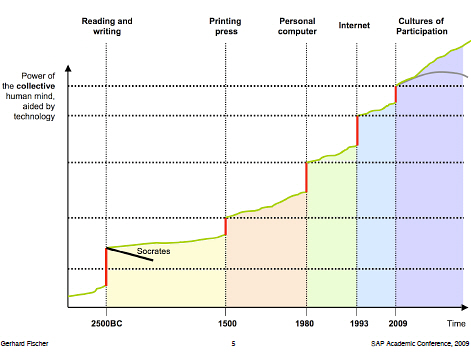
Projects succeed or fail based on collaboration. Therefore, improving an organization’s project success rate requires attention to cultural dimensions. For example, many companies find that communication between business and technical groups is challenging. This communication gap leads to information silos that directly impede project success.

I asked HR technology and service delivery expert, Naomi Bloom, to comment:

Ensuring that project team members have the right capabilities, are well-organized to succeed in their communications and collaboration, have the right incentives and behavioral enablers in place to support communication and collaboration as organizational imperatives, are given relevant development opportunities –  and the list goes on — is the work of effective human resource management (HRM) applied to the needs of project-based work.

Communication and collaboration are essentially human behaviors, which can be hired for, managed, learned, incented, obstructed, evaluated and rewarded, encouraged or discouraged by an organization’s HRM policies and practices. Thus, at the heart of successful project cultures is effective HRM. The two are inextricably intertwined.

When analyzing IT projects, I often use a framework that links culture to IT and business activities. Although the items shown in this diagram are non-technical, they are the true drivers of IT success or failure.

My take. “Culture of participation,” as the paper terms it, is a bedrock concept describing the most basic business activity: people working together to achieve specific goals. From a narrow project failures perspective, it’s high time we recognize that technology solutions alone do not increase success rates. The real answer lies in collaboration, communication, and cross-boundary participation.

Kick off your day with ZDNet's daily e-mail newsletter. It's the freshest tech news and opinion, served hot. Get it.

Topics

Michael Krigsman is a recognized authority on the causes and prevention of IT failures.

Disclosure

Michael Krigsman

Michael Krigsman writes and speaks about technology in a manner that most observers consider to be fair and balanced. Michael believes that writing about IT failures, which often have complex causes, creates a unique obligation to be reasonable and accurate in both reporting and analysis.

Michael maintains active personal and professional relationships with enterprise technology buyers, vendors, analyst firms (or individual analysts), consultants, and system integrators. As CEO of Asuret, Michael sells and delivers paid services to members of these same groups.

Vendors regularly reimburse Michael's out-of-pocket travel expenses to attend industry conferences and events. Conference organizers frequently waive entry fees when Michael attends industry events. Michael often speaks at industry conferences and events.

He is a member of the Enterprise Irregulars, a loose association of consultants, investors, industry representatives, analysts, and users of enterprise software.

For daily updates on Michael's activities, follow him on Twitter.

Biography

Michael Krigsman

Michael Krigsman is CEO of Asuret, Inc., a consulting company dedicated to reducing technology implementation failures. Asuret's suite of software tools improve the success rate of enterprise software deployments by quantifying and measuring governance issues that cause most project failures. Michael led the research effort underlying Asuret's model of collective intelligence and its practical application to reducing IT failures in consulting environments. He is a recognized authority on the causes and prevention of IT failures and is frequently quoted in the press on IT project and related CIO issues. He is considered an enterprise software industry "influencer" and provides advice to technology buyers, vendors, and services firms.

Previously, Michael served as CEO of Cambridge Publications, which develops tools and processes for software implementations and related business practice automation projects. Michael has been involved with hundreds of software development projects, for companies ranging from small startups to Fortune 500 organizations. Michael graduated with an M.B.A. from Boston University and a B.A. from Bard College. He is a Board member of the America's Cup Hall of Fame and the Herreshoff Marine Museum in Bristol, RI.

3
Comments

Join the conversation!

Just In

RE: 'Cultures of participation' and IT success
elizab 25th Sep 2009
Collaboration doesn?t mean putting out lots of information for people to consume e.g. writing, publishing, PCs, Internet, and "collaboration tools" or having the means to so. To me, it means having the interest and willingness to work in a cooperative, respectful way, where everybody shares part of the burden.

Today, so many people think that collaboration is making their burden yours and expecting you to carry it for them.
0 Votes
+ -
I couldn't agree more that the aspects outlined in the graphic depicting IT project success are immensely critical. With almost 20 years of IT project participation in large and small IT shops, the projects that had those aspects were hands down more successful than the ones missing even one aspect.

Knowing that every IT project you might participate on doesn't have strong representation of all aspects, I've posted a series of articles on techniques an IT manager might employ to survival weak projects for those interested: http://bit.ly/1HddJW
0 Votes
+ -
Human Factors are Often Overlooked
Steve Romero 24th Sep 2009
Thanks for another great post Michael. All too often the human factors are overlooked. We invest so much in the development and advancement of frameworks, methodologies, processes, systems and tools - and none of them are worth a hill of beans if we don't address the dimensions of human behavior that are key to any success in any endeavor.

Steve Romero, IT Governance Evangelist
http://community.ca.com/blogs/theitgovernanceevangelist/
0 Votes
+ -
Collaboration doesn?t mean putting out lots of information for people to consume e.g. writing, publishing, PCs, Internet, and "collaboration tools" or having the means to so. To me, it means having the interest and willingness to work in a cooperative, respectful way, where everybody shares part of the burden.

Today, so many people think that collaboration is making their burden yours and expecting you to carry it for them.

Join the conversation!

Formatting +
BB Codes - Note: HTML is not supported in forums
  • [b] Bold [/b]
  • [i] Italic [/i]
  • [u] Underline [/u]
  • [s] Strikethrough [/s]
  • [q] "Quote" [/q]
  • [ol][*] 1. Ordered List [/ol]
  • [ul][*] · Unordered List [/ul]
  • [pre] Preformat [/pre]
  • [quote] "Blockquote" [/quote]
ie8 fix
Click Here
ie8 fix

The best of ZDNet, delivered

ZDNet Newsletters

Get the best of ZDNet delivered straight to your inbox

Facebook Activity

White Papers, Webcasts, & Resources
ie8 fix
ie8 fix