Greetings, Hewlett-Packard, nice to meet you!

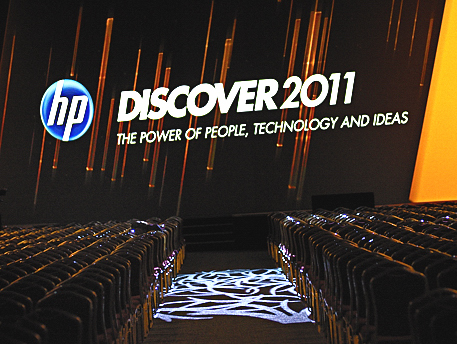
Last week, I attended Hewlett-Packard's user conference, called HP Discover 2011, in Las Vegas; it was an enormous event with 10,000 on-site attendees and 800 conference sessions. At the conference, I explored themes related to business transformation, cloud, and IT success.
This post highlights specific products, services, people, and issues that caught my attention. In the future, I will dive deeper into HP's work on these topics and more.
Size and scale. Company size must dominate any introduction to HP (NYSE:HPQ), which is the world's largest IT vendor. Consider these facts:
- Revenue: Approx $126 billion (Number 10 on Fortune 500 list.)
- Employees: 324,600
- Customers: Over 1 billion customers in 170 countries on six continents
Wikipedia describes the broad scope of HP's product and service lines:
Major product lines include personal computing devices, enterprise, and industry standard servers, related storage devices, networking products, software and a diverse range of printers, and other imaging products. HP markets its products to households, small- to medium-sized businesses and enterprises directly as well as via online distribution, consumer-electronics and office-supply retailers, software partners and major technology vendors.
During a breakfast meeting with HP's Chief Communications Officer, Bill Wohl, he noted that HP generates between two and three billion dollars in revenue every week. One can only imagine the challenge of unifying strategy, execution, and marketing messages in such a massive company with diverse product lines and customers.
Professional services innovation. As someone writing about IT success and failure, professional services is an important topic. I asked Corporate Analyst Relations Manager, Deborah Lyons, for information on HP innovation in this area, so she arranged a meeting with Kathy Garcia, Senior Vice President of Application Services for HP Enterprise.
Application Services helps customers modernize their software to improve efficiency, suitability to task, and so on. The group includes Applications Development Services, Applications Management Services, Applications Transformation & Modernization Services, and implementation services for Enterprise Applications (SAP, Microsoft, Oracle).
During our conversation, Kathy stressed the value of helping HP customers align IT execution with business goals and priorities. She explained that many organizations measure IT performance against technical service level agreements (SLAs) such as system uptime or transactions per second. While necessary from a technical perspective, IT-centric measures may not reflect line of business objectives, making this an important theme for HP consulting services.
Kathy's organization is creating "industrialized centers of excellence" to standardize consulting tools, processes, and technologies on a global basis. By creating knowledge repositories and building channels to share information among subject matter experts across all geographies, HP hopes to reduce information silos related to professional services. Although Kathy would not give a precise schedule for completing the centers of excellence approach, she called the rollout a "high priority."
Talking with half a dozen HP executives and service delivery professionals, it appears the company is undergoing an internal transformation to increase efficiency and improve its own ability to help customers define (and execute) technical objectives within the broader context of delivering on business goals. For an engineering-focused organization the size of HP, this culture shift requires consistent strategy, executive support, broad-based buy-in, and sustained internal communications.
Discovery workshops. Visitors to the show floor were greeted with modular "pods" showing key components of HP's primary business areas. Several of these pods described business-centric Discovery Workshop sessions, intended to introduce areas such as cloud, application transformation, and data center transformation. The concept is intriguing, so I examined workshop content, attended an abbreviated Cloud Discovery Workshop (PDF download), and spoke with leaders from the Application Performance Discovery Workshop.
The significance of these workshops lies in emphasizing transformation and process -- while the teaching framework discusses technology, the primary focus is illuminating the business and organizational impacts associated with adopting new technology. Given HP's history as an engineering-driven company, I was pleasantly surprised to see this strong focus on business impact rather than bits, bytes, and technology.
Cloud strategy. HP's approach to cloud includes software and hardware that supports private, public, and hybrid models. To jump on this topic, I spent thought-provoking time with HP executive, Joe Weinman, who writes about cloudonomics. During a public talk, Joe argued that:
Cloud economics-or cloudonomics-is often counter-intuitive. However, most firms can benefit from a hybrid delivery model, in terms of both cost and the ability to respond to sudden shifts in demand.
According to this logic, public cloud environments tend to make sense for small organizations, while larger companies often benefit from hybrid environments that combine public cloud with privately-owned computing resources; key variables are scale and variability of demand.
In a paper titled, Mathematical Proof of the Inevitability of Cloud Computing (PDF download), Joe elaborates this theme:
If there is a short enough period of peak demand, rather than use only dedicated resources it makes sense to slice at least that out of the total solution and use on-demand pay-per-use resources to serve it. On the other hand, if there is a long enough duration of non-zero demand, you may as well use dedicated resources to serve that baseline.
He summarizes the (somewhat obvious, once you think about it) point in a graph:
In another paper, called Time is Money: The Value of “On-Demand” (PDF download), Joe concludes:
The bottom line is that when we attempt to deploy resources to serve demand in a variety of scenarios, we can never do any better than on-demand, but we can often do worse. To recap the insights derived here:
1) For flat demand, on-demand provisioning offers no benefit.
2) If demand can be forecasted accurately further out than it takes time to provision, on-demand provisioning also is unnecessary.
3) If on-demand is not an option, and the cost of unserved demand is greater than the cost of resources, it is better to be ?safe than sorry? by building in excess capacity
However, when there is variability coupled with unpredictability, the following rules hold:
4) For linearly growing or declining demand, a reduction in time (monitoring cycle or resource provisioning) offers a proportional reduction in cost.
5) For exponential demand, the loss associated with even fixed interval provisioning grows exponentially, so on-demand provisioning is essential.
6) If the demand in each time interval is drawn from a random distribution, on demand is far superior to the expected loss from the best fixed capacity strategy.
7) If demand varies as in a Random Walk, time compression offers sub-linear benefits, for example, a two-fold reduction in cost requires a four-fold reduction in time.
Although Joe developed his position long before HP announced its current cloud strategy, the approaches are consistent.
For additional perspectives on HP's cloud strategy, see this conversation at Focus.com, where I asked, "What do you think of HP's massive push into private, public, and especially hybrid cloud?"
Competitive marketing. During his keynote, Executive Vice President of Servers Storage and Networking, Dave Donatelli, conducted a detailed competitive analysis of specific HP equipment against products from rival Cisco.
Unlike the negative emotional pandering one often sees in the enterprise software world, Donatelli's analysis was direct, clinical, and fact-based. He described HP products, explained the competitive Cisco offerings, and demonstrated specific feature and price advantages.
Take note, enterprise software vendors that sling mud rather than push facts -- there's a lesson here for you.
TouchPad and webOS. Buzz about the upcoming tablet hardware was everywhere and I saw cool demos; however, many blogs specialize in mobile devices, and you can learn more elsewhere.
=================
Photos by Michael Krigsman.
Thanks to Ethan Bauley, from HP Corporate Communications, for suggesting I spend time with Joe Weinman; and a big thank you to David Collins, from HP Public Relations, for arranging the meeting.
Jennifer Harbour, Becca Taylor, Michael Procopio, and Terri Stratton arranged meetings and generally did everything possible to make the conference productive and useful, so I owe them a debt of appreciation.
Disclosure: HP paid my out-of-pocket travel expenses associated with this event.