In just three years, Android has crushed the smartphone competition

Summary: In one-and-a-half product ownership cycles, Android has crushed the likes of Symbian and RIM almost out of existence, and even Apple's iOS platform is feeling the pressure.
It's hard to appreciate just how much the smartphone landscape has changed over the past few years, and it's easy to attribute most of that change to the work of Apple. But Google's open-source platform Android has done more to shape the ecosystem than iOS has, and in three years it has come from nowhere to crush the competition.
Horace Dedui, analyst at Asymco, posted an interesting chart to Twitter that shows just what a sweeping influence Android has had on the smartphone market in just one-and-a-half product ownership cycles.
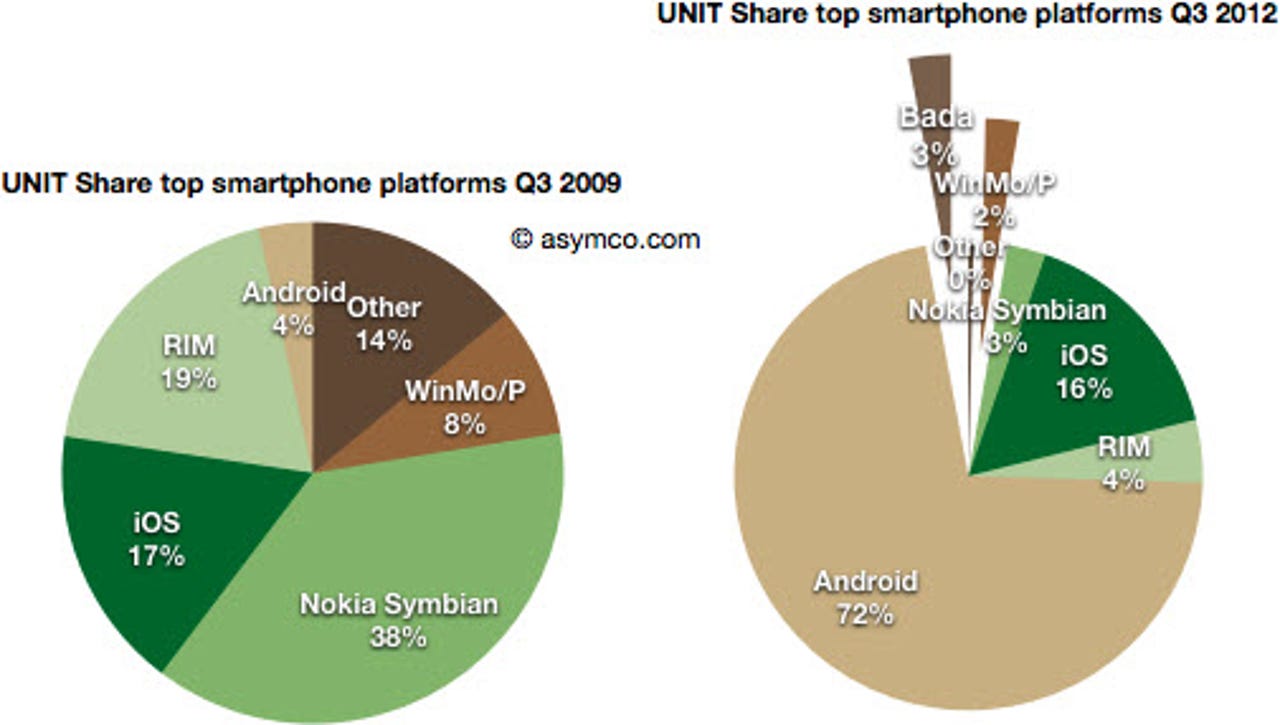
In that time, Google's platform has grown from having a four percent unit share of the market to having a commanding 72 percent unit share, crushing the likes of RIM, Windows Phone, and Nokia's Symbian platform.
The only platform that can stand up to the pressure is Apple's iOS, and even that has lost one percentage point over the period.
It is Android, and not iOS, that has effectively killed off the competition and turned the smartphone market into a two-horse race.
But this isn't to say that Android doesn't have some challenges to face. Google, along with its hardware partners, have been effective in getting handsets into the hands of users, but keeping those handsets updated with the latest versions of Android is turning out to be quite difficult. According to Google's own data, more than half of the Android devices out there are powered by Android 2.3 'Gingerbread,' a version that hasn't seen an update since September 2011.
Compare this to Apple, which managed to get more than 60 percent of iDevice users to upgrade to iOS 6 in under a month.
Image source: Asymco/Twitter.
Kick off your day with ZDNet's daily email newsletter. It's the freshest tech news and opinion, served hot. Get it.
Talkback
The hardware partners of Google..
Android crushed Microsoft
Apple is doing better than Microsoft, but heading to its old position of second fiddle, like it was during the Mac era.
As for Android updates, other stats show a large proportion of Android users are on 4.0 or above. Anyone who likes fast Android updates should stick to Google's own Nexus devices, which are always the first to get OS updates.
Early to say.
Android is self-crushing with its FOSS signature fragmentation
Lbiege..math is lost on you?
You state that "far more Android users switch to iOS / WP than the other way around". I think you forgot to include the link to the data you based this statement on.
If you look at the article, you'll notice that 72% of the users use Android, 16% IOS and 2% Windows.
Let's just say that there are 100 users in total. You'll notice that if 10% of each group moves, that 7 users will switch from Android and only 2 from IOS. OH MY GOD, Android users must hate their devices, 3 1/2 times more people switch from Android than from IOS!
If "far more" users are switching from Android could you also explain how it is growing faster than IOS and Windows; are you suggesting that new users to Smart Phones almost exclusively buy Android phones?
Furthermore, if this issue with Google having to strip services in China is causing such a problem, why is Android's market share in China growing so quickly and Apple's market share declining?
http://gs.statcounter.com/#mobile_os-CN-monthly-201112-201301
China Mobile (the countries and the worlds largest provider) doesn't even sell iPhones, only two smaller providers, China Netcom and China Unicom do.
If second fiddle is making 65-75% of all the profits...
Re: I am guessing Apple will be very happy with that.
Who will rescue them this time?
Never under-estimate the low end
Android has not really touched Microsoft's share in computing
Also, you make a mistake in assuming WP8/RT/Win8 will die as quickly as the Zune and Kin did--those items lacked the integration support between products that the new trio offers. While not perfect, WP8 offers much better integration even with Win7 than any predecessor.
Meanwhile, Apple will continue to lead in the high-end market, though I won't argue that Samsung's one-shot Galaxy S3 was able to pass the iPhone's sales for one quarter during a very traditional sales slump leading up to the newer iPhone.
As for Android updates, that "large proportion" is 25% of all Android units in the year since ICS was released--and most of that is due to newer devices sold with An 4.x already on board, not due to upgrading through OEMs or carriers.
Mobility is computing now
That means that Microsoft has gone in a few short years from being the OS on 90% of client devices sold in a quarter - an overwhelming monopoly - to 40%: a respectable share but not intimidating. That is all the difference in the world. Their monopoly is broken.
Verizon is the biggest reason, not even "the providers"
It's not the OEMs
Actually, Google has a poor update design implementation.
To be correct, Apple's iOS' share among smartphones grows, but, obviously,
So without turning to semi-annual update cycle, Apple will lag behind.
Also, with cease of iPhone 3Gs sales, Apple confirmed that they are not going to seriously compete with Android on wider scale in numbers. If Apple would keep iPhone 3Gs for at least unsubsidised markets -- but lowered its price from $375 to $275 -- then this would bring many more additional sales to Apple, and with that price margins would be still very high.
Yet Apple decided that they are not going to compete for lower than $400 price segment devices.
Right
In the high-end.
HTC has great build quality, and now a great display (though I still prefer SAMOLED for deeper blacks and colors), but that's about it. Their software has no innovation (not even gimmicky features), while Samsung is doing so much, specially with the Note 2.
Why the hate of plastic?
Metal vs Plastic
Have you ever seen how brittle plastic is at -40C?
Plastic has a high impact on the environment
The older "candybar" phones used thicker plastics to offer just that bit more strength, but when you're making a phone that weighs mere ounces, that thin plastic is so temperature sensitive and so shock sensitive that the body of the phone itself gives way before the internals--unlike a metal-bodied phone with a glass face that will continue to function even when dropped from 2,000 feet.