Is Microsoft changing its policy on System Builder licensing for Windows 8?

Summary: In a paragraph tacked into the end of last week's announcement of cheap Windows 8 upgrades, Microsoft appears to have made a significant change to its Windows licensing rules. What's really going on?
Microsoft's Windows licensing policies are confusing and chaotic. Even Windows experts and Microsoft employees routinely get confused on the do's and don'ts of all the different packages.
That's especially true with the Windows OEM System Builder packages. When Windows 7 shipped, Microsoft made it very clear that this particular package is not authorized for installation by end users. They even went so far as to scrub their OEM partner website of previous comments that had specifically exempted hobbyists.
You can read the full background in these two posts:
- OEM licensing confusion starts at Microsoft.com (September 8, 2008)
- Is it OK to use OEM Windows on your own PC? Don't ask Microsoft (November 15, 2009)
This isn't a trivial difference, financially. Legally, the only option you have today for a home-built PC or a virtual machine on a Mac or PC is the Windows 7 Professional full packaged product (FPP). The retail price of that package is around $250. The OEM System Builder package of Windows 7 Professional is $140, or nearly 45% less.
So I was especially intrigued to read the final paragraph of Brandon Leblanc’s blog post on the Windows Team Blog last week. The topic was the announcement that upgrades for Windows 8 Pro would be a flat $40 for anyone with an underlying license of Windows XP, Windows Vista, or Windows 7. But then he added this comment:
Oh, and by the way - if you’re not upgrading from a prior version of Windows and are building your own PC or installing Windows 8 in a virtual machine or a separate partition, you will be able to purchase and install the Windows 8 and Windows 8 Pro System Builder product.
If that's true, it represents a massive shift in Microsoft's Windows licensing policies, and it would require a major change to the OEM System Builder license agreement.
Specifically, that license agreement as it exists today contains three requirements that prohibit the use of OEM System Builder software by end users:
- The software must be installed on a “fully assembled computer system,” with a specific list of requirements (including a CPU, a motherboard, and a case).
- The software must be installed using the OEM Preinstallation Kit (OPK). Although the discs that are included in the OEM System Builder package can be used to install the software directly, the license specifically prohibits this.
- The computer system must be resold to an “unrelated third party.” If you're a consumer building for yourself, you don't meet the terms in Section 2, Authorized Distribution and Acceptance.
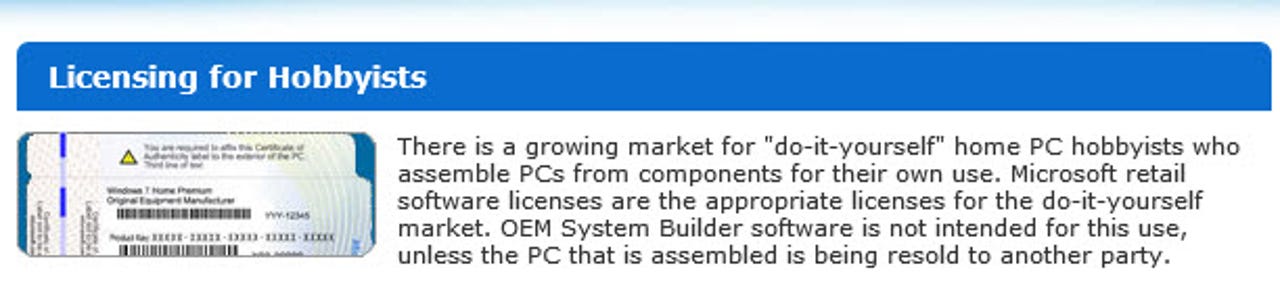
Microsoft has hammered home this message for at least four years. See this "Licensing for Hobbyists" page, for example:
![]()
It contains the following text:
There is a growing market for "do-it-yourself" home PC hobbyists who assemble PCs from components for their own use. Microsoft retail software licenses are the appropriate licenses for the do-it-yourself market. OEM System Builder software is not intended for this use, unless the PC that is assembled is being resold to another party.
And in a Q&A section at the end, it specifically addresses one scenario that a lot of small- and medium-sized businesses dream of. If you buy hundreds of PCs a year, why not set up your own System Builder shop in-house? Under the current license terms, you can't:
Q. I would like to build PCs for my company and use OEM System Builder software for the operating system. Can I do this?
OEM System Builder software must be preinstalled and then resold to another party. If you are using the PC within your organization, this "resale" requirement will not be met. In addition, as a system builder preinstalling OEM System Builder software onto new PCs, this requires that you grant the end user license terms to the third party acquiring the PCs from you. If you are distributing the PCs within your organization, you can’t grant the end user license terms to yourself.
The burning question is this: Does this post constitute an announcement of an upcoming change in System Builder license terms? At one point, Microsoft officially sanctioned this use of System Builder software. It's possible that this use will be written into the license agreement for Windows 8.
Normally, I'm skeptical about this sort of change in policy, because I've been burned too many times before. But this type of announcement, on the official Windows blog, is generally vetted carefully by lawyers. So I'm cautiously optimistic.
A Microsoft spokesperson declined to comment, noting that the language of license agreements is not yet final.
Kick off your day with ZDNet's daily email newsletter. It's the freshest tech news and opinion, served hot. Get it.
Talkback
Another burning question
Sorry if this is off topic for the current article.
Another question about the comments in that article is the one about using this 'upgrade' version of Windows 8 to perform an install on a system currently running the Windows 8 Release Preview.
Question:
@Brandon LeBlanc Let's try this again (for the fifth time): **ahem** HEY BRANDON HOW ABOUT THOSE OF US WHO ARE RUNNING WINDOWS 8 RELEASE PREVIEW?????? ARE WE ABLE TO UPGRADE OR DO WE HAVE TO REINSTALL WINDOWS 7 OR A PREVIOUS VERSION OF WINDOWS IN ORDER TO TAKE ADVANTAGE OF THIS UPGRADE PROMOTION???????? Sorry for raising my voice, but at this point it seems like you're deliberately avoiding my question...
Brandons response:
A previous version of Windows needs to be on your PC to upgrade. If you are on the Windows 8 Release Preview, you can upgrade via the Windows 8 Upgrade Assistant but will only have the options to migrate your personal files or keep nothing at all when upgrading. You will need to make sure you have an underlying license for either Windows XP, Windows Vista or Windows 7 as well.
He posted this response several times, but never explained what is meant by "an underlying license"?
This is also made even more confusing by the recent article that Mary Jo posted.
Microsoft confirms Windows 8 testers to get $40 upgrade price, too | ZDNet:
http://www.zdnet.com/microsoft-confirms-windows-8-testers-to-get-40-upgrade-price-too-7000000409/
J
nuanced response..
a) there is nothing that will impede your ability to upgrade from Win8 RP to the final bits
So .. can you do the upgrade ? .. yes. No worries ..
b) you will not be properly licensed should you do this without an underlying license (ie. sticker on your PC / laptop) or previous boxed copy of a previous OS. That is .. the $40 only buys you a license that is valid when combined with a previous OS license. To do so would be a little like buying a concession train ticket without being able to prove you're entitled to it .. yes you can get on the train .. but ..
Most people will only care about a).
It's deliberately confusing and chaotic
I can see why they do that.
Wouldn't assume you're safe without b though..
..unless Microsoft decides to change the way they do this upgrade, and automatically deactivates Windows 8 upon upgrading. They may just as easily require you to enter the "underlying" license key in order to activate your newly upgraded Windows 8 machine.
Then people will care about b) a lot more.
Wrong.
"People can move from the Windows 8 Release Preview to Windows 8 Pro using the Windows 8 Upgrade Assistant and will only have the options to migrate their personal files or keep nothing at all when upgrading"
http://windowsteamblog.com/windows/b/bloggingwindows/archive/2012/07/02/upgrade-to-windows-8-pro-for-39-99.aspx
Did the PC originally come with Windows?
If you built the PC yourself from scratch and did not install a full copy of Windows XP, Vista, or 7 on it, then it does not have an underlying license.
Clear?
Really?
Not good news...
If MS is chagning its policy on System Builder licensing for Windows 8, its disappointing....But as long as an OEM version is available to but in the open market, I won't care because how would MS verify that I built the machine and sold it to a third party?
Disappointing?
Old way ("legally") =
OEM copy - cannot be used by you, must be a machine sold to a third party. (Yeah, I know, nobody actually *cared* but the wording was there.)
Your machine - must buy the "full" (read: most expensive) version of the product.
New way -
OEM is officially OK for system builders, including those building at home for their own use. In other words, Microsoft - if the blog post is official policy - is officially "blessing" home builders to use the OEM copy when building their own machine.
Saying this with the caveat that it is in a blog, even if an official microsoft blog, and the lawyers and other assorted suits may say "What? No, we're not changing that!" by release.
OEM licensing for personal system builders was ridiculous anyway
And really, how often does a techie call Microsoft for support? The last time I called Microsoft was when I had a deskstar hard drive that failed 3 times in the same year and I had to reinstall and reactivate Windows and the license wouldn't let me. One of the drives failed 2 weeks after it arrived. The current replacement drive (Hitachi or Toshiba or whoever it was that bought IBM's Deskstar unit) still works and runs my web server.
The headline of that post is wrong
One more sign
And that's it. Microsoft finally gets it. It's not going to be Windows in the future, but it is going to be devices that run Windows. Thus the push for Surface, the streamlining of the versions (I think before long there will just be "Windows" with Pro being the one we all will get, and then an "Enterprise" version to keep corporate reps happy) and that's it. You will have cheap upgrades if you already have a prior version, have an affordable option if you are a hobbyist/builder/white box retailer (a dying breed anyway) and otherwise not care because it will just 'be there' on a new piece of hardware.
It is now apparent the money is rapidly shifting to the gadgets, the apps, and other revenue streams. These changes are just proof.
Or maybe they just have a broader picture now
Now they are selling a whole ecosystem, with an eye on not only generating app revenue, but also attracting customers to own a whole family of devices in the ecosystem: PC, tablet, and phone. The number of licenses per user therefore will increase, and the income stream from apps will further make up the shortfall. In the past, few people initially upgraded their OS because of increased hardware requirements. Microsoft (and their OEMs) needed to sell new PCs to make (or break) the success of the new OS; upgrades were just a bonus. Now, however, there is an imperative on upgrading existing machines. The OS won't require new hardware for most users, and the potential revenue from bringing them into the ecosystem exceeds the discount given on the upgrade.
They have not quite got it yet
Is Microsoft changing its policy on System Builder licensing for Windows 8?
It's crucial to get these details right
"This is a change for the better for everyone so I wouldn't question it too much."
I get paid to question this sort of stuff. Those who don't do so can wind up in court, on civil or criminal charges. Yes, it happens. So it's important for people like me to get the details right.
does the actual OEM System Builder License say that?
It only points the Builder to www.microsoft.com for details (section 1.A "Customer System").
"A Customer System must meet the system requirements of the software as posted on
http://www.microsoft.com and must be able to run the Software."
http://oem.microsoft.com/public/sblicense/2008_sb_licenses/fy08_sb_license_english.pdf
See Section 2
and accept this license. “System Builder” means an original equipment manufacturer, an assembler, a refurbisher, or a software pre-installer that sells the Customer System(s) to a third party."
It does not include the word "unrelated," but that's a reasonable interpretation from "third party."
So it is on the distributor, not the customer, according to that sentence..
reasonable interpretation
No Ed. That "unrelated" term appears on Microsoft's website, not in the license. It was added as at their whim. Actually, you've protested this very thing in past editorials. I'm surprised to see your different position today.
Regards