Microsoft has 'become the thing they despised'

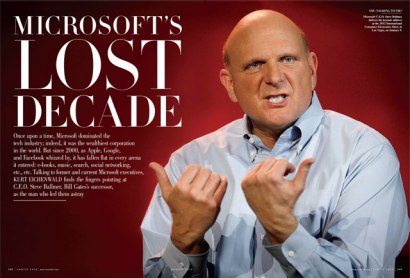
Summary: There's a new feature about Microsoft in Vanity Fair this month. It's called "Microsoft's Lost Decade." Uh oh.

microsoft-downfall-emails-steve-ballmer

"Astonishingly foolish management decisions."

"[It] could serve as a business-school case study on the pitfalls of success."

"They completely blew it because of the bureaucracy."

Rough words for the folks in Redmond this month as Vanity Fair rolls out a feature on Microsoft's "Lost Decade" -- that heady period when it coasted on its successes and destroyed...well, everything that could continue them.

Using dozens of interviews and internal corporate records, Kurt Eichenwald pieces together life at Microsoft during the reign of chief executive Steve Ballmer -- who's still on top, I'll remind you -- and it's not altogether warm and fuzzy.

Lowlights:

  • The crippling effect of the management system known as "stack ranking" -- in which every unit must rate a certain percentage of employees as top performers, good performers, average and poor.
  • Microsoft had a prototype e-book reader in the can in 1998, but Bill Gates vetoed it because "it wasn't right for Microsoft" -- that is, it didn't run Windows.
  • It folded R&D groups tasked with pursuing future-thinking ideas into business units where profit was king.
  • Ideas about mobile computing were shot down if they didn't play nice with Windows and Office strategy.
  • Microsoft saw, and still missed, the instant message revolution because it saw them as frivolous.

"They used to point their finger at IBM and laugh," former Softie Bill Hill told Eichenwald. "Now they’ve become the thing they despised."

Good reasons to visit the old newsstand, I think. Until then, read our own Mary Jo Foley's "The three phases of Steve Ballmer's tenure at Microsoft" as well as her thoughts on the executive in his eleventh (now twelfth) year.

Topic: Microsoft

Kick off your day with ZDNet's daily email newsletter. It's the freshest tech news and opinion, served hot. Get it.

Talkback

29 comments
Log in or register to join the discussion
  • My question is

    why doesn't he name names? It's always "a former this", or whatever.

    And for such a great idea, how come no one else put one out back in 1998. MS couldn't have been the only one to look into this.

    Not saying MS didn't screw some things up (I can point to any tech company to find something) but not understanding the angle of the article.

    They grew their desktop, Office, server sales every year. XBox, Sharepoint, and development tools.
    So because Apple struck gold with the iPod (Even Apple admitted they never saw those sales coming), anyone else who didn't see MP3 player growth somehow messed up?

    An interesting article, but I always take it with a grain of salt when the 'proof" is "accoring to the writer...
    William Farrel
    • The ting I really like about Apple is they take chances... They've had

      failures mind you Newton, Apple III, Lisa to name but a few but thy've also had successes and great ones at that. The thing is unlike most OEM's they can afford to take risks and to fail and learn from each failure to make something better the Newton can be said to be the fore father of the iPad for instance. When you sell at razor thin margins you don't have a lot to risk nor a great deal to research and develop with. Indeed you are a lot like many American today and living off of paycheck to paycheck and hoping nothing comes that rocks the boat. Problem is something always comes to rock the boat MS will survive and thrive in ove form or another after all look at the company MS use to point fingers at and laugh IBM they still exist and are doing quite well.

      Pagan jim
      James Quinn
      • A lost decade ... to government intervention

        They were running in an environment where government simply hated them being that successful. They had to deal with self-righteous politicians thinking forcing consumers to pay 40$ for a copy of Netscape over a free IE.somehow benefits, well, consumers. To be able to navigate through this load of BS and still remain profitable is a success story I'd say.
        LBiege
        • Too F'N funny...

          how some people try to rewrite history!!

          Defend the hive!! Defend the hive!!
          Arm A. Geddon
    • How Comes, What Ifs, And Besides

      Anonymous? Someone who thinks they have gotten or are getting a raw deal and are worried about retaliation. Does this make their assessments necessarily false? Well no. As the saying goes, just because one is paranoid doesn't mean they aren't out to get you. It is a biased perspective and the reader should take care.

      Let's assume that the best people in 1998 were working at the best place, Microsoft. Or, let's suppose that the PDA guys were thinking about it, but no one is asking for their story because the PDA companies were blown away by the cellphones.

      Thinking it was new and missed (I think Mary Jo Foley is the best reporter round here and I worry that this redesign and globalization makes it harder for her to get onto the front page), I checked out the linked post from January, 2011. Having re-read that and the comments, I have two points. First is I hope Ms Foley does a 12-1/2 year Ballmer review in a week or so (call it the Eighth-of-a-Century Assessment), and secondly, how the accomplishments you list above are exactly the same accomplishments listed by Ballmer's advocates back then. 18 months later, and nothing new to be added. Well some were proclaiming Windows 7 the best ever and those same people are these days doing a s/7/8.

      The 6.2 billion write-off. The way-in-advance Surface announcement, the way it's restructuring the OEM relationship, and the $85 WinRT license. $40 upgrades for a limited time. These are not the signs that everything is hunky-dory in 2012.

      Having only read a couple of summaries of the Vanity Fair report, I think Ms Foley is essentially correct; these items are not news to those who are fully engaged in thinking about Microsoft.

      In my glib, remote, up in the stands way, I think the problem is that Microsoft has always been fiercely protective of Windows as its dominant product. There were very good reasons and also costs for that fierceness. In the late 90s, it was undergoing the burden of the anti-trust trial, when Microsoft's desktop was not in any clear or present danger from java or Netscape. In the last decade, the protectionism meant they suppressed all attempts to disrupt Windows from within. The competitors routed around Windows and got very established in new markets with new customers and we see Microsoft coming from behind, trying to be novel and familiar at the same time, because Redmond sees that mobile could cause the desktop os market to stop growing and possibly decline. If that happens, and they aren't replacing those licenses with new mobile business, revenues will decline, the stock price will follow, and we've seen that movie before.
      DannyO_0x98
      • Huh, Edit Button is Gone

        And me with a comma I regret.
        DannyO_0x98
  • Microsoft: 'They've become the thing they despised'

    Mary J. Foley already debunked this article. Besides that no one would trust a tech article coming out of Vanity Fair anyway. Microsoft is doing just fine with what they are doing now.
    Loverock Davidson-
    • The source is important or the content?

      MS has failed massively the decade. The items in the article aren't obvious with the benefit of hindsight, many of he issues has been talked about extensively.

      MS saw everything through their abused Windows monopoly. As a result they wasted billions in R&D per annum not producing actual products for sale.

      Ballmer continues this trend, and why his tenure is limited if Win8 doesn't perform.
      Richard Flude
  • Nonsense

    It's nonsense to characterise as decade of "downfall" a period during which Microsoft: launched Windows XP, which is still the most popular OS of all time; launched Windows 7 which is the fastest-selling OS of all time; launched Xbox 360 which is the best-selling games console; launched Kinect, which holds the Guinness World Record for being the fastest-selling gadget of any kind of all time; released multiple iterations of Halo, which is one of the most popular and innovative video games franchises of all time; etc, etc.

    Microsoft's flagship product, Windows, was king a decade ago and still is today. Almost every computer on almost every desk in almost every home and business on the planet is running Windows, and among the tiny minority of other computers most still run Microsoft software.

    Apple failed to take a substantial chunk of the desktop OS market share. GMail consistently failed to beat the popularity of Microsoft's Hotmail and Messenger (recent claims by Google are spurious and unproven). SkyDrive is young but is arguably the best consumer cloud platform available and already very successful. SharePoint is still one of Microsoft's biggest earners. Furthermore, some of Microsoft's least successful products have been nonetheless brilliant, and some of Microsoft's best services are still like their best-kept secrets, e.g. SkyDrive.

    There have been some missed opportunities, but even in these areas there is a more complex story beneath the surface. E.g. Microsoft gets $5 USD for every Android device that's sold. E.g. Facebook is partly owned by Microsoft.
    Tim Acheson
    • I like MS but...

      Xbox 360 - Not the best selling console. Nintendo Wii has that title.

      Halo is revolutionary? In what sense of the term? It's a FPS like dozens of other FPS games out there. Nothing is revolutionary.

      Some of your other points are valid though. Just shouldn't mix in made up "facts" if you're trying to make a legit point.
      LiquidLearner
      • Nope XBox 360 is the best selling console

        Not Wii, Wii holds third rank, http://video-game-consoles-review.toptenreviews.com/
        Ram U
        • @Rama.NET

          I followed your link and it has nothing about sales!!

          Sales I got from the web are:

          Wii - Worldwide: 95.85 million (as of March 31, 2012)

          Xbox 360 - Worldwide: 67.2 million (as of April 19, 2012)

          Care to prove me wrong?
          Arm A. Geddon
          • XBox360 does well in North America

            1 PlayStation 2 (PS2) 153.68
            2 Nintendo DS (DS) 152.15
            3 Game Boy (GB) 118.69
            4 PlayStation (PS) 104.25
            5 Wii (Wii) 96.22
            6 Game Boy Advance (GBA) 81.51
            7 PlayStation Portable (PSP) 74.63
            8 Xbox 360 (X360) 67.05
            9 PlayStation 3 (PS3) 64.94

            source: vgchartz

            Despite being released a year earlier, with little technological innovation it isn't dominating (barely holding on). Embarrassingly it still hasn't returned the money spent on it.
            Richard Flude
    • Also MS-Office, Windows Phone and Bing are great products

      I haven't seen Linux or Oracle or Google deploy a successful office suite as Microsoft's which is used by most corporations, students and schools in America and Asia (Europe is an exception)

      Windows Phone was called by Apple's co founder Steve Wozniak as the most beautiful handset OS in 2012. I believe the popularity of this phone OS is still behind Apple and Google for bad marketing and bad reviews done by popular bloggers like Joshua Topolsky which said the Nokia Lumia 900 had a very bad designed OS which is insane.

      Bing has been increasing marketshare in search industry every year between 3 and 7% in US and despite not being very popular in Latin America or Asia, many Google users are switching to Bing because of privacy concerns, knowing that their Google search giant is now tracking users even if they don't log in to their gmail account which is scary if you ask me.
      Gabriel Hernandez
    • A decade ago MS was the dominant IT company

      Windows XP, Office worshiped in the enterprise. Even their comparatively poor server offering was making massive inroads because of their reputation.

      As IBM before it MS no longer has that presence, hence their downfall. Like IBM it isn't saying they don't have strong performing products. IBM missed it's opportunity to capitalise of the rise of the desktop, rewards went to MS.

      MS has missed the consumer IT rivers of gold in music, mobile and tablets. 'Beleaguered ' Apple flying past them in revenue and profits; a position unthinkable a decade ago; .

      MS revenue growth still tied to stagnant PC market growth, still recovering from the Vista disaster.

      Google in search, Facebook in social media, Apple in consumer electronics; all markets missed by MS.

      Yes MS has a relatively successful gaming console and controller, that hasn't yet recovered the money spent on it against a competitor (Sony) that is also in decline. Well done.
      Richard Flude
  • Defend the hive!! Defend the hive!!

    I see some of the Microsoft drones are out already today.
    Arm A. Geddon
    • Along with the Apple lemmings
      milo ducillo
  • This does bring one salient point to mind.....

    For personal use (home and consulting), if I had a good replacement for MSOffice I could dump Windows for Android. For my real job (large corporate enterprise), no MS is not a viable option. This gives MS significant leeway on fixing "misjudgements". That time though, is limited.
    rhonin
  • Again?

    Eichenwald, Microsoft is much bigger than your magazine and they know how to handle their business. I hate that article when it comes to promoting Apple. It just makes people feel like the only right way to do is following what Apple's doing. Perhaps Microsoft may follow this trend but I'm sure that would be another article saying "Microsoft Copies Apple Strategy." From this I can tell: no matter how fancy the article was, it's just all about bias point of view. I don't see what role Vanity Fair has to do with it but I concern about the danger of the media. There is only one person's perspective that make news headlines for a bunch of crap articles that filled mostly by quotes and paraphrasing.
    Quoc Cao
  • Keeping the brand alive

    The familiar notion here is that, because of Redmond's utter preoccupation with its self-appointed role as the holy defender of the Windows universe, it had built itself a legacy-bound institution so rigid in its bureaucratic order, it lacks the flexibility, imagination and daring to be a true technological leader.

    Yes, most of the cast members, counting Balmer, remain the same throughout this purported "lose decade" of the 2000s. Their fundamental mission -- preserving the Windows brand -- certainly will not change. What's different now, and what has always been changing even through the slow-and-dry years, is Windows itself.

    By year's end Microsoft will have fully revamped their flagship product, Windows 8, running with new reference hardware branded in their own name. By next year the Windows 8 kernel will be the same for PCs, tablets and phones, presenting all sorts of interesting possibilities for developers and consumers.

    Economists keep telling us that markets are brand-driven, that we will always buy one product as opposed to another if it bears a certain logo. Microsoft has committed billions of dollars and decades of labor behind its unwavering belief that people will always be want a better Windows product than the one they're using at home or at work right now. I, for one, find this conviction a good thing.
    Tech watcher