NASA Mars mission gets a helping hand from Europe, in pictures

Mars Express and MSL
On 6 August, NASA will land its Curiosity rover on Mars to study whether conditions on the red planet have ever been, or could be in the future, favourable to life.
The landing is part of its Mars Science Laboratory (MSL) mission.
During the rover's descent, the MSL spacecraft will slow its velocity using a parachute, and lower the rover in the final moments of descent using a tether.
MSL will enter the Martian atmosphere at almost at almost 21,000km per hour, and in seven minutes should decelerate to less than 3.6km per hour.
The European Space Agency (ESA) will track the mission's progress using the ESA Mars Express orbiter.
"We began optimising our orbit several months ago, so that Mars Express will have an orbit that... provides good visibility of MSL's planned trajectory," Michel Denis, Mars Express spacecraft operations manager, said in a statement.
This image shows an artist's impression of the Mars Express orbiter (left) and the MSL mission.
The Curiosity rover will be delivered by a 'skycrane'
The Curiosity rover will be delivered by a 'skycrane', as pictured in this artist's impression.
The entry, descent, and landing (EDL) phase of the MSL mission will begin when the spacecraft reaches the Martian atmosphere, about 81 miles (131km) above the surface of the Gale crater landing area.
The spacecraft will then steady its rate of descent with up to eight throttle-controllable rocket engines.
The rover is connected to the MSL spacecraft during the descent stage by three nylon tethers and by an 'umbilical' cable providing a power and communication connection. Once the rover has landed, the cable and tethers will be separated and the spacecraft flown off.
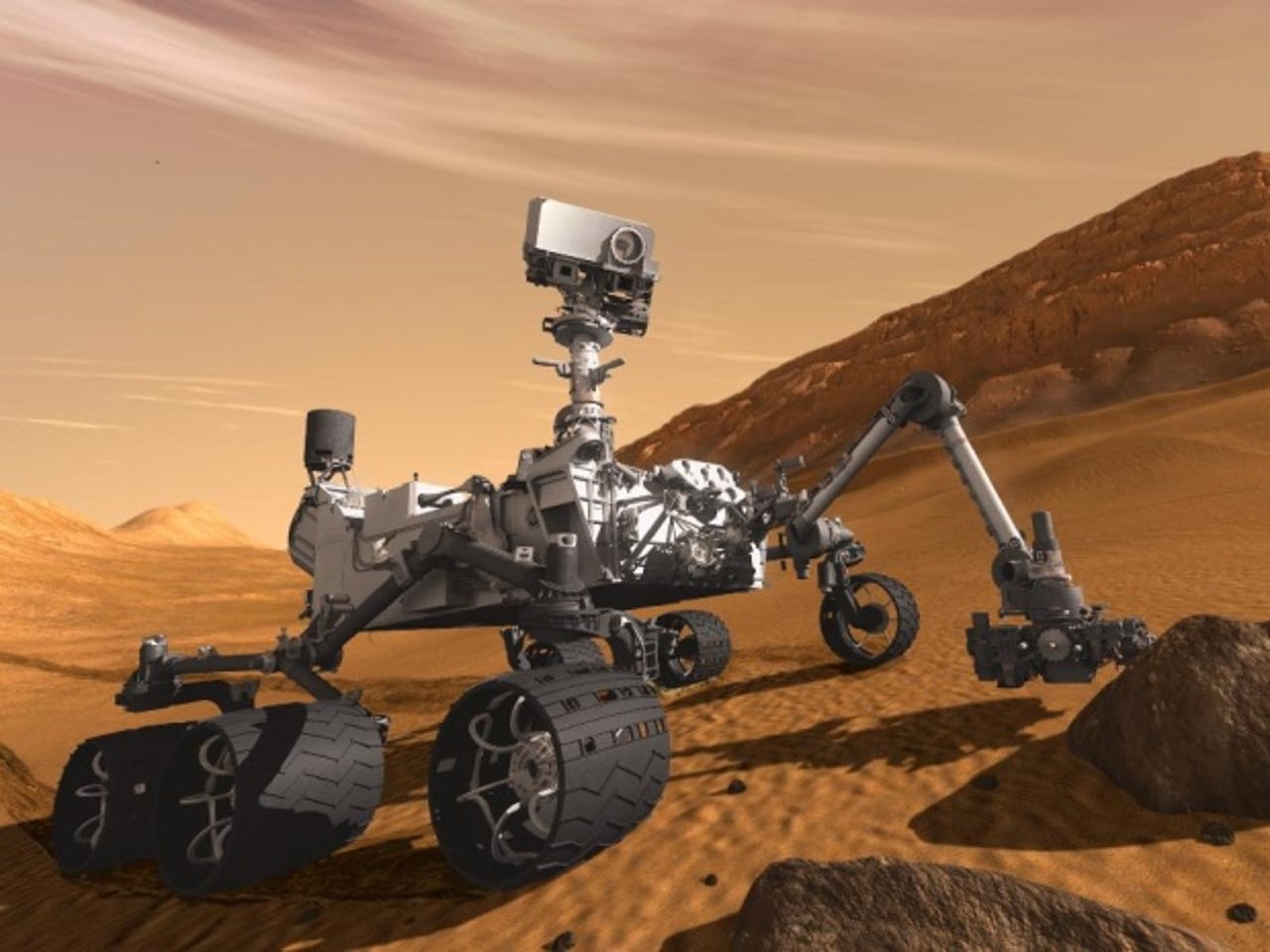
Curiosity rover
The Curiosity rover will carry laboratory instruments to analyse samples of rocks, soil and atmosphere. The 900kg machine is too heavy to make a gas-bag assisted landing, which is why it will be lowered by skycrane.
Geometry of tracking
This diagram shows the geometry of how Mars Express will track signals from the MSL during its descent.
The Mars Express orbiter
The Mars Express orbiter, pictured above, was launched on 2 June 2003 using a Russian Soyuz/Fregat launcher.
The mission spent six months cruising at a velocity of 10,800 kilometres an hour before ejecting the unsuccessful Beagle 2 lander six days before arriving in orbit around Mars.