Nexus 7 leaves Google with razor-thin profit margin

Google's first branded tablet was bound to rouse the interest of analysts across the globe, as well as appeal to consumers. Combine that with a bargain-rate price of $199 and curiosity becomes surprise.
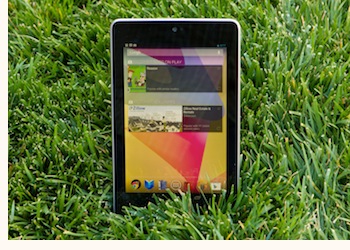
Can Google make a fair profit margin on the device, which was announced last week for preorder? Or is the price tag on the Internet giant's first tablet model, the Nexus 7, based on gaining a customer base rather than profit margin?
This is where hardware specialists come in. Research firm UBM TechInsights recently came up with a preliminary cost estimate of $184 per device, which covers components and assembly of the Google tablet.
If we compare this to an estimate of $153 for the identically priced Kindle Fire, the story becomes more intriguing. $199 for a tablet, which would make the company a measly $15 in profit; and the Kindle Fire, which makes $46 a head.
So why do it? It's possible that the Nexus 7 has been designed to either snatch away the consumers who are buying Kindle Fires or Barnes & Noble's Nook tablets, or lure enough of a market share that constructing additional revenue streams based on the use of the tablet becomes worthwhile.
Google is paying more for the hardware, which correlates reasonably with the list of features that are more advanced than either the Amazon or Barnes & Noble's devices. More expensive components, potentially a better customer experience, and you pave the way for stealing a decent share in the tablet market.
Combine this with a name like Google, and you may be betting on the winning horse.
So, how does Google's Nexus 7 compare to Amazon's Kindle Fire tablet? The higher resolution display of 1,280 x 800 in comparison to the Kindle Fire's 1,024 x 600 is a plus. However, increase the resolution, increase the price. UBM placed this figure at $49, in comparison to $35 for the rival tablet.
It also includes a front-facing 1.2 megapixel camera for video chat, through Skype or Google+, which the Kindle Fire lacks. Not great for snapshots, but still a step up on the identically priced Kindle, which has no such capabilities. The tablet will also include Bluetooth and GPS features; seemingly emphasizing near-field communications.
Once you begin bolting on advanced features, it stands to reason you would need a boost in power and processing. Google chose a quad-core Nvidia Tegra 3 chip that includes four central processor cores -- and an additional fifth for basic housekeeping chores. The dual processor used in the Kindle Fire stands at $18 -- Google's multichip set costing an additional $7 per tablet.
If the estimated cost of construction proves sound, then the Nexus 7 must be intended for use in other ways to claw back some of the potential lost profit margin Google has established for itself. What has the company chosen? According to reports, online advertising revenues will make up the shortfall. In comparison, Amazon relies on downloaded, purchased content -- and does well by it.
Both of these lower-end tablets will generate revenue through additional content and services, whether through advertising or downloadable content.
In comparison, Apple has the high-end tablet market in the bag -- through intense hardware development, UBM pegs Apple's estimated cost of production at $278, generating profit of $171 per device on a $499 iPad.
This post was first posted on CNET.