Open-source: so much more than just software and freebies

Summary: Open-source is so much more than just Linux and free software. Learn more about open-source and how it positions itself to better people, businesses, and much more.
Typically, when you see or hear the words "open-source," what's the first thing that comes to mind? For many, "open-source" is synonymous with "free software," but in reality, it's so much more than that: it's a movement; a chance to improve lives; a chance for success; a total lifestyle change. In this article, I hope to shed some light on what open-source really is -- and more importantly -- why everyone should care about it, or at least be aware of it.
To start, how would you like to raise $10 million to fund production of a project that was birthed out of work freely provided by people who seek only to fuel imagination? Figuratively speaking, your success -- whatever that might be for you -- is their success, too. Well, just a couple of months ago, this very thing happened via Kickstarter to a small team of individuals seeking to create a watch that interfaces with iPhones. They sought $100,000 in funding for production, but instead, ended up raising a whopping $10,000,000:
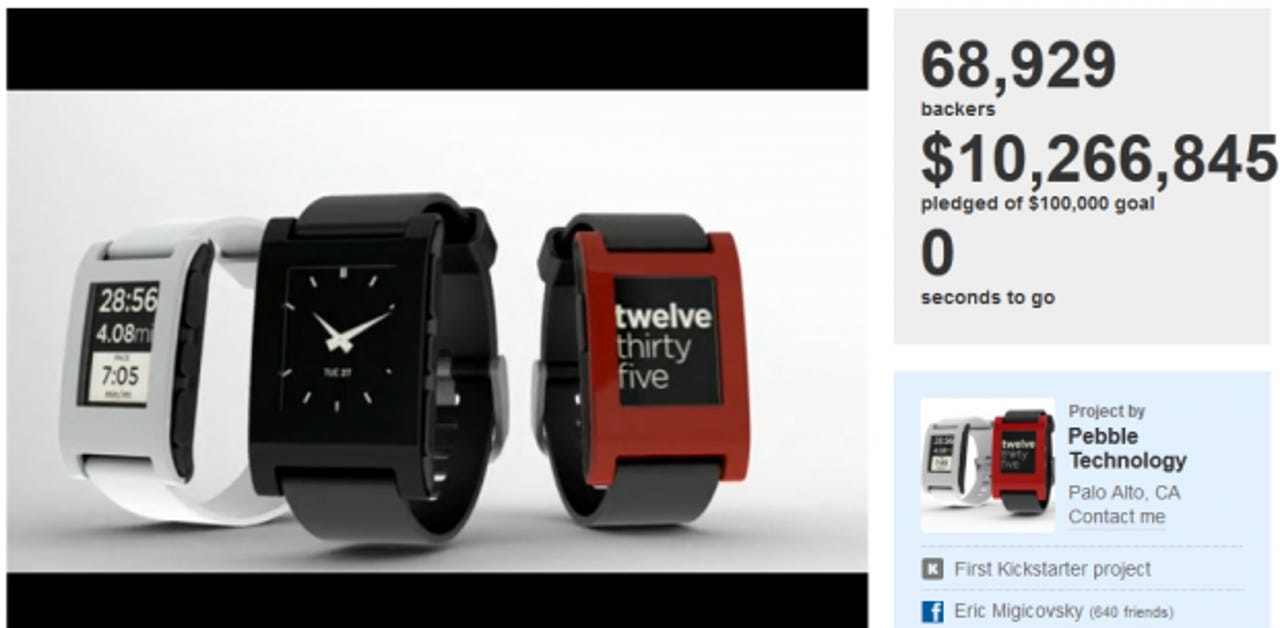
Not a bad return on something based on freely-available technology, huh?
Massimo Banzi, co-founder of open-source micro-controller maker, Arduino, recently gave a presentation at TED regarding open-source technology and how they are helping to put it in the hands of people everywhere. Open-source hardware? Yes! For a number of you reading this, that should already put "open-source" outside of your current perception of it.
When you have the opportunity to do so, please watch Massimo's presentation below. In it, he discusses many of the amazing things that have been done with open-source hardware -- everything from the watch above; to RC quadcopters that could be cheaply constructed and used to deliver supplies to villages in Africa; to satellites that could be launched into space for students to do tests with, and far more:
With everything Massimo covered in his presentation, it's quite easy to see how open-source is beginning to shape an entirely new landscape filled with imaginative creations that serve as everything from toys to potential life-giving catalysts.
So, with that in mind, what might life be like for an individual trying to live a 100% open-source life? Is such a thing even possible? Interestingly, one man has stepped forward to accept this challenge and document everything along the way. For one whole year, New Zealand filmmaker and writer, Sam Muirhead, will use open-source means "for every aspect of life, from cutting videos to chopping onions." If you can't quite wrap your mind around that, here he is explaining it:
Last of note, please don't forget to watch Massimo's presentation if you have yet to. It really serves as the cornerstone of substance for this article. Open-source really does have the potential to greatly enrich all of our lives -- personally, in business, and otherwise. If you're interested in digging more into open-source as covered in this article, here are a few great resources for you to start with:
1: Arduino
What are your opinions of open-source products? Do you think a widely-open-source future is a legitimate possibility, or do you see money as always being an eventuality of well-build products, no matter their humble origins? Share your thoughts with us in the comments below!
Related Stories:
Open Source stories on ZDNet
Eaves: Open source communities need simple social hacks
New life for the Open Source Initiative
Kick off your day with ZDNet's daily email newsletter. It's the freshest tech news and opinion, served hot. Get it.
Talkback
Open propaganda
For example, this extract amounts to excessive hype, and it's virtually meaningless:-
"it's a movement; a chance to improve lives; a chance for success; a total lifestyle change"
The success of "open" owes much to the fact that Google chose this as a stick with which to beat Microsoft, and thus became a champion of the cause. In reality, Google is unambiguously only "open" precisely as and when it serves their own corporate interests.
Open propaganda - Short sighted
A chance to improve lives? How about the open source medical device initiative at he University of Wisconsin? What if we open sourced medical technologies? Do you think we could save lives if the collective community fond a fatal flaw and fixed it? Rather than a for-profit company figuring out how to put the best PR spin to protect their profits while more people died? What if we had open source MRI and these life-saving costly treatments were readily available to everyone? Do you think that maybe the healthcare community could benefit from lower cost options that could extend better care to everyone?
It is a movement. Today I am writing this on a virtual desktop being accessed through a $35 Raspberry Pi board computer running a custom image for thin client computing developed by a person solely interested in furthering thin client computing in an amazingly cost effective manner. What began many years ago is now a part of your life in almost every facet. Sure it is not free, sure it requires a lot of work, sure it doesn't integrate easily with other proprietary systems, but it is here to stay and will only continue to grow. Much of the growth will be fueled by companies who take open source and incorporate it to improve their products and profits. Why Android? Because it saves a cellular manufacturer costly licensing fees. No brainer.
Because Google chose this as a stick? Really.....
What open source is and what open source isn't.
[Has some open source components in it] != [is open source].
There is a place in this world for both of these. It's a business decision made by who ever owns the code. Either they release their code or they don't. The decision they make doesn't make them good or bad, it's their prerogative. Be careful, just because they do doesn't give you carte blanc...you could still end up in court fighting a patent dispute.
Open Source Initiative -- a Definition
http://opensource.org/osd.html/
Yes
XNU operating system is 100% open source and free software (license is accepted by OSI and FSF). Yes, Mach microkernel is open source, I/O Kit is open source, the BSD part of XNU operating system implements filesystem and networking and they are as well open source.
Apple use same XNU operating system in OS X and iOS and most people don't even know that Apple has lots of open source software used in both systems from operating system to HTML engine.
Yes
XNU operating system is 100% open source and free software (license is accepted by OSI and FSF). Yes, Mach microkernel is open source, I/O Kit is open source, the BSD part of XNU operating system implements filesystem and networking and they are as well open source.
Apple use same XNU operating system in OS X and iOS and most people don't even know that Apple has lots of open source software used in both systems from operating system to HTML engine.
Yes
XNU operating system is 100% open source and free software (license is accepted by OSI and FSF). Yes, Mach microkernel is open source, I/O Kit is open source, the BSD part of XNU operating system implements filesystem and networking and they are as well open source.
Apple use same XNU operating system in OS X and iOS and most people don't even know that Apple has lots of open source software used in both systems from operating system to HTML engine.
Here we go.
Perhaps you should read a few open source education, as the patented one you have sucks.
Ya, there is more to EVERYTHING in the world than meets the eye. Not news.
But honestly, dont talk to me about open source, charities, and entire lifestyles and that pile of hoke.
In the end, its all very nice and lovey dovey but it dosnt mean much of anything. Bill Gates and his wife now give more away personally in a year then what this guy is talking about open source does as a whole. Are we all about to circle around and sing kumbaya for the Gates foundation???
And is an "open source life" possible? Who knows. Maybe...maybe not.
The question is, who cares. The second question is; why should they.
I'd rather be Bill Gates.
Selective examples
"Well, just a couple of months ago, this very thing happened via Kickstarter"
Kickstarter is an interesting case, but picking an example like this risks overlooking the vast ocean of failed attempts which of course we never hear much about.
What about them?
Um, not really
You sound like the guy on the corner trying to give free newspapers away while the world ignores you and buys a real paper from the vending machine or street vendor.
So, what's Microsoft and Apple ecosystems?
Hey Stephen
also synonymous with generosity...
True, is also synonymous with generosity and good practice in business
And then threat to wild and monopolist ecosystems such Microsoft, hence attracting negative messages of people like Tim Acheson (people who make their living on the crumbs thrown / fallen from the table of companies like Microsoft).
Open-source: so much more than just software and freebies
"So, with that in mind, what might life be like for an individual trying to live a 100% open-source life? "
It means he wants attention and is only in it for the money, not because open source is supposed to have some type of better quality of life.
Troll
@Natanael_L
Open source hardware? Not in the mainstream!
True comments . . . and false, too
Now some people will say - without thinking much - it's open source, you can fix it yourself or add new features yourself. Sure, in a language I might not know in an environment where I'm quite busy with my other programming chores? No. It's more efficient to buy tools that are supported than it is for me to learn some new language, with the picky coding standards some of these communities require, test, debug, commit, etc.
So to the open source community, I say "more power to you", but it's not some panacea like the author seems to think. Sometimes it can be great, but sometimes it's not so great at all.