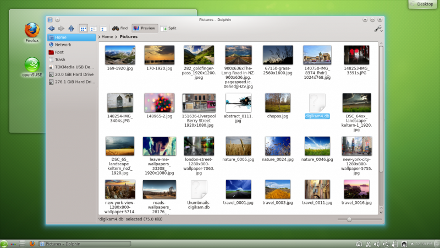
OpenSUSE 12.2 Linux finally arrives

Summary: It took longer than expected, but openSUSE 12.2 is now available.

OpenSUSE, SUSE's community Linux, may not be as sexy as Fedora, Mint, or Ubuntu, but it's still a strong, popular Linux for both servers and desktops and it's good to see the latest version finally arrive after months of delay.
First due on July 11th, openSUSE didn't make its release date because, frankly, it wasn't ready for prime time. OpenSUSE release manager Stephen "Coolo" Kulow said in June, “our development project, is still far too unstable. Things have improved.
Andreas Jaeger, openSUSE's program manager told ServerWatch's Sean Michael Kerner that the openSUSE developers had” concentrated on stabilizing the release.” The resulting Linux distribution may not always have the latest software, such as the newest editions of Firefox and KDE, but it should be very stable. Rock-solid reliability and performance have long been openSUSE hallmarks.
OpenSUSE, as always, supports multiple Linux desktops including KDE 4.x, GNOME 3.4, and Xfce 4.10. KDE, however, is its main desktop. OpenSUSE 12.2comes with KDE 4.8, but the developers will be updating it to the latest and greatest, KDE 4.9.1 within the next week.
Under the hood, openSUSE now uses the 3.4.6 Linux kernel. Thus, it has better Brtfs file system and graphics driver performance. Server and datacenter administrators will like that the kernel enables them to cap CPU usage across groups of processes.
When it comes time to boot the system up, openSUSE now uses GRUB2. Looking ahead to the day when Windows 8 systems try to lock out all other operating systems, openSUSE has a Fedora-like plan in place to deal with Windows 8's Unified Extensible Firmware Interface (UEFI) lock-in.
For desktop users, openSUSE comes with the latest version of the best open-source office suite: LibreOffice 3.5. When it comes to your Web browsing needs, openSUSE defaults to Firefox.
All-in-all, the new openSUSE sounds very promising. If you want to check it out for yourself, there are many openSUSE 12.2 versions available for download. Personally, I'm going to wait until KDE 4.9.1 is available before trying it on the desktop.
One nice feature about openSUSE is that you can do in-place upgrades of your existing openSUSE installations, going all the way back to openSUSE 11.2. Since I run openSUSE on my in-house servers, where the desktop doesn't matter so much, I'll give that a try first. If you also like openSUSE for your servers, I recommend you not wait to give it a run too. Enjoy!
Related Stories:
openSUSE 12.2 delayed again, project looks to reorganize
The openSuSE "Tumbleweed" Rolling Distribution
OpenSUSE's new Linux distribution is for the clouds
openSUSE 12.1 debuts cloud, virtualization, Google Go support
Kick off your day with ZDNet's daily email newsletter. It's the freshest tech news and opinion, served hot. Get it.
Talkback
But how does it run?
Boot time, battery life compared to Windows 8, and so forth are important. Most important, though, is how much RAM/CPU it uses while idle.
Also, how's BTRFS?
Novell is gone
Yeah I was never very clear on that..
Attachmate -> SUSE
http://www.datamation.com/osrc/article.php/3933866/Attachmate-Exec-Takes-Control-of-SUSE-Linux.htm
Also...
Are you sure about that?
Just going by personals...
Like I say it was very slow to read from disk- a noticeable few seconds launching programs like Firefox, though of course YMMV.
It could be that it was default only on the full instal disk, or one of the things that changed over the initial updates (I downloaded on launch day)
You're quite right about the version numbers though, I just confused reinstalling with an official update in my memory... Too many distros...
Anyhoo, all loaded and running on my test machine now; a Samsung netbook (1.6 Ghz N270, 2GB, GMA 950) using BTRFS, and posting good results, only two hours of testing, but getting it up and how I like it I've had no errors... Well auto hiding the panel after locating to the top.. But a restart cued that. But yeah I use the old netbook because it seems to be just about powerful enough to use all the desktop managers sensibly, but it's quite underpowerd, so I get a good feel on it... So far the cold start after install numbers were; CPU between 1.2 - 4% RAM 329 MB, after configuration; adding widgets, setting up mail, prefered packages, etc., In use, with Writer, Chromium, Amarok open, 16 - 19% cpu, RAM around the 930 mark. Oh and cold start of Firefox... 7 seconds, so yes BTRFS is working much nicer... All Much zippier on the netbook than the last time I used it on my desktop - around twice as long.
Also combining the points, it is not the default anymore. But as OpenSUSE has one of the most configurable installers, The first question after the suggest partition map allows you to load suggested LVM abd BTRFS layouts for your drive.
OpenSuse....
laptop fans
For the 3.4.6 kernel:
Battery life: Depends on what is running. Days when doing nothing, down to minutes if watching a movie, while video editing, with 50 other users logged on and working at the same time.
CPU Usage while idle: Between 0.0% and 0.2%
RAM Usage: Linux has much better memory management than Windows, so its apples to oranges. Linux will use as much of the free memory as it needs to cache virtually all open disk files. When programs require more memory, the cache size is reduced dynamically, if need be, to give programs what they need. Since 2Gb and more RAM has become common, I haven't seen a Linux system with less than a 100 users use its disk swap area. (pagefile to you) because it uses RAM so efficiently. But if must have a number, on the 3 second boot system, Linux will use about 10Mb RAM when idle.
Now
Just think about how awesome it would be.
You can, but not from SUSE
Android?
It also takes a good thirty seconds to boot on the Nexus 7.
I'm talking about just Linux.
You Can
http://doc.opensuse.org/documentation/html/openSUSE/opensuse-reference/cha.tablet.html
That keyboard
@anothercanuck
The mechanisms you describe above are exactly the same as Windows' memory management and caching strategies.
I don't care how
cache crazy
@Goff