Gallery: Landing site chosen for new Mars rover Curiosity

NASA has selected the Gale crater to be the home base for its new Mars rover Curiosity when it begins its exploration of the Red planet - scheduled for August 2012. According to NASA the crater is about 96 miles in diameter - about the size of Rhode Island and Connecticut.
More importantly, it contains a mountain that soars higher from the ground than Mount Rainier reaches over Seattle. The mountain contains layers that show a sequence of deposits that indicate water. In additon, the crater "has an alluvial fan likely formed by water-carried sediments" according to NASA.
Curiosity's primary mission is to search for life signs on Mars and is scheduled to last at least one Martian year or about two Earth years. Curiosity will contain a nuclear battery that will allow it to operate more freely that the original Mars rovers Spirit and Opportunity.
Image credit: NASA/JPL-Caltech/ASU/UA
Here's an artist's model of the landing area.
"One fascination with Gale is that it's a huge crater sitting in a very low-elevation position on Mars, and we all know that water runs downhill," said John Grotzinger, the mission's project scientist at the California Institute of Technology in Pasadena, Calif.
Image Credit: NASA/JPL-Caltech
Here's an overhead view of the Gale crater.
Image credit: NASA/JPL-Caltech/ASU
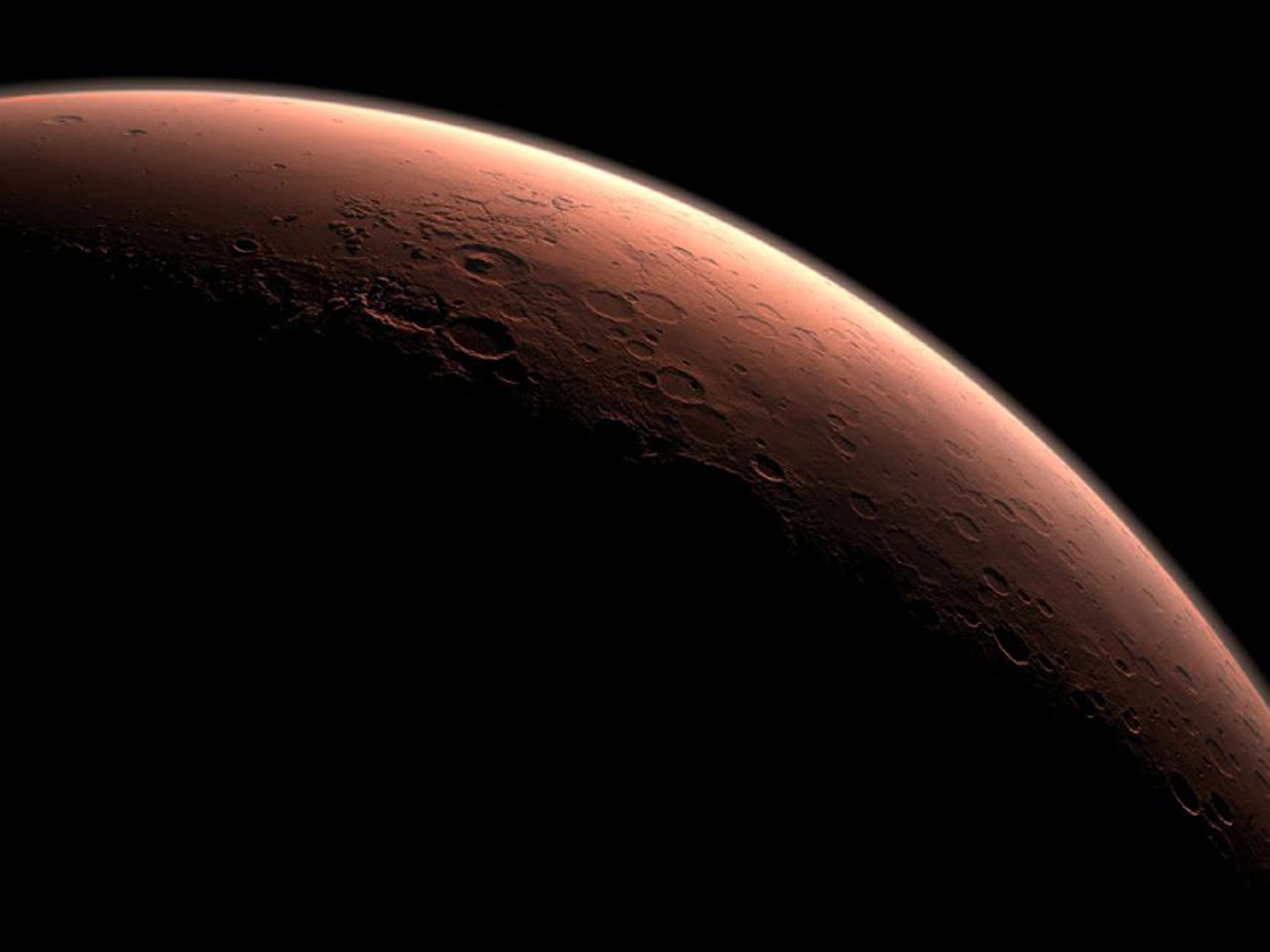
This computer generated view shows the Gale crater near the top center of the image - it's got a large mound inside it.
Image Credit: NASA/JPL-Caltech
At 10 feet long and 1,984 pounds, the new Mars rover Curiosity is twice as long and about 5 times as heavy as the earlier Mars rovers. Its 10 science instruments include two for "ingesting and analyzing samples of powdered rock that the rover's robotic arm collects."
Here's the "head" of Curiosity. The rover's Mastcam includes two cameras (the squares below the white top), one with a zoom lens and the other with a wide-angle lens. NASA had experimented with a last minute change to give it two zoom cameras with 3D capability but the cameras weren't quite ready to take over from the existing ones.
The circle in the white box is the laser sensor which can "zap" a rock about 23 feet away and then determine its composition based on the spark it gives off.
Here's a side view of Curiosity.
Curiosity is raising its arm that features a percussive drill and sample-handling system. It will test samples of fine powder taken from interiors of Martian rocks and deliver them to two analytical instruments inside the rover. The tools at the end of the arm include a color camera, an element-identifying spectrometer, a scoop for collecting soil samples and a brush for cleaning rock surfaces.
The arm can be extended about 7.5 feet and the turret and tools on its arm weighs about 73 pounds.
Here's what Curiosity might look like when traveling on Mars.
The heat shield that will protect Curiosity during its decent to Mars is being readied for shipment to Florida and its launch in Nov. or Dec. 2011.