Microsoft's iPad battle plan for partners

by Mary Jo Foley | January 24, 2011 10:56am PST | Image 1 of 10
Previous | Next
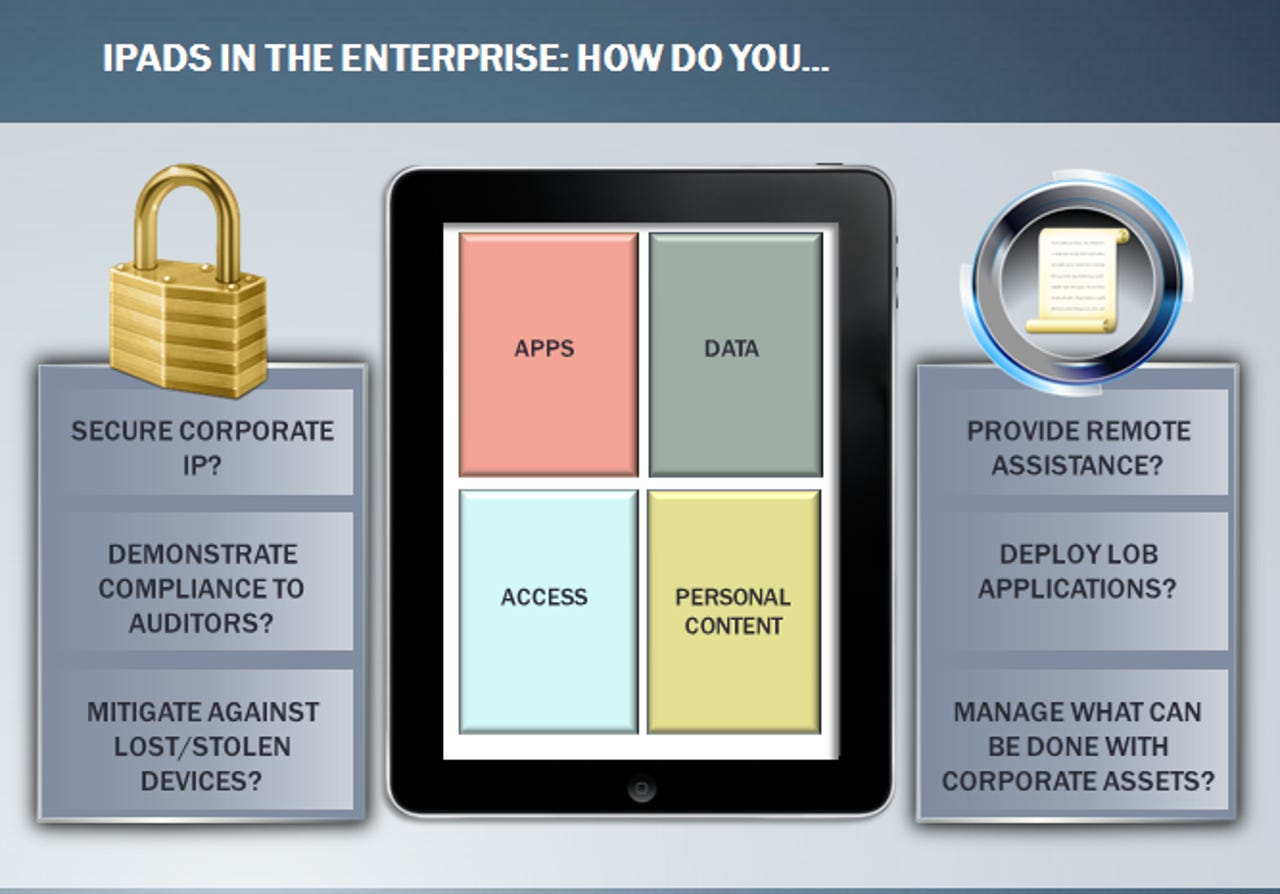
iPads in the enterprise: How do you....
Microsoft has come under a constant barrage of criticism for its failure to launch a real competitor to Apple's iPad. When the iPad initially seemed like a consumer-only-focused device, that was one thing. But now that Apple's slate is gaining real, measurable traction with enterprises, Microsoft -- and its partners -- have a real challenger on their hands. Microsoft and its OEMs are not expected to field the first credible iPad competitors until 2012, however, when Windows 8 machines hit the market. Until then, Microsoft and its partners will need to find a way to beat the "commercial slate PC" drum and look for ways to slip through cracks not being addressed by Apple. The following slides are from a PowerPoint deck Microsoft is making available to its partners as part of its strategy to help them try to sell Windows 7 slates against the iPad in 2011.
Just In
Not for long, however. As soon as N-Trig's pen/touch solution for Android is ready, Windows will be all but dead.
Microsoft's only option is scaling Windows down, before tablet operating systems can scale up.
Right now, it doesn't look like this will happen. Windows on ARM was an important first step, but 2013 is too late.
If they can't launch Windows 8 before the end of 2011, I won't care anymore. I know Android tablet manufacturers won't be that slow to deliver what is needed.
I might even ditch Windows for Linux entirely in 2012, because if Microsoft fails to deliver a tablet version of Windows, then it will be only a matter of time until Android derivates take over the desktop PC market, too.
Nope. I am too! I still think handwriting recognition is an important tablet feature. The finger isn't everything.
Not just writing. I like using the tablet pen to sketch and share quick diagrams during meetings. And of course you can use it for signature capture in some apps.
I've actually never had a tablet before I bought my ASUS T101MT. I bought it to try out the touch features on Windows 7 to see what all the hubbub was about. Truth be told, it's not as bad as everyone makes it out to be, and to be honest, I can get a full 5 hours out of the battery per charge.
Having a full OS on a tablet has it's benefits. For those (like me) who hate swimming in a sea of apps, Windows gets the job done.
Well, those can be fixed. Battery life is improving with newer devices, pens can be attached to the case with a wire if you really want to (and to be honest, I never lost mine anyways), and - well, I just never really ran a VB6 app, although I imagine support is possible if a coder wants to implement it.
. . . although I actually used a tablet with a keyboard, so if the pen didn't work, I could just go back to the keyboard anyways.
IMO it was a very promising technology, and if I were to to back to college someday and could afford it, I'd gladly buy another one.
With the latest version of OneNote having equation support, it could certainly completely replace all of my old paper notebooks.
Tablet PC + OneNote 2010 = complete replacement of paper notebooks for college students.
There are numerous iPad/iPod/iPhone styluses out there, and more than a few notepad-like apps to take advantage of it.
[edit]
But you're right, there's no official handwriting recognition to the extent that you can use it in any application you want.
I used to be one - and yes handwriting was a major use, but the challenge of interpreting handwriting as bad as mine was too much of a challenge for it!
I am a happy user of a HP 2710p tablet since Jul 2008.
Why do you need interpreted handwriting ?
When you have to write to somebody, you use the keyboard: it's faster than any handwriting, and it is clearer.
But when you have to take notes for yourself, handwriting is much more rich of information: colors, underline, sketches, arrows, and so on. It's like having an electronic piece of paper.
Since I started to use OneNote I stopped using paper. And OneNote allows you to search your handwritings with a 70-80% of success (my handwriting is very bad).
Again the different form factors might cause fragmentation a-la-android.
Different form factors are a benefit that most users appreciate, and Windows and Linux can cater for very well. But Apple insists you enjoy the form factor that Steve Jobs likes.
Can you even get a ruggedised iPad for industrial use?
The MS sales or marketing rep shows the executive a PowerPoint presentation and pieces of paper that tell this executive why his firm should not use the iPad.
The executive says to the sales or marketing rep, "I don't care about PowerPoint slides. Look, I want this. Can you give me a Microsoft supported product that can do "this or that" just like I can do now on this iPad."
All I can say is, that sales or marketing rep had better have a Windows product in hand to demonstrate to this executive the features that he wishes. PowerPoint slides just won't "cut it" anymore.
Personally, I looked at those ten slides and they mentioned important points, to be sure, but there was one elephant missing from those slides.
The elephant was the Apple App Store ecosystem. With easy,low cost and available apps, most of those PowerPoint bullets could be addressed. (For example, network printing.)
And, quite frankly, I suspect that this set of PowerPoint slides have already been used when the iPhone first became a commodity that enterprise customers wanted. With very little editing of those slides, MS could have used those same slides to advise customers against adopting the iPhone in an enterprise environment. No one needs to be told how "that debate" turned out.
That's the reason the OEM's are betting on Honeycomb. They see a waterfall effect, specially on the enterprises.
Upper management wants an iPad, but can't afford one. IT wants Windows [easier development, more platform options, more peripheral selection] but can't justify the investment nor the inherit limitations of a non touch optimized platform. So both make a compromise and go Android. Almost as hip, none as limited (in ITs mindset), easily extended using pseudo Java.
Long story short: Microsoft should target Android not iPad, 'cause in the end enterprises as a whole won't adopt iPads (just upper management) just Honeycombs.
You're scenario for Android's success is more of a bit of wishful thinking. Yes, Android makes for a better solution than what Microsoft is currently offering. Then again, that's not saying much. Android is a bit behind the curve here as well. Current pre-Honeycomb offerings are a joke compared to the iPad. However, Android based tablets are actually less suited for the enterprise due to their security / application installation model. Apple's "walled garden" plays in their favor here.
Further, so far, due to Apple's supply chain power, they've been able to compete on price while keeping margins high. This is something no Android OEM has been able to match.
Finally, Android based devices have only competed well in markets where Apple is not present. Where are the Android based iPod touch competitors? Clearly the market is big enough. How well has Android faired against the iPhone on AT&T? That's a rhetorical question of course, because we all know the answer. Android based vendors are about to get a similar beat down on Verizon as well (gradually over the next few quarters).
MS is trying to sell their vaporware, to be delivered at some undetermined time in the future against the iPad snapshot they take today without allowing that the iPad platform will also grow during that time.
Just remember MS's greatest and most abundant product: FUD. Fear, uncertainty and doubt. Delivered via PowerPoint presentations!
I guess the HP Slate I'm holding running Windows 7 that has all the functionality doesn't actually exist?
We're buying three more, for our admins to be able to run diagnostic tools and maintain systems.
At least you didn't make yourself sound stupid.
Microsoft needs to realise that the OS and the device are commodities. Data and apps are important - and if my iOS apps can share data with my Windows ones I don't even care about the apps... I can use an iPad (or something else) when mobile, a PC at work, my phone when out with friends, etc.
If you're not doing those, then sure - it's a good choice.
But if you ARE, then the iPad quickly becomes an overpowered ebook reader/email client/web browser.
Besides, I can always dock my Tablet PC and voila - large screen monitor, full sized keyboard, mouse.. any kind of user input device I want...
And when I'm done, I pull the tablet PC from the dock and I'm on the road.
THAT'S the difference. It's the best of all worlds, not just the one dumbed down world of Steve Jobs.
You are correct, sir. Microsoft's new phone OS might be extensible enough, but it's not at the moment touch-enough. But while it works on a better mobile OS, Microsoft is right to push whatever PR tools it has, even if it has to resort to a Powerpoint piece of verbiage. One does what one can, and Microsoft is behind now. I hope they are pushing hard to catch up. Apple need more competition than its getting from Android-based phones and tablets. They are not that good. Not yet, anyway.
I don't think the documents posed by Microsoft differ from your opinion. Unfortunately, many people haven't taken the time to read what that 'roadmap' says. To me, it looks like an assessment of current-to-future analysis to guide them to a well received product by both enterprise and consumer.
People who dismiss Windows touch devices don't have a clue what they're talking about.
Question for Microsoft: Doesn't the iPad make an ideal client for cloud applications? Why is Windows/Office required on each and every tablet when a browser would do the job?
Problem is that MS just can't focus on getting the little details right before moving onto the next shiny object. They had the better part of a decade, uncontested, to refine and optimize their tablet version of Windows. But, instead of figuring out how to make the Windows tablet editions work better, they veered off into the woods with experimental niche projects like Surface and Courier.
Courier might have looked interesting, but it's obviously a lot easier to put together a bunch of conceptual animations in a presentation than to sweat the details (and manage the tradeoffs) in an actual shipping product.
Windows slates have been around for years. They've also been expensive, and the UI is still more stylus-centric, because most normal Win32 apps are designed for a mouse and keyboard. The battery life is also poorer, in part because they use x64 instead of Arm.
The iPad is a simpler, cheaper device than Windows tablets, and has much better battery life. The low price and the better battery life are important, and an iPad gets the simple tasks done more effectively than existing Windows tablets (at least the ones that I'm familiar with). It can't do the more complex tasks, but most people don't care because they also have a PC (but corporate IT departments may).
To be competitive, Microsoft and Intel have to match or at least get closer to the low-price and low-power characteristics of the iPad with Windows 7 on Atom (or Microsoft can wait for Windows 8 on Arm). They also need to get developers to write touch-centric apps (starting with Microsoft's own developers).
Microsoft's second problem is that they don't manufacture the entire product. Maintaining the integration of the hardware with the software is akin to measuring the distance between two rowboats in a lake during a storm. It's doable,but hard, and there will be mistakes, making the quality of their product appear lower, even if it isn't.
Microsoft's third problem is that the Microsoft-pad won't come out until iPad is at version 3. Given Apple's aversion to giving competitors information about future products, keeping up is going to be a serious problem.
Microsoft's fourth problem is that they can't possibly build a Microsoft-pad ecosystem that is as large as Apple's in 2012. They have to steal developers from iOS, which is already lucrative, to work on a device that is only hypothetically lucrative.
Microsoft's fifth problem is that Apple will have an even more immense installed base by 2012, meaning that Microsoft has to sell to people who already have iPads and are happy with them. How do you sell a me-too product to a contented saturated market?
Microsoft's sixth problem is that when they copy Apple, they are effectively endorsing Apple the leader. Many people will wonder why they should buy a Microsoft product when they could cut to the chase and buy the one that Microsoft tacitly recommends.
Microsoft's seventh problem is that they don't know the difference between consumer choice and consumer confusion, and that having many places to buy a thing doesn't constitute consumer choice.
I see a corporate pratfall coming. Microsoft should try to imitate Apple in a different way: create a compelling product and create its market at the same time. Selling Microsoft-pads to an iPad world is harder than selling devices for which there is yet no competition.
This is the exact issue they ran into with the Zune. In order to supplant an entrenched market leader, MS needed to come out with something undeniably better than the iPod. Instead, they introduced a series of "me too" media players that sold for about the same price as competing iPod models, and did not plug into Apple's ecosystem (aside from the iTunes store, there's also a huge number of audio and home theater components that plug directly into Apple's 30-pin connector).
By all accounts, the current Zune models are well designed and very good options in their own right. But, that's not good enough if it merely matches the hardware specs, while still lacking a broad ecosystem of content, apps, 3rd party hardware support and accessories.
Sure, the iPad has many shortcomings, but it also has first mover advantage and Apple is not a stationary target. By the time this strategy actually bears fruit, Apple will have already introduced the iPad 3 and brought multiple iOS updates to the previous iPad models. MS has no first mover advantage, so they don't have the luxury of merely matching today's iPad. They will have to match or exceed Apple's third generation iPad, and get it right on the first try, something that MS does not do well. And that's the best case scenario, because it does not account for whatever Android and WebOS will have out by that time.
I loved the TC form-factor with the detachable keyboard turning into a slate. I held onto the TC1100 for 4 years before it gave up the ghost.
iOS vs Win7? For home entertainment iOS. As a road warrior, Win7. I guess what I really want is the best of both worlds but that IS just to much to ask for.
Steve Jobs realized that Microsoft had dominant market share in PCs. So he decided to compete by changing the game entirely. What I see in the slides above is a frantic and desperate attempt to hold off an onslaught. If this is the best Microsoft can do, there will be many chairs thrown in Redmond.
As someone said further up the comments, for all it's shortcomings as a "business device" (whatever that is) - this is about the consumerisation of IT above all. And right now MS doesn't have a sexy consumer OS or Tablet to sell...
I would have also liked to see some mention of Kinect and Lync as there are different apps that can play in this ecosystem.
Lastly, I suspect the AppleLabs folks have some even more exciting products on the way and so as one viewer wrote, don't play Apple's, Cisco's or anyone else's, create a new game for others to follow you.
Am I asking or expecting too much?
MS pulled the plug on the Courier last April, less than a month after the iPad went on sale. It was never a real working device, and never got beyond the concept stage. It's easy to produce conceptual animations and mockup photos. Much harder to get the details right for an actual shipping product.
Microsoft does not need to "get it" it only needs to wait and see people migrate back for functionality. (there is a windows app for that and there always has been)
I would not put in money for a form factor and lose the benefits of a real OS. VVB
Join the conversation!
The best of ZDNet, delivered
ZDNet Newsletters
Get the best of ZDNet delivered straight to your inbox