Samsung retains U.S. smartphone crown, Apple rapidly catching up

Summary: There's absolutely no doubt that month-on-month, Apple is catching up to market leader Samsung in the U.S. mobile market share race.
Latest comScore figures show that while Samsung remains at the top of the U.S. smartphone market share rankings, Apple is rapidly catching up to its staunch rival.
The figures for the August 2012 report, collected from more than 30,000 U.S. mobile subscribers, show that Samsung's share remains flat, compared to a significant growth for Apple. Interestingly, the figures close before the iPhone 5 was released -- let alone announced -- showing an increase in iPhone uptake ahead of the expected next-generation Apple smartphone.
Apple's smartphone share grew 2.1 percent -- the highest increase in mobile subscribers seen since April -- edging closer to second-place smartphone maker LG, which dropped by close to 1 percent in the three-month average period ending in August.
In the race for the top two podium spaces, it's clear that by comScore's next monthly report, Apple could rise to second place, ready and braced to take on the rival Android maker at the top of the rankings.
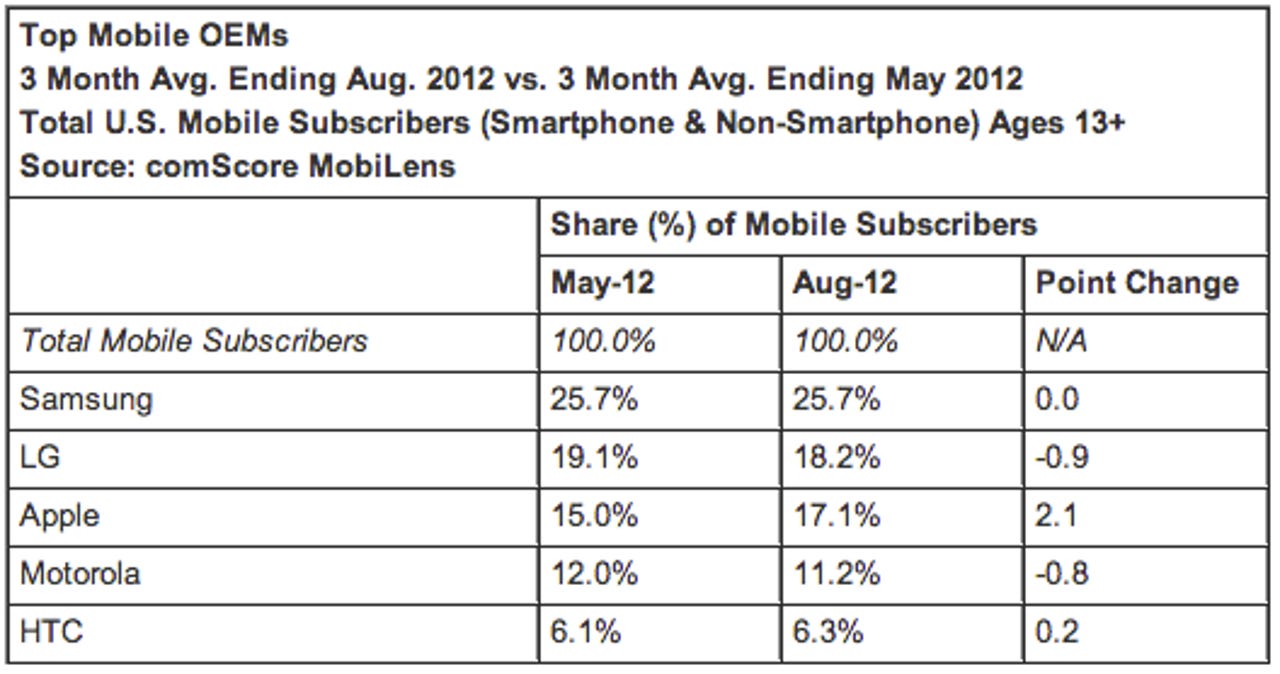
Though HTC grew by 0.2 percent in the August report, the Taiwanese firm continues to struggle with poor smartphone sales and sinking revenue. HTC's second-quarter earnings in July reported a 57 percent decline in net profit year-on-year.
Meanwhile, Google-owned Motorola Mobility dipped by 0.8 percent, currently standing at 11.2 percent of the U.S. smartphone market share.
On platform market share, only Apple and Google managed to secure an increase in subscribers, while the other platform makers saw a decline.
Android operating system increased marginally by 1.7 percent to 52.6 percent in total. Google, which develops the mobile operating system, said last month that there are more than 1.3 million Android activations per day, an increase from 1 million per day in June. In total, this represents more than a half-billion Android devices activated in total since the mobile software was first launched.
Apple, however, stormed ahead with its iOS software with an increase of 2.4 percent to 34.3 percent.

On the other hand, BlackBerry maker Research in Motion saw the greatest loss with 3.1 percent in the platform space. The ailing smartphone maker has seen consistent losses through the year, but has now dropped below the 10 percent mark to single figures in share.
Microsoft's Windows Phone and Nokia's Symbian operating systems declined by 0.4 percent each, representing bittersweet news for the Finnish phone maker.
Symbian's decline comes as a blessing for Nokia as it continues to plug the Windows Phone platform through its 'special relationship' with Microsoft. But for Microsoft, this represents a continued headache for the software giant as it seeks to drum up support for the mobile platform -- only weeks away from an expected Windows Phone 8 launch -- but falls below the radar in favor of the major players in the platform race.
Image credits: comScore.
Kick off your day with ZDNet's daily email newsletter. It's the freshest tech news and opinion, served hot. Get it.
Talkback
Top chart is both Smartphones and NON-Smartphones
Apple just can't stop violating patents
Why can't Apple ever just pay for the innovations they copy? Hopefully this costs them upwards of $1,000,000,000.
This does not mean Apple has actually infringed.
But just like Samsung case, this is so obvious
"What does this have to do with this article?"
Let's see if ZDNet publishes the story before I answer that question. ZDNet has a habit of ignoring stories that make Apple look like the slavish copier that they are.
Trolling
All I gotta say is...
Dude you're sick
Of course it's catching up.
However, most "normal" people I know aren't really interested in upgrading to the new iPhone.
Actually, quite a few are beginning to questioning other brands.
Especially when the competition offers so much more.
Of course, some people will still love Apple.
But the pendulum is starting to swing away.
Android is equal to IOS, if not better.
And the new handsets BEFORE the iPhone 5 were already miles better.
There's only so long you can coast before you get overtaken completely.
I totally agree
The funniest thing I read launch week was that the iPhone 5 was 150% faster than the iPhone 4S. Then we found out that it was still slower than the Samsung Galaxy S3 which came out BEFORE the iPhone 5. Note that no one focused on that since that makes a particularly poor script. Instead, the focus was put on how much faster this was than last year's hardware. Well duh. I would hope it was faster than last year's hardware. That isn't an accomplishment.
Duh
http://www.pcmag.com/article2/0,2817,2410034,00.asp
Nope, you are wrong
Note this is from macobserver and they love all things Apple.
Apple loses.
Samsung wins.
I guess everybody may find links backing their claims about performance
http://www.anandtech.com/show/6324/the-iphone-5-performance-preview
This review was done AFTER the actual release of the iPhone 5.
Well well A6 is going to be obsoleted in months
http://uk.hardware.info/reviews/3206/2/benchmarks-samsung-galaxy-note-ii-vs-apple-iphone-5-3d-performance---glbenchmark-251
And we're talking about a SoC that is at least 2-3 quarters older than A6... With A-15 based Exynos 5 Dual only months away from mass production (rumored to be either update version of GSIII or GSIV), A6 is gonna be displaced in memory and graphic department as well by Exynos 5 in record speed.
I'm sorry but Apple is just moving way too slow in SoC development. It's home team advantage for Samsung too since they actually have their own fab to play with.
And yet...
I guess the only thing that really matters is user experience.
So,
User Experience
Not true
I wonder what this look like...
Although the current administration is doing everything
depends on if you consider the EU as a single entity or not
But I would wish more articles like this would specify to which country or region or the globe they apply.