The Internet is getting faster

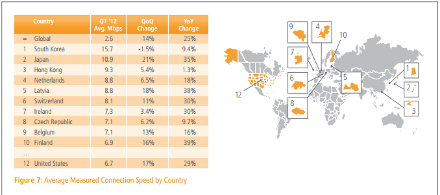
The good news, according to Akamai, a high-performance Web and analytics company, is that “the global average connection speed experienced a 14% quarter-over-quarter increase in the first three months of 2012, returning to 2.6 Mbps (Megabits per second).” The bad news is we want much faster connections than we're getting.
Akamai, in its The State of the Internet, 1st Quarter 2012 report (PDF link, registration required.), now defines “high broadband” as connections to Akamai at speeds of 10 Mbps or greater. In the past, the company defined “narrowband” as connections to Akamai at speeds of 256 Kbps (Kilobits per second) or below, but as connection speeds continue to increase globally, especially in countries with developing infrastructure, the number of connections that Akamai sees at these levels continues to decline so Akamai will no longer be reporting on narrowband adoption.
With those specifications, Akamai found that with a few exceptions, such as South Korea, the last mile of Internet was getting faster throughout the world. Even with its decline though, South Korea with an average speed of 15.7Mbps still easily won the gold for the fastest Internet in the world. The United States, with an average speed of 6.7Mbps came in 12th.
The company also reported that “Long term trends were once again very positive, reflecting a continuing shift toward higher speed connectivity. All of the top 10 countries, as well as the United States, experienced positive year-over-year changes in average connection speeds."
When it comes to peak connection speed—the average of the maximum measured connection speeds--”there was strong improvement around the globe with the peak rate increasing nearly 10% to 13.5Mbps. In this metric, Hong Kong bested long-time leader South Korea 49.3Mbps to 47.8Mbps. Here, the US placed 8th with a peak speed of 28.7Mbps.
“Looking at year-over-year changes, the global average peak connection speed was once again up by 25% as compared to the same period a year ago. Extremely strong yearly increases were seen across all of the top 10 countries, with Belgium having the lowest growth rate at 18%. Globally, nearly 130 qualifying countries saw year-over-year increases in average connection speeds, ranging from 3.8% growth in Pakistan (to 5.9 Mbps) to a 213% jump in Libya (to 3.8 Mbps). Only five countries saw a yearly decline in average peak connection speed, with the greatest loss in Tanzania, which dropped 21% (to 5.1 Mbps).”
If you were to guess which state in the US had the highest bandwidth, you might guess California, New York, or Massachusetts. Or, if you thought about it for a minute you might suggest Missouri thanks to Google's recent Gigabit Internet deployment in Kansas City... but you'd still be wrong.
Within the US, “Delaware [yes Delaware] remained the fastest state in the union, with an average connection speed that improved 24% quarter-over-quarter to just over 10 Mbps. New Hampshire remained the second fastest state, improving 15% to 9.4 Mbps. All of the top 10 states joined Delaware and New Hampshire in having quarterly changes that exceeded 10%, as did 38 other states across the country. Only Minnesota, California, and Nebraska improved by less than 10% as compared to the fourth quarter of 2011, though they did not trail very far behind, with average growth rates around 9%. Arkansas remained the state with the lowest average connection speed, though it increased 14% quarter over-quarter to 3.6 Mbps.”
Still, even as the Internet gets faster, customers want faster rates. 4G customers aren't happy, but all you need to is ask anyone if their Internet connection is fast enough and chances are they'll say no. That's because while our overall speed has improved, we're demanding more from our network connections than ever. For example, we now expect to watch full-screen video every night be it from the Olympics or Netflix movies. Indeed, at night, Netflix has been taking up more bandwidth than any other single Internet service since the spring of 2011. 6.7Mbps may sound good, but in 2012 it's not fast enough.
Related Stories:
Lies, damned lies, and Internet speeds
4G isn't fast enough for tablet and smartphone users
Google Fiber trumps NBN speeds, pricing
What does Google Fiber mean for the rest of us?
Sprint 4G LTE network live in Houston: Hands-on