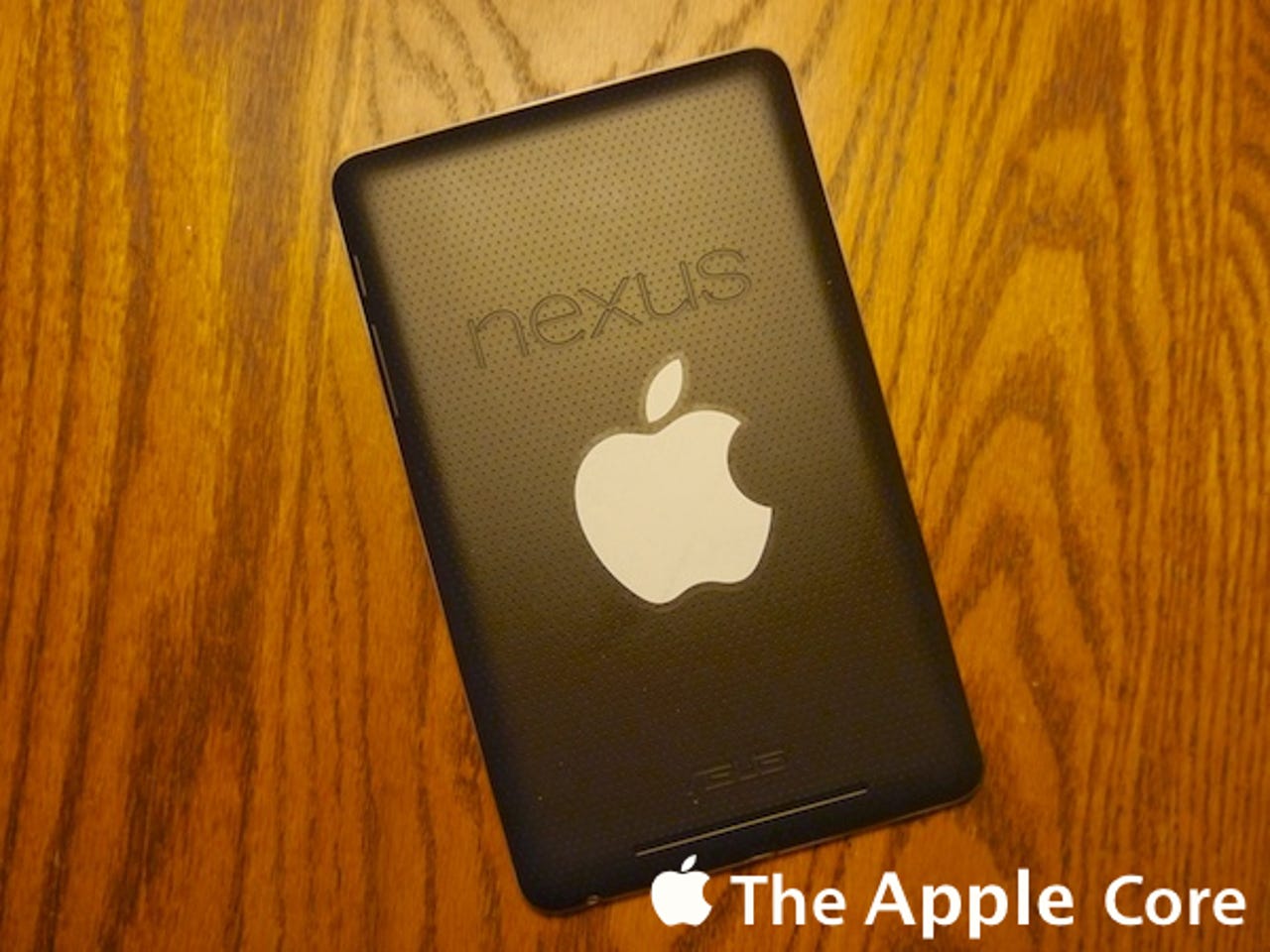
The Nexus 7 is only missing one thing

Summary: The Nexus 7 is the best 7-inch tablet to hit the market and it's selling like hotcakes. But there's one thing that would make it sell even better.

The new Nexus 7 from Google is a lot of tablet for $200. Is it as good as the iPad 3? Well, not exactly, but it's also half the price.
I took delivery of a 16GB model today (which bumps the price up to $250) and I'm duly impressed with its specs, build quality and overall feel in my fist few hours of using it.
Early reviews (CNet, Engadget, Verge) similarly sing its praises. It's the first "pure Google" tab (hence the "Nexus" moniker), it's the best $200 tab, its fast and responsive (courtesy of its quad-core Tegra 3 processor,) yadda. And all of it is true, especially the bit about it being pure Google -- no one dislikes Android skins more than I do -- plus the N7 enjoys the distinction of being the first tablet running Android 4.1 "Jellybean," the smoothest and slickest build of Android yet.
- Read ZDNET's Ed Burnette's excellent post What's new in Android 4.1 (JellyBean)
The Nexus 7 is the real deal. Don't mistake it for other 7-inchers (like the Galaxy Tab, or the awful Kindle Fire). The problem is that it's missing something: an Apple logo.
Rumors have been swirling that Apple is going to release a 7.85-inch "iPad mini" and the Nexus 7 validates why Apple shouldn't ignore the smaller, mini-tablet market.
Clearly consumers want a tablet smaller than 10-inches. Sales of the Fire and Nexus 7 bear this out. The Nexus 7 is sold out at most brick and mortar stores nationwide and the 16GB model is back-ordered 3-4 weeks on the Google Play store. Update: Google has halted sales of the 16GB Nexus 7 model.
Size matters, and a 7-8-inch tablet is more manageable than a horsey 10-incher which requires a special case because it won't fit in a pocket. 7-8 inches also fits easily in the hand and is less intimidating to novice users than a 10-incher. A 7-8 inch tablet is appealing to women, kids and people that don't want to wield a full-size tablet. There's just something about the 7-8 inch form-factor that works.
And then there's the price issue. At $199 the 8GB Nexus 7 is a steal. An serious user will want to pony up the extra $50 for the 16GB model, and even that is half the price of the entry-level 16GB iPad 3. Price is a big barrier to entering the Apple ecosystem, especially for new users. Existing Apple customers have less of a problem with the "Apple tax" because they're already believers in the Total Cost of Ownership (TCO) arguement because they live it.
Windows PC users are a tougher sell. They're used to paying bottom dollar for PCs and having vendors fight in a race to the bottom for their business. Many PC users get sticker shock when they realize that the 16GB iPad costs $500 ($630 if you want 4G) and that higher capacity models go for up to $830 -- and that's without the AppleCare. For $900 you can buy a pretty powerful Windows desktop or laptop with all the trimmings. Or a car.
Apple has to be closely studying the market's response to the 7-inch tablet and absolutely licking its chops in anticipation. When/if Apple releases a 7-8-inch tablet it will freeze the market, especially if it's priced right. If the rumors are true and the "iPad mini" is indeed 7.85-inches, that's 36% more screen real estate than the Fire and the Nexus 7, so don't expect it to sell for $199. $249 would make is a no-brainer purchase over the Android competition (for app selection alone), but I have a feeling that the iPad mini is going to retail for $299.
And you know what? It will still leave the Nexus 7 and the Kindle Fire in the dust.
There are a ton of reasons why Apple should release an iPad mini, can anyone make the argument that it shouldn't? If so, I'd love to hear it.
Update: About my 36% comment above, it's based on the diagram below from @trojankitten which shows the Nexus 7 screen area measuring 22 sq. in. vs. the "iPad mini's" screen area measuring 30 sq. in.

Kick off your day with ZDNet's daily email newsletter. It's the freshest tech news and opinion, served hot. Get it.
Talkback
Awesome Tablet
40% more?
Double check that math.
Here's the math
Notably, a 7.85-inch iPad's screen size would be 40% larger than the current 7-inch tablets such as the Kindle Fire.
Thanks for providing the backup
that's 40% more screen real estate
which is what the text of the article incorrectly stated. The picture caption states:
Almost 40% larger
It is actually only 36% larger so if "almost" covers an 11% inaccuracy then I really hope that none of you ever work on anything that requires fine measurements.
The thing about the 7" form factor is portability. With the 4/3 aspect ratio, a 7.85" iPad Mini is MUCH wider than a 7" Nexus. That makes it far less portable and convenient which is what the 7" form factor is all about. So you end up with a horrible compromise in the iPad Mini of something that doesn't have any of the portability advantages of a 7" tablet while also losing 50% of its screen real estate when compared to the iPad. Steve Jobs was right. Apple shouldn't make a 7" tablet because they clearly don't know how to.
LOL
"Apple shouldn't make a 7" tablet because they clearly don't know how to."
Apple hasn't announced or released any information about an iPad Mini, so upon what information are you basing this statement?
I'll tell you one thing, if there's anything that Apple DOES know about, it's making consumer-level tablets.
You tell me
You are right, it doesn't exist. So right now, Apple's iPad Mini is a big pile of sucky vaporware compared to the Nexus 7.
*Deep Breath*
- Jason
Sounds good
Still, at 4/3, this iPad Mini is going to be extremely wide, far less mobile than any other 7" tablet which is what the 7" tablet form factor is all about.
"Steve Jobs was right. Apple shouldn't make a 7" tablet because they clearly don't know how to."
You sound scared!
Was that really what the 7" tablet was all about, mobility? Or was it that companies who was struggling to compete with the iPad and the cost and availability of the larger 10" screen, ran with the smaller 7" form factor as the only way to compete?
The best selling 7" tablet, the Fire, sold 4-6 million units in 2011, at the height of the shopping season. Sales has been plummeting ever since then. Compare that to how much iPad Apple is selling. Is there really a 7" tablet market for Apple to be concerned about? Apple could release their 7.85 4/3 iPad and in a short time outsell Amazon and Google combined.
You are probably right
I agree, it will do well for 1 reason and it is the reason that Jason pointed out above: it will have a genuine Apple logo on it, not because it was well thought out.
"Was that really what the 7" tablet was all about, mobility?"
Yes. Where have you been?
As for being "scared", I don't see how. I have no interest in a 7" tablet or an 8" tablet. My iPad is "good enough" for now and if Surface is at least half as good as it has been announced to be, I'll be dumping Apple and moving to that. So if Apple kills the 7" Android tablet market, it doesn't affect me in any way other than I think it is sad when a 9000lb bully patent troll is able to use its monopoly power in 1 market in order to destroy all the competition in another.
Actually, you're dead wrong
Nah, it will do well for many reasons:
- It will get updates (OOOOOH DISS, SLAAAAM). That's right - instead of lazily passing along the end-user experience to carriers and manufacturers like Google did, Apple actually takes the time to craft an intact and complete user experience that is standard across devices and does not suffer from having a disproportionate amount of hardware platforms to sit atop. This equates to better apps, a better UI, and a better device over time as the iDevice will continue to get new functionality instead of having to be turned into a science experiment with some random person's custom ROMs.
- It will have an intact user experience. (See above)
- It will have a rich application environment written solely in native code - not interpreted shittiness on low voltage systems which is a match made in hell.
- It wont be much less open or "big brother" than Google anyway. Ask yourself. Why do all Android programs - even games written almost entirely natively - still have to run through Dalvik to be executed on Android? That's right -- Google's just as Jobsian as Apple. I'll say it again - the same draconian crap you'd expect from Apple is at the very heart of Android. It's Dalvik, and it's the big brother crap that's regulating all of the things that's on your device and NO, nothing that doesn't touch Dalvik will ever be executed on any of your devices. Android is laughably closed compared to real, direct-to-kernel developed software on real open source operating systems.
The nexus 7 is a really, really awesome device*.
* Compared to the laughably bad Kindle Fire.
It will get updates
Since the Nexus 7 doesn't come from a "carrier," this is no longer an issue. It will be up to Google to provide updates, and those of us that use Google apps on our Android phones know that Google updates and improves software almost daily.
Wrong
@toddbottom3
Apple is rumored to be making a little brother of the world's most well thought-out and most successful tablet device to date, the iPad. What in the world are you talking about. So well thought out that everyone in the world has tried for years to clone the iPad formula, with Amazon coming the closest with their Kindle Fire+Ecosystem. Google is now trying to clone that with their Nexus 7, trying to tie closely their content ecosystem. Microsoft will try to do the same with the Surface.
And you wonder why Apple was selling iPads like hotcakes all these years? And why consumers was equating their logo with quality? The highest satisfaction ratings year-after-year? Number one rated in -consumer support year-after-year?
You misunderstood
Neither is putting out a 7.85" tablet that is too wide to allow people to benefit from the improved portability of a smaller device. 7" tablets are successful because of their portability. There is a real market there. Whether they "copied" Apple or not is irrelevant. They saw a market that Apple missed and they went for it. Good for them. Why this bothers you is beyond me.
So you jumped to conclusions when I said a 7.85" tablet would only sell because of the logo. I never said the iPad sold only because of the logo. The iPad sold well (and continues to sell well) because it is a good product. The iPad is fairly well thought out (though it isn't perfect, the keyboard ecosystem sucks). Never implied otherwise. This 7.85" tablet that Jason is talking about would be a horrible product but would sell well because of the logo. It is not well thought out because it totally misses why others have been successful in the 7" market: portability.
And since you brought up consumer satisfaction:
http://news.softpedia.com/news/Nokia-Lumia-900-Offers-Great-User-Satisfaction-Nielsen-Says-280388.shtml
Huh, guess that means Nokia Lumia 900 and WP7 are fantastic products. Thanks for admitting that.
"Was that really what the 7" tablet was all about, mobility?"
lol..
I have no issue with their profit margins
And they don't even realize that Apple doesn't even make there own....
That A5X processor...
...yeah that's made by samsung guys! They've haven't made there own HDD since the Apple 2E. Apple(Macintosh) as a whole is New York and Android is Washington DC w/ the US being it's consumer base.
Come on people of the Apple crave, you may have a hijacked platform device that is more stable, but at the rate of change in the very competitive consumer electronics market today, Apple will not be able to remain in the competition for
much more than 5-10yrs from now...
The minority never becomes a monopoly, it only empowers the majority to be stronger!
Do they really care that Apple doesn't make their own components?
And here's the flaw with 'Apple's too slow for a rapidly changing market' argument. ICS and Jelly Bean may be great, but the majority of users won't see those either of them until they're "last year's model". A large majority of Android users are still on Gingerbread or older, not to mention the fact that carriers and stores still have phones/tablets on their shelves with Gingerbread, and almost a year has passed since ICS was released. That means the poor sap who buys that phone under a 2 year contract today will still be sitting there on GB in 2014. So, Android responding better to a fast changing market is much like the old "if a tree falls in the woods but nobody's there to hear it, does it make a sound?"
I see many Android fans argue that users don't expect OS updates on a phone, but at the same time, the market is supposedly changing at a rapid pace? So which is it?