You could be charging your laptop via USB cables soon, thanks to new USB PD technology

Summary: The new USB Power Delivery (PD) standard was shown off last week at IDF 2012. It can provide the 60 watts of power needed to recharge a laptop battery, and may be available starting later this year.

You've long been able to recharge your smartphone via USB, and you can even juice up your tablet using that method. But a new flavor of USB is designed to pump out much more power, gving you the ability to charge up your laptop via a USB adapter.
The new standard, USB Power Delivery (or PD), was showcased at Intel's IDF 2012 event last week, and our sister site CNET provides details from the presentation that two Intel engineers gave on the new technology. While you can currently get up to 7.5 watts of power from a specialized battery charging version of USB (USB 3.0 ordinarily provides 4.5 watts), USB PD could offer up to 100 watts of juice -- more than enough to cover nearly any portable device.
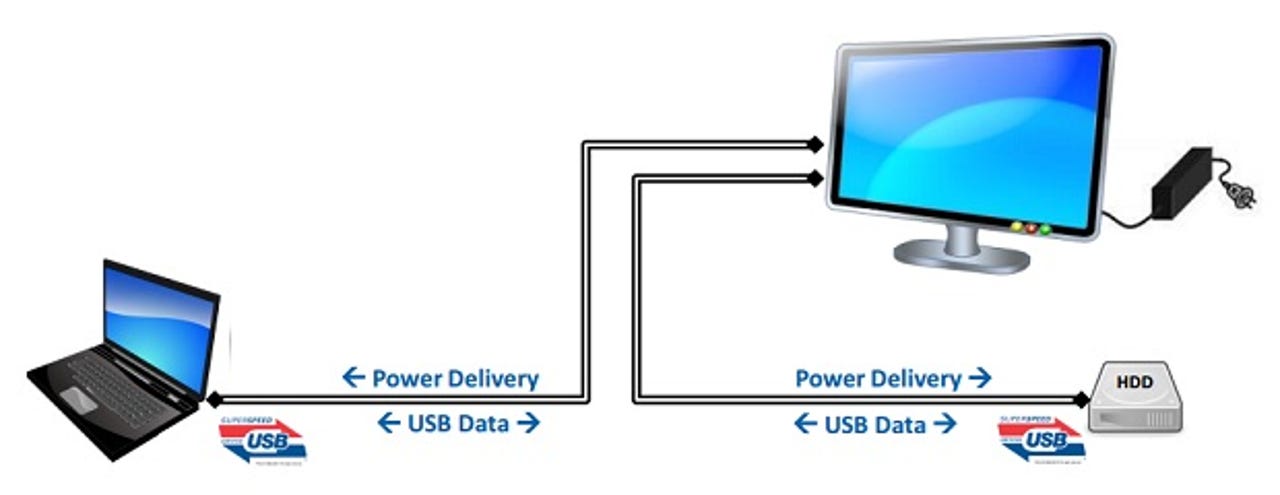
In a presentation available on the USB Implementers Forum site, the organization envisions a scenario (shown above) where an LCD monitor would have a USB PD port, which could be used to charge a notebook battery while also serving as that computer's primary display. In theory, the USB PD port could also be built into a new desktop or even a wall adapter to free you from using a "wall wart" style plug to recharge your laptop battery using AC power.
While no specific product announcements have been made about USB PD, the Forum thinks we may see some products using the new standard by the end of 2012. According to CNET, companies that have expressed interest in USB PD technology include Hewlett-Packard, Microsoft, Nokia and, of course, Intel.
Kick off your day with ZDNet's daily email newsletter. It's the freshest tech news and opinion, served hot. Get it.
Talkback
Great!
I love being alive in these technologically exciting times.
What is the point?
And why would I be plugging my laptop into a monitor? Just to cahrge it? Not likely.
Another epic FAIL.
Well...
Apple's solution isn't quite this elegant. But it is quite useable.
Close, although not quite
However, the more valid point is that most of the time, if you're in a situation where you might have a device like the example monitor that you can plug into, you're going to have access to a wall outlet anyway...so why get one more cable that a) you have to find room for in your laptop case, and b) requires a special USB port that not only isn't widely available for purchase, but is extremely unlikely to be found in the average office?
Maybe in a few years, when they've become more standardized on computer hardware & the next cycle of enterprise investment has occurred, it'll be more helpful. Or maybe if coffeehouses & restaurants install those hybrid outlets with USB ports & stick USB PSD hubs into them...
So I guess you think micro USB power adapters were a bad idea
If you think the fact that most phones and many small devices use micro USB as a power connector and charging standard, then you should be behind this.
It would be really funny if one ventured over to an article on the new connector on the iPhone 5 and found you criticizing it for not being micro USB, while labeling this "epic FAIL".
Wake me up when
Except
USB cables
Even at 20V, that's 5A current, way more than the original USB design of 0.5A (which has been increased recently).
Given that current 5V chargers go up to 2.1A -- if we consider this "safe", then voltage should go up to 48V to accommodate 100W and 48V is not exactly low voltage..
A new, USB compatible interface is something different... but that would mean every thing changes. Again.
I believe...
So a 48V USB voltage at 2.1A (100W) in theory could be a possibility.
This standard
Look at your typical 60W notebook AC adapter (or even 90W adapter if you have one) that outputs at 18.5 - 19 volts and compare the DC cable size to a typical USB cable.
If you read the introduction document (http://www.usb.org/developers/powerdelivery/PD_1.0_Introduction.pdf), you'll note that existing cables are limited to 7.5 watts, while higher power delivery specifies "PD aware" cables.
INVENTORS - DO NOT TRUST INTEL!!!
I invented a CPU cooler - 3 times better than best - better than water. Intel have major CPU cooling problems - "Intel's microprocessors were generating so much heat that they were melting" (iht.com) - try to talk to them - they send my communications to my competitor & will not talk to me.
Winners of major 'Corporate Social Responsibility' awardS!!!
Huh!!!!
When did RICO get repealed?"
INVENTORS - DO NOT TRUST INTEL!!!
BTW, I have the evidence - my competitor gave it to me.
BBTW, I am prepared to apologise to Intel if;
• They can show that the actions were those of a single individual within the company, but acting outside corporate policy, and:
• They gain redress on my behalf.
I accept full responsibility for this post. Stuart 21 at mac dot com.
Universal is the key word
More realistically, wireless charging will progress beyond the mass-adoption of the new high-powered USB and then it will be rendered obsolete for charging purposes. Hopefully.
The problem I see with this is...
Not that big of a problem
Cheaper to replace a cable than a power adapter
If those adapters had used a standardized cable, the story would have been very different. Which do you think would cost less: A power adapter that sells only to owners of that specific notebook, or a cable which is used on almost every notebook and computer peripheral?
Hmmmmm.
I can see a lot of power supplied popping out there.
It wouldn't go pop
If the manufacturer was dumb enough to allow 90 watts power delivery on a machine that had a 250W power supply, but was using 200 watts for itself, then they would be to blame.
You could be charging your laptop via USB cables soon, thanks to new USB PD