A tour of Jolicloud's netbook Linux OS

Over the last week, Jolicloud started rolling out the first complete version of its Linux distribution to existing users.
The distro is highly netbook-centric and, until Jolicloud 1.0, looked very much like the Ubuntu Netbook Remix on which it is based. However, the new version looks significantly different to the '"="" Released"="" href="http://www.zdnet.co.uk/blogs/jamies-mostly-linux-stuff-10006480/jolicloud-pre-final-released-10015478/">pre-final release' that preceded it. That was an unusual move for the company, as major user interface (UI) changes tend to be tested in beta before their final release.
At the time of writing, there is no direct installer for Jolicloud 1.0, so getting it relies on installing the pre-final release, then getting an invitation to upgrade.
Jolicloud was founded last year by Tariq Krim, who before that had set up iGoogle competitor Netvibes. The French Linux company is backed by venture capitalists including Niklas Zennström and Janus Friis, the founders of Skype.
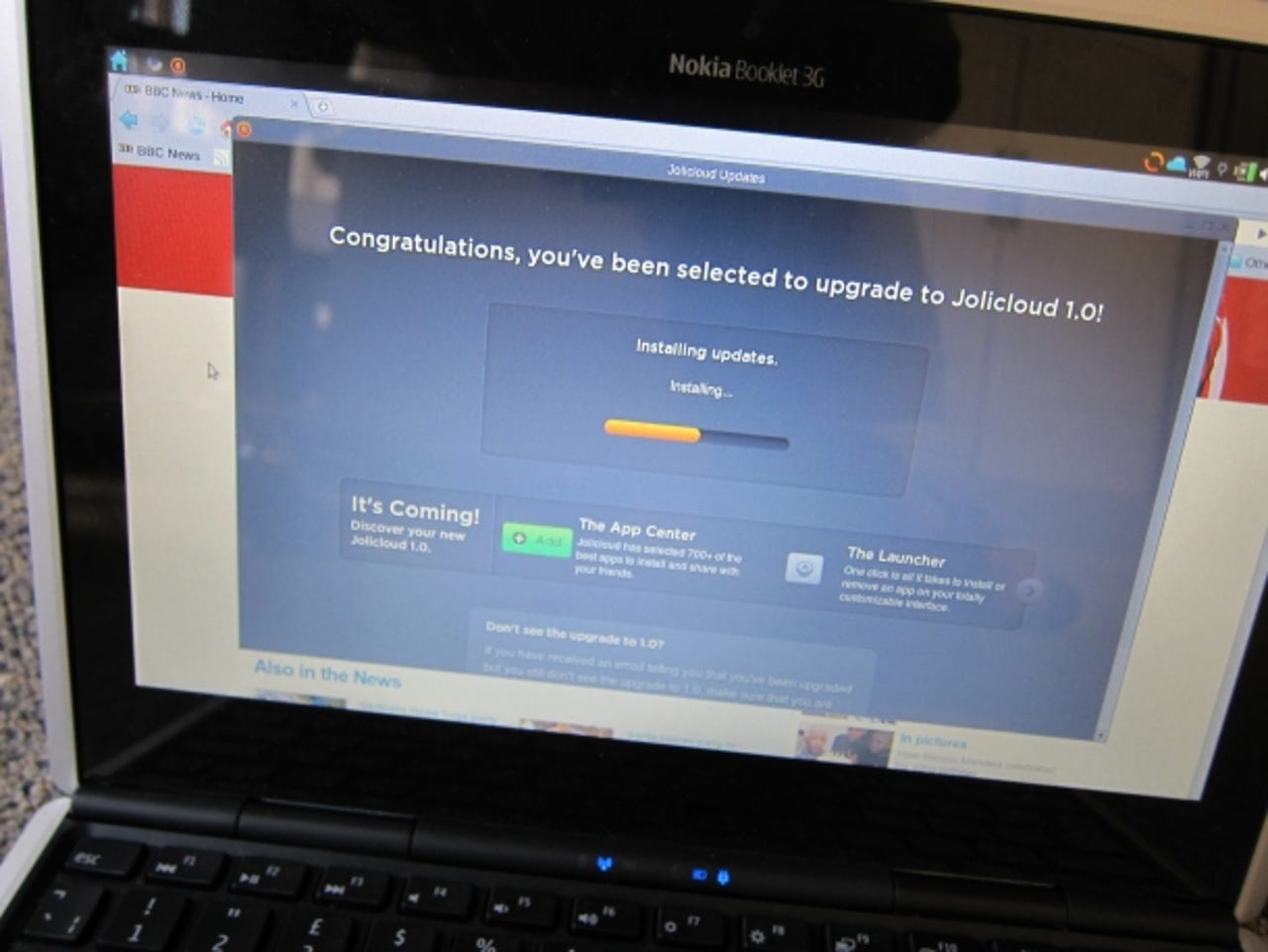
The splash screen for Jolicloud 1.0 is shown here on a Nokia Booklet 3G.
The operating system is one of the few to support Nokia's netbook, mainly because the device uses Intel's Linux-phobic 'Poulsbo' GMA500 graphics chip. However, Jolicloud — which has a long list of supported devices — automatically handles the Booklet 3G's chipset and 720p resolution with ease.
One of the key features of Jolicloud is — as its name would suggest — its synchronisation with the cloud.
A person installing the distro creates an account that lets them sync their desktop with Jolicloud's servers. As this picture shows, an existing account holder who makes a fresh installation then sees the desktop automatically populated with their chosen apps.
This is the Jolicloud 1.0 launcher, which is written in HTML 5. A sign of this is that the launch icons bounce when the pointer hovers over them, as is the fact that they only require one click to launch an app.
The apps showing on this launcher are a mix of web apps and desktop apps. Each of the web apps simply brings up the relevant website within a single-tab, cut-down browser window. As will be seen later in this gallery, the desktop apps can include not only Linux applications, but also Windows programmes that run using Wine.
Jolicloud's web-centricity extends to storage, as can be seen in this shot of the distro's file system.
In the file system, local folders and drives sit alongside web-based storage services such as Dropbox and Box.net. In this case, clicking on Dropbox will start up that service's web app, although there is also a Dropbox client available for download that shows up as a folder icon.
Jolicloud is intended as a social Linux distribution; this shot shows the author's profile.
The idea is to let various Jolicloud users see each other's profiles and what apps they are using. Apps can then be commented upon, and people can see how popular each app is.
Although the pre-final versions of Jolicloud also had an app store, this function has been given a major revamp for version 1.0.
The app store, which contains more than 700 apps at launch, is organised into various categories. Installing an app — web, Linux or Windows — requires only hitting the 'add' button.
Spotify is a good example of a Windows app that can be downloaded from the Jolicloud app store.
It runs comfortably and quickly using the Wine wrapper — a technique that the user doesn't have to think about, as the app starts up in the same way as a Linux or web app.
Of course, many Linux apps such as Audacity are also available in the app store.
Many Linux apps, however, do not appear in the app store, which is a minor issue that needs ironing out. While they can easily be installed in the usual Linux ways, they don't show up in the HTML 5 launcher and need to be run from the drop-down menu in the upper left corner of the screen. The Linux version of Tweetdeck is one example of such an app.
This shot shows Jolicloud's main settings centre, which should appear familiar to most computer users.