Add Sharp to the list of Microsoft exFAT licensees

Summary: Sharp is the latest company to agree to license Microsoft's exFAT file system. Microsoft wants to be sure you know there's an Android connection.
Sharp Corp. is now one of a growing list of companies licensing the exFAT file system from Microsoft.
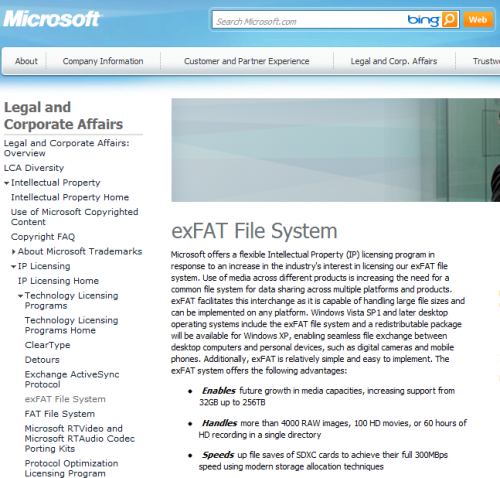
Microsoft has signed up a number of other companies as exFAT licensees, including Sony, Canon, Sanyo, SanDisk and Tuxera over the past few years.
exFAT, or EXtended File Allocation Table, is an enhanced version of the FAT file system from Microsoft that uses less overhead than the Windows NTFS file system. It extends the maximum file size of 4GB in FAT32 to virtually unlimited. exFAT has been part of part of Microsoft's embedded version of Windows, as well as of Windows client. Microsoft also has continued to license FAT (the "full FAT"?) alongside exFAT to interested parties.
(Back in 2010, Microsoft was charging a $300,000 flat free to license exFAT for certain consumer device categories, including cameras, camcorders and digital photo frames, with volume-based pricing available for those who want to license it for mobile phones, PCs and networks, officials told me.)
What I found most interesting in today's press release was Microsoft's decision to play up Android in today's press release about Sharp.
"The agreement covers the use of exFAT in smartphones distributed by Sharp based on the Android platform," reads the press release.
This makes me wonder whether exFAT is one of the Microsoft patented technologies which the Softies use to convince those using the Android operating system to sign patent-protection agreements with Microsoft. Microsoft has not publicly disclosed a list of its technologies which it uses to get Android and Chrome OS device makers -- and recently a service provider (in the case of Amdocs) -- to pay Redmond royalties to ward off the threat of potential patent litigation.
Speaking of Android device makers agreeing to pay Microsoft patent licensing fees, Honeywell joined the ranks of that expanding club last week. Microsoft didn't put out a press release to mark the occasion, and Honeywell's acknowledgement that its scanning and mobility division had agreed to pay Microsoft patent royalties for Honeywell devices running Android or Chrome OS was mentioned as part of its August 2 press release about its new Android-based digital assistant.
Kick off your day with ZDNet's daily email newsletter. It's the freshest tech news and opinion, served hot. Get it.
Talkback
Add Sharp to the list of Microsoft exFAT licensees
The Linux Connection Is Just FUD
I thought Linux is FOSS
Wikipedia
Sure sure....
It is strange that almost after two decade Microsoft FUD campaings, someone still comes and say that Microsoft was right, even when they has not ever shown any proofs, not even in court.... (SCO case).
or...
Look at all the other billion dollar corporations slugging it out in courts over patents, but you think they are all to afraid of Microsoft to do the same?
Why has none of them taken Microsoft to court to prove these "non existent" patents?
and
Exfat & Linux
Not true.
Actually
I would say that every Android manufacturer should go and use only Ext filesystem on Android phones and actually say to every card manufacturer that FAT32 isn't going to be supported anymore. And then together make a Ext4 driver for Windows so every Windows user could install it and OEM pre-install it and then get once and all Microsoft out of filesystem markets with FAT.
As now only reason to use FAT (were they FAT32 or ExFAT) filesystem is the memory card needs to be visible to windows as thumb drive or the phone NAND memory by same reason.
Or other way would be that Android would itself make a conversion layer between computer and phone when connected via USB.
Agreed 100%
Errrmm...Windows has had exFAT support for years
Sorry, fail on my part
Useful to know
We'll see if any of MS' PR people are fired over this.
Actually
Actually it has, but not all. Microsoft vs Barners and Noble case Microsoft listed 5 of 6 patents what Android was infiring. All five (microsoft withdraw sixth to keep it in secret) were about WWW browser patents and GUI functionality.
http://www.groklaw.net/article.php?story=2011111122291296
One, like how to select a word by double clicking it....
Microsoft is playing very dirty game and these patents should never have been allowed to be registered in the first place...
Android, But Not Windows Phone?
Great marketing coup there, Microsoft.
It's LFNs that are patented
As there is no way around this, why didn't Android and others switch to UDF years ago? UDF has flash optimizations, no size limits, LFNs, and is patent free.
they never used fat internally
Microsoft's trump card
The current standard for memory cards in digital cameras, camcorders and other electronic devices is SDHC. Most electronic devices that take any type of memory card now take SDHC cards (or the Micro version). But the SDHC standard only allows memory cards with capacities up to 32GB. And newer cameras keep pushing the envelope of mega-pixels, and therefore image file size. New HD-capable camcorders, which use only memory cards instead of tapes or hard drives these days, are particularly bumping up against the 32GB limit.
The successor to SDHC is SDXC, with capacities up to 2 TB. SDXC cards (with capacities greater than 32GB) are already on the market, and many (most?) 2012-model-year electronic devices support them. And most (or all?) SDXC cards that you purchase today come pre-formatted with exFAT, so if you are device maker and you want to support the memory cards that are available today, you have to license exFAT. If you are a manufacturer of memory cards, you have to support the existing standard (and license exFAT) in order to compete. It is that simple - I don't think electronic device makers or memory card makers have a choice anymore.
I think that Microsoft has played its cards right (in its own self-interest, I mean) and has properly laid the groundwork for everyone to eventually have to license exFAT. The downhill-rolling-snowball has already reached critical mass and (in my opinion) can't be stopped. Every electronic device maker that wants to work with digital memory cards (in order to store/access pictures, videos, etc.) will have to license exFAT and nothing can be done about that at this point.
I am not intending to be positive or negative about this "fact" but I am impressed that Microsoft was able to pull this off.
Jeremy
Microsoft's trump card - follow-up
My guess is that Microsoft, and Android device-makers, know that they will eventually have to license exFAT in order to read SDXC memory cards. But that is more of a distant requirement vs. a "you-are-currently-in-violation-of-our-patents" issue.
So, I think that the ability to license exFAT is more of a "carrot" (at this point) that Microsoft may be using to sweeten the pot, and not one of the 6 (?) "sticks" that Microsoft is threatening Android device-makers with.
My $.02...
Jeremy