The SSD failure debate

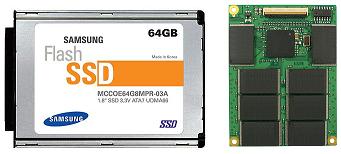
Summary: To listen to some people talk about it, Solid State Drives (SSDs) – like the 64GM model from Samsung that you can get in the new MacBook Air – are doomed to fail.SSD is defined as "A disk drive that uses memory chips instead of rotating platters for data storage.
To listen to some people talk about it, Solid State Drives (SSDs) – like the 64GM model from Samsung that you can get in the new MacBook Air – are doomed to fail.
SSD is defined as "A disk drive that uses memory chips instead of rotating platters for data storage."
By now you should be able to recite the benefits of SSD by rote: lighter, longer MTBF, more shock resistant, lower operating temperature, faster boot times, yadda, yadda.
In a previous post I posited that SSD may be overhyped because it's not really that fast but is super expensive. While random "disk" access is pretty fast, initial benchmarks show that SSD boot times and sequential disk access are nothing special.
The other big knock on SSD technology is its finite lifespan. People in the know claim that SSDs can start to fail after 100,000 writes to every single cell in the chip, which is almost virtually impossible.
Steve Gibson addressed the SSD lifespan issue on Security Now podcast #122 (transcript). Gibson also responded to a commenter on The Apple Core that wrote to his company to ask why he couldn't use his Spinrite hard disk repair software on a thumb drive.
...the other thing that happens is, if you write to (non-volatile, solid state memory) over and over and over, they die. So they don't die fast. It's like on the order of 10 to the 5 write cycles, so like 100,000 write cycles. But not infinite. Hard drives are infinite. That is, it doesn't hurt them in any way to change the data on them. It actually hurts non-volatile memory to change its data. So in order to mitigate the damage, non-volatile RAM has a technology that spreads the actual writing around the surface of the RAM. So that even if you are reading and writing the same area, that is, the same address of the RAM over and over and over, it's actually occurring in a distributed fashion across different physical areas of the RAM. They do that in order to spread out the damage caused by writing to it.
But naturally the manufacturer says that it's not the case...
Samsung’s Michael Yang defends flash reliability in solid-state drives claiming that SSD's are virtually impossible to wear out. A flash device rated at 100,000 write cycles can write 100,000 times "to every single (memory) cell within the device." In other words, the device doesn't write to the same cell over and over again but spreads out the writes over many different cells. This is achieved through "wear leveling" by the SSD's controller.
Yang said a pattern could be perpetually repeated in which a 64GB SSD is completely filled with data, erased, filled again, then erased again every hour of every day for years, and the user still wouldn't reach the theoretical write limit. He added that if a failure ever does occur, it will not occur in the flash chip itself but in the controller.
Can SSDs be any worse than HDDs? There are only two types of hard drives, those that are dead and those that are dying. After about three years or so I don't place much faith in any hard drive. They all start to get flakey after three and five years of use.
Prone to failure or not, SSDs are too expensive to be practical for me. If the MacBook Air had an 128MB SSD option for, say $500, I'd be all over it.
[poll id=105]
Kick off your day with ZDNet's daily email newsletter. It's the freshest tech news and opinion, served hot. Get it.
Talkback
Most SSD doom and gloom writers seem uninformed
Not only are SSD's super reliable, they are are future of portable media. Why not simply use the well oiled MTBF and IOmeter measurements to compare SSD's to HDD's is testament to the goal of creating rhetoric around SSD failure. They point to HDD's "infinite" write cycle endurance yet ignore the failures caused by platters banged by a microhead mere microns away from a fast spinning surface. Nah, forget that. LOL
I presented both sides...
I would hardly call that "a whole doom and gloom campaign around that one limitation" or "irresponsible technical journalism." Were you referring to my piece or to Gibson?
Either way, the piece was written to elicit a response. Are you worried about SSD reliability? Why? Why not?
Rhetoricpolice obviously isn't...
Best,
Jason
Not worried about SSD reliability
I am not at all concerned about SSD reliability. I know enough about what is happening in this space to comment. I confess, I work for a company that produces these. Either way, you simply cannot ignore that inevitable path that mobile devices are going solid state - period. The other point is that while NAND (and most charge trapping NV memory) have long term reliability limitations, they are corrected with wear leveling (as you pointed out) as well as ECC and other "tricks" to effectively render that issue moot.
In the not too distant future, NAND will be replaced with phase change or perhaps another technology but it is not so much about reliability, it's about cost and scale. I find the 100K erase cycle issue as a non-issue in practical terms. We are talking about a (possible) failure situation far beyond the use models of where this technology is being applied to.
Also, correct your last point about 128MB. You mean 128GB. I think I'll stick with rhetoric police but will not ticket you this time around :0-)
SSD is emerging technology. It will improve with time. (nt)
My MBP hard drive has failed twice in 2 years
I have had Flash memory cards for years and the only reason one of them failed is because it went through the washer and dryer a couple of times :) Bring on the cheap SSD media for future devices!
Doesn't Toshiba make a thicker disc accessory hard drive for laptops ?
RE: The SSD failure debate
reliability come from the
rotating media companies
(Seagate, WD, etc.) and are
based on some very early flash
drive data.
To me, the SSD argument is a
no brainer... once they get big
enough and cheap enough, they
are the only way to go for
laptops.
The rotating media guys are all
looking at how to make money
with SSD in the future, whether
that's hybrid technology or
something completely
differently like holographic. I
think that's going to be hard
for them as its not their stock
in trade. They have gigantic
manufacturing operations that
crank out the very unique parts
that are required for rotating
media, and don't have chip
fabs, etc.
Rotating media will eventually
be relegated to bulk storage
applications where the absolute
lowest cost of storage is the
driving factor.
I'm also waiting for the 128GB-
160GB SSD for $500 bucks
(about a 10x price premium
over rotating, but that's my trip
point to put it on my laptop).
It's Jerry Pournelle's second law...
Certainly, we are all just waiting for technology to catch up with Dr. Pournelle's vision.
RE: The SSD failure debate
chuggin' along....
128MB SSD?
Yeah, I know, it was a MB/GB typo, but had to give you a hard time. Really do have the hard drive in my old Powerbook replaced with an IDE-to-CF converter and a 2GB SanDisk Ultra II CF card, though. Works spiffy, and not that expensive at all. (Could have gone for a larger size, and would have been more cost-effective, but the 3400c has a couple quirky bugs when you try to stick drives larger than 3GB in it.) Only a matter of time before the cost of that 64GB drive comes down. By the by, Dell sells pretty much the same darned thing for $100 less than Apple. Hmmm.
I have several 10yr old SCSI drives...
Agree 100%. You get what you pay for....
To thosse comments on "my drive died 12 times in 3 days" (exageration, but they're whiney anyway) did you buy the HDD "special of the day"? A HDD is not HDD is not HDD! there are classes of drives meant for differing applications and level of reliability but the average person and half of people that call themselves "knowledgable" don't know this.
Most people will just purchase a SATAII drive by virtue of brand and/or price.
Seagate is a perfect example they have differing drive lines in SATAII to meet differing needs and cost constraints.
They have the SV line for multiple streaming as in video recorders that trade off error correction for number of simultaneous streams. They have the good old stxxxxxx'AS' line for a reliable consumer drive that is not meant to hold "critical" data. They have the NL (near line) series which are meant for enterprise offline snapshot storage. Then they have true enterprise class drives as in the STxxxxxx'ES' SATAII drives which are meant for mission critical data and incorporate a high level of error detection and correction as well as fault tolerance.
These drives will outlast their FLASH equivalents in the same environment by years.
Better buy a lot of RAM and disable swap
Think of how hard your drives get hit and manufacturers of flash drives don't suggest defrag (no need to since it's random access) because it will shorten the drive's life.
The only situation I see using SSD are for "toughbook" type laptops or automotive apps.
HDD will normally last for many years. SSD guaranteed to go "soft" after so many write cycles.
Sudden versus gradual/predictable
cells will 'soften' in a predictable manner, and the
controller can do a lot to minimize the impact by moving
hot files around. It can also warn you when its no longer
safe to write, although I'm not sure how that's being
interfaced to the OS at this point.
Rotating media drives, in comparison, tend to have
sudden, unpredictable failure modes. SMART was
supposed to warn when the drive was getting flaky
before it impacted the data reliability, but the drive
manufacturers really don't know how to predict most of
the sudden failure modes.
(How many of you have had SMART warn you in time to
backup and replace the drive before it impacts your
system?)
In the end, SSD should wear out gracefully, and give you
time to replace it before it loses data, while rotating
media drives will wake up dead periodically, forcing you
to go to your backup, just like they always have.
The real question is how long an SSD will operate as the
only drive in the system. If that's 3+ years, wearout is
not an issue for me. I upgrade to a new laptop every 2
years or so.
John Marshall
That's why you buy an 'ES' series drive...
RE: The SSD failure debate
In fact, I brought this up on the ZD/Net forums a few weeks back
It may be ultimately irrelevant - or it may not be. I'm currently using a EEE PC as a "knockaround" laptop, as well as a iPod Touch (which also uses flash memory) - if I come back in six months or so snarling about disk failures, we'll have the answer.... :/
Please, inform me if so. I am using an Eee also
don't we oughtta make an SSD failure incident database????
i' m open....
RE: The+SSD+failure+debate
Someone take this "stuff" and put it through the wringer to make sure that it is a viable product. Anyone remember EEPROM's? The manufacturer of these devices stipulate on the technical documentation the ETBF which was about 100000 write to the chip.
No more debate on the issue ... test the blasted things an see for ourselves.
RE: The SSD failure debate
I did not use this Laptop often, and never for very long. It worked perfectly until it instantly failed.
In 25 years of computing I never had a Mechanical Unit fail instantly and catastrophically like this.
I've also had several USB Drives fail - and I always remove them "Safely".
SSD's are fast, but Back Them Up !!