A closer look at Windows Update problems

Summary: Two weeks ago, I reported on widespread problems with Microsoft's Automatic Updates and Windows Update services. Microsoft confirmed those problems a few days later, assuring Windows users that the delays in downloading updates were "perfectly normal." I've put together a new image gallery that illustrates substantial problems with Microsoft's update process. But they're not willing to talk about it.
Two weeks ago, I reported on widespread problems with Microsoft's Automatic Updates and Windows Update services. Microsoft confirmed those problems a few days later, assuring Windows users that the delays in downloading updates were "perfectly normal."
The more I look, the more I'm convinced that there's a substantial problem with Microsoft's update process. But they're not willing to talk about it.
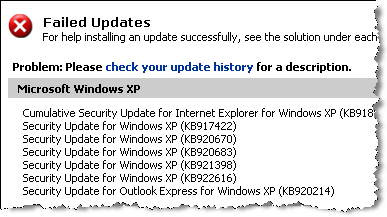
I've put together an image gallery that documents problems I experienced, and which were confirmed by other people in newsgroup posts, comments, and via e-mail. Problems include lengthy delays before receiving updates, missing updates, and errors when connecting manually to Microsoft's update servers. In this gallery, I document how you can use some widely available tools to investigate how well the update process is working for you.
I tried to arrange a phone interview with a security expert at Microsoft who could explain what's going on. Unfortunately, the person I needed to talk to wasn't available, so I was invited to submit a list of questions to a representative of Microsoft's public relations agency, who promised to get them to the right people and assured me that I would get "transparent responses, with no waffling or sugar-coating."
The answers arrived in an unsigned e-mail reportedly prepared by a group of Microsoft employees working in Windows and security groups. Unfortunately, they didn't answer most of the questions I posed, and my request for a follow-up was turned down.
Microsoft insists there's no problem. Delays are normal, they say, especially when they choose to prioritize one update:
it is our goal to align security threats and distribution. Some of your questions asked about how long customers should expect to wait before receiving patches. The Microsoft Security Response team works to align the severity of a security threats with an appropriate speed for update distribution. It’s really an extension of a core security practice – as Microsoft assesses a security threat it determines whether it is appropriate to release an update during a standardized patch Tuesday, or whether there is a need to issue an update out of band from the regular cycle.
According to Microsoft, one of the errors people experienced on Windows Update earlier this month might have been caused by a unique scenario.
The threat presented by the vulnerability addressed in MS06-040 prompted us to do everything possible to ensure that customers received the update with the highest possible priority. We are aware of one scenario –which may explain what you observed. If a PC has been off for several update cycles, an AU scan will happen as soon as you log in, resulting in longer time for AU scan, inventory and downloads applicable updates.
That doesn't explain why I and many others were completely unable to reach the Windows Update servers for several days at a time.
Finally, Microsoft is sensitive to its responsibility to not overload the Internet. This theme was repeated throughout the replies I received:
[W]e believe our approach is a responsible use of the Internet. As you know, the Internet is a shared resource. As an infrastructure, it has capacity limits and the organizations that use it in the course of their business must act responsibly to ensure that high bandwidth use does not impact or slow down others use. As is further detailed below, Microsoft’s updating infrastructure is highly scalable and we purchase additional bandwidth capacity if that is required to ensure that the distribution of updates is aligned with the perceived threat. That said, we can’t let our use of the Internet impact or slow down others.
As I noted in my original post, I've kept meticulous records of the performance of Automatic Updates on a test machine since late 2004. For the first year, updates routinely arrived within 1-2 days. This year, the average time between the release of Critical updates and their arrival via Automatic Updates has slipped to 4-5 days, and in August it took a full week. Microsoft won't answer any questions that address this issue.
They also won't answer the simple question, "How many days does the Automatic Updates cycle take? How long after updates are released (typically on Patch Tuesday), should a customer wait before assuming something is wrong?" Last year it was a day or two. This year it's a week. Will some customers have to wait even longer next year?
According to Microsoft, "hundreds of millions" of people connect to the Automatic Updates servers each month. They deserve more information about what, exactly, they're getting.
See image gallery for a closer look at problems with the update process...
Kick off your day with ZDNet's daily email newsletter. It's the freshest tech news and opinion, served hot. Get it.

Talkback
even autopatcher had it's monthly rollup ready for download on 8/13
if you have a fresh install of SP2 just download the full and you can patch offline.
That is not hardly the point.
This makes windows very unreliable and unstable. It has probably been the leading cause of me switching teams. I am now a linux user and enjoy a system of stability.
Hmmm, by limiting how fast people update
Could just be...
...more people are vulnerable
So now you've got the exploit people being given the means to exploit the box and a growing window of vulnerability for Windows users...
It is possible
It is a shame because, where security side of MS is concerened, they are trying to do the right thing, and are working hard to protect people computers as best they can. In this respect, I feel for the developers at MS.
Ironically, it is probably time for some new ultra reliable high capacity dedicated hardware from Sun. They don't need flexibility, they need some raw performance. (Sun is a partner, so it is much more appealing than a Linux cluster farm).
TripleII
They are already using a cluster of ...
High capacity Windows servers?
It's a cluster alright........
I'm not trying to get a flame started here but....look at Vista...hacked already! And yes, I do understand any software can be cracked/hacked given enough time.
I say open the doors and let the patches roll! If I remember right there are differant time zones????
I agree with mstngtim
Now they ae being nice to the internet when in reality they are reverting to a whenever possible timesale.
Patch Tuesday should not exist.
Patch as soon as one is available and be a good citizen.
And stop the Hype.
Where's the upside?
"Better to remain silent and thought to be unreliable rather than speak up and remove all doubt."
This [1] is a PR problem, so it's hardly a surprise that MS is treating it like one.
[1] Communications with you -- not the engineering, which is none of our business.
Of course it takes longer...
;)
Windows Update issues
Is it acceptable?
While this may be inconvenient for the at home user, those of us in a work environment do not have the kind of time required to wait for site access and subsequently downloads. I have seen times as long as two hours to complete the task, and often times fail completley.
Unfortunatley, it is not always practical or secure to leave multitudes of desktops, laptops etc. with automatic update running, thus the issue of the "middle of the night" download often times being invalidated, so while the concept here is a good one, the execution is often times flawed.
While I suppose there is some validity to Microsoft not wanting to deplete the bandwith of the internet with massive amounts of visitors to the various update sites, I think the deeper question needs to be asked, and that in my eyes is why so many updates in the first place? In looking what runs on my machine, which granted is not the norm, I could potentially spend an inordinate amount of time downloading patches for XP, SQL, VS just to name a few.
Perhaps the problem is not really the update issue, but why we need to update so frequently. If Microsoft looks there first,at the core product in a pro-active manner, then perhaps the level of traffic to microsoft.com would decrease accordingly.
Of course it's acceptable...
I'm glad I only have to deal with WinDos at work. The machine runs like a dead dog but that's the company policy so it's not my problem. I find it rather amusing to hear the boss complain about what goes wrong each week. Patch didn't arrive. Patch broke MacAffee software. Patch broke payroll system. Patch was followed up by worm in a matter of hours. Patch broke backup software.
Of course not all problems are Microsoft's fault - there are just a lot of really awful programmers out there, and with modern 'managers' being trained by Jack Welch's latest management bestseller, they have this ridiculous notion that the cheapest programmer is as good as any. Personally I'm rather angry at the number of people being given diplomas in computer programming when they're absolutely clueless. Unfortunately, have paper get job. I have never considered myself a top-notch programmer, but I do a much better job than most I've seen - pretty sad considering that programming machines isn't even my job. Apparently I'm not the only one who thinks the newer generations of programmers are generally no good - several people in various Australian companies have told me they have a very hard time finding good programmers - each job ad receives hundreds of applications and it's not unusual that there is not a single qualified applicant.
Friedrich
A close look at Windows Update Problems
Auto Updates
Time to find a new seller
????
Do you mean the UPS WorldShip software won't phone home to mama? Or you can't pull up the tracking data from the UPS web site? Those are two very different problems. Do you have an automated scale in your warehouse linked up to a computer? Label printer and all that? Because my question is why isn't UPS supplying that PC for you?
Is this a warehouse or billing issue? It's either warehouse or you're doing accounting and you can't access your reports.
Thanks for the heads up. I'm sure this jewel will add even more billing for meeeeeeee. lol. Gotta love it.
You must be smokin something
For the money, I would stick with older versions of XP for stability. IE7 has proven to be a nightmare. I don?t care how it?s touted, IE7 is crap.