ie8 fix
madison

Coming soon to a Mac near you: serious malware

By | May 2, 2011, 9:42am PDT

Summary: Last week I showed you how malware authors are targeting Google Chrome. Now there’s evidence that the next target is Apple. According to a Danish IT security company, an underground group has completed work on a fully operational kit specifically designed to build malware aimed at the Mac. And all the pieces are in place for a devastating attack. I’ve got the details.

Welcome, Daring Fireball visitors! You really should read the much longer and more detailed follow-up post here: Why Mac malware is on its way.

Follow-up: Malware attempts that use Apple-focused social engineering are now in the wild. I just found one via Google Image search. See for yourself: What a Mac malware attack looks like.

Last week I showed you how malware authors have begun using social engineering to target Google Chrome, with convincing replicas of Chrome’s bright-red security screens to trick victims into installing a package of malware.

Now I am seeing evidence that the next target is OS X. That’s potentially very bad news for Mac owners who have abandoned their PCs in the belief that switching to a Mac somehow immunizes them from malware.

Security experts know, of course, that there’s nothing magical about Macs when it comes to security. They just haven’t been targeted because Windows has been such a big juicy target for so long.

But now that Macs have achieved a critical mass of success in the marketplace, they’ve attracted the attention of malware authors. According to a report from a Danish IT security company, an underground group has completed work on a fully operational kit specifically designed to build malware aimed at the Mac OS platform:

The first advanced DIY (Do-It-Yourself) crimeware kit aimed at the Mac OS X platform has just been announced on a few closed underground forums. … The kit is being sold under the name Weyland-Yutani BOT and it is the first of its kind to hit the Mac OS platform. Apparently, a dedicated iPad and Linux release are under preparation as well.

[…]

The Weyland-Yutani BOT supports web injects and form grabbing in Firefox; however both Chrome and Safari will soon follow. The webinjects templates are identical to the ones used in Zeus and Spyeye.

CSIS eCrime Unit is in possession of videos documenting both the admin panel and its functionality as well as the builder itself. Both video clips prove this kit to be fully operational already.

This is not a proof-of-concept attack written by a researcher or someone trying to score a prize in a security contest like Pwn2Own. This is the real deal.
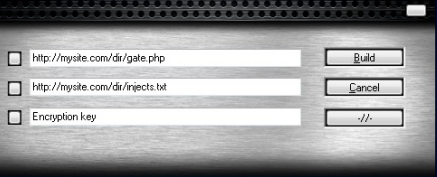

Photo credit: CSIS

CSIS partner Peter Kruse told me that the builder runs on Windows, “and based upon the configuration added by the user it will create a Mac binary which obviously can be used to steal data from infected Mac hosts.” I’ve had an opportunity to observe the videos of this program in operation, and it works as advertised. Building the malware package took literally a couple of clicks and less than five seconds. With the Trojan installed on a Mac, a remote host was able to log keystrokes in Safari and capture passwords for a Gmail account—it was even able to detect and log the victim’s attempt to change the compromised password.

The widespread attack that I watched unfold in late April already has all the ingredients in place to make an attack like this possible. Here, for example, is a snippet of the script that I saved from one of the Google-targeted sites:

This particular attack, which I saw over and over again in Google search results, customizes its results based on the victim’s browser and operating system. When I used Chrome, I saw an attack that duplicated the security screens from Chrome. When I used Internet Explorer, I saw screens that mimicked Windows Explorer in Windows 7. When I used Firefox, the attack looked like a series of Windows XP screens.

And when I visited a poisoned site using a Mac, the script detected my OS, skipped the fake malware screens, and redirected me instead to a phishing site.

So why didn’t the authors of this malware deliver a booby-trapped OS X installer package? Maybe it’s on their to-do list.

If a malware author can detect that you’re visiting a “poisoned” site using OS X, it could easily serve up an executable file tailor-made to run on a Mac and steal passwords, log keystrokes, send spam, or deliver pop-ups. The malware author can code in exploits to take advantage of unpatched vulnerabilities in OS X or in programs like iTunes or Adobe Flash to install the software as a drive-by download. They can also use the same tactics that have worked so well against Windows users. That’s where the social engineering comes in. If a Mac owner is told that there’s an important update for Flash or iTunes and they need to install it immediately, will they do so? Some significant percentage certainly will.

An even more sobering thought for Mac owners is the possibility that attackers will create targeted packages aimed at businesses that have switched to Macs. If you can send a booby-trapped PDF file that appears to come from your HR department, the chances that it will be opened go sky-high.

If a group decides to deploy an attack like this on a wide scale, the impact on Mac users could be devastating. Only a tiny percentage of Macs run antivirus software, and Mac users have been conditioned to believe they’re immune from Internet threats. That’s a deadly combination.

Update: H/T Rob VandenBrink at SANS, who mentioned this in a post this morning that sent me to the original source.

Kick off your day with ZDNet's daily e-mail newsletter. It's the freshest tech news and opinion, served hot. Get it.

Topics

Ed Bott is an award-winning technology writer with more than two decades' experience writing for mainstream media outlets and online publications.

Disclosure

Ed Bott

Ed Bott is a freelance technical journalist and book author. All work that Ed does is on a contractual basis.

Since 1994, Ed has written more than 25 books about Microsoft Windows and Office. Along with various co-authors, Ed is completely responsible for the content of the books he writes. As a key part of his contractual relationship with publishers, he gives them permission to print and distribute the content he writes and to pay him a royalty based on the actual sales of those books. Ed's books written prior to fall 2011 have been distributed by Que Publishing (a division of Pearson Education) and by Microsoft Press. As of November 2011, Ed is a partner in the independent publishing company Fair Trade Digital Exchange, which exclusively publishes his books.

On occasion, Ed accepts consulting assignments. In recent years, he has worked as an expert witness in cases where his experience and knowledge of Microsoft and Microsoft Windows have been useful. In each such case, his compensation is on an hourly basis, and he is hired as a witness, not an advocate.

Ed does not own stock or have any other financial interest in Microsoft or any other software company. He owns 500 shares of stock in EMC Corporation, which was purchased before the company's acquisition of VMware. In addition, he owns 350 shares of stock in Intel Corporation, purchased more than two years ago. All stocks are held in retirement accounts for long-term growth.

Ed does not accept gifts from companies he covers. All hardware products he writes about are purchased with his own funds or are review units covered under formal loan agreements and are returned after the review is complete.

Biography

Ed Bott

Ed Bott is an award-winning technology writer with more than two decades' experience writing for mainstream media outlets and online publications. He's served as editor of the U.S. edition of PC Computing and managing editor of PC World; both publications had monthly paid circulation in excess of 1 million during his tenure. He is the author of more than 25 books on Microsoft Windows and Office, including the recently released Windows 7 Inside Out.

416
Comments

Join the conversation!

Just In

RE: Coming soon to a Mac near you: serious malware
FAULKNE 13th Oct
Good day to confirm this comment I would appreciate T h e b e s t o f Z D N e t d e l i v e r e d your website very nice to everyone Yes, Oracle is the only one with shared-disk architecture, but that is there advantage. It means you can add or remove nodes and the database lives on. In a shared nothing architecture, if you lose a node, you lose the system. I'm sure Oracle appreciates EMC highlighting their advantage.I also desire to signal in your RSS feeds. Thank you as soon as once again and maintain up the great operate Awesome post! Thank you very much || thanks for nice content this is really benefit to me.
0 Votes
+ -
Pause this for just a moment. I need to go grab some popcorn. I'll BRB.
0 Votes
+ -
@Cylon Centurion 0005 Same.
0 Votes
+ -
@Cylon Centurion 0005, Slow reader? You may be dyslexic. If you're in full time education, which I presume you are, you may qualify for a free Mac. Worth checking out. Good luck little fellow.
0 Votes
+ -
@Graham Ellison Don't shoot the messenger. happy
  • Flagged
0 Votes
+ -
Message has been deleted.
Narg Updated - 3rd May 2011
  • Flagged
@Cylon Centurion 0005

Absolutely, this should be an interesting year for malware and how secure various platforms really are (or aren't).
0 Votes
+ -
@CobraA1
Of course this very story is repeated here every few months or so. " Mac is finally popular enough for malware writers to care- here comes the flood of Malware" And then nothing happens. This cycle has been repeated for decades.
@Tigertank,

There are Mac bot nets out there.
0 Votes
+ -
No, this isn't the same old story.
Lester Young 2nd May 2011
@Tigertank Read it again. It's an actual, not hypothetical, product targeting OSX.
0 Votes
+ -
You're a FUDster
Info-Dave 2nd May 2011
@CobraA1 No, there aren't any Mac bot nets.

Links? Proof? You are making this up.
0 Votes
+ -
Actually, infoDave, there is one...
vulpine@... 2nd May 2011
... consisting of about 60,000 machines compromised when their users downloaded cracked versions of legitimate, but expensive, software. Yup; people who wanted something for nothing got exactly what they paid for.

By the way, that 60,000 machines totaled out to 0.02% of the Macs in use at the time.
0 Votes
+ -
Waiting...
Info-Dave Updated - 2nd May 2011
@vulpine Links? Identification of the expensive software? Proof? Anything?
0 Votes
+ -
An internet search is your friend.
Lester Young 2nd May 2011
@Info-Dave

If you want to find out, you will. If you don't you won't.
0 Votes
+ -
@CobraA1 Yes. Malware will be adapted to go after other platforms. Most likely mobile OSs. All you need is a user less than knowledgeable.
0 Votes
+ -
@Info-Dave
ScorpioBlue 3rd May 2011
Links? Proof? You are making this up.

That's true and they are.
@info-Dave
http://lmgtfy.com/?q=mac+botnet

Note there is an article which places Mac Botnets as far back as 2006, but 2009 was the first one real media types reported on.

Why don't you search for/against proof instead of throwing a tantrum?
0 Votes
+ -
RE: Coming soon to a Mac near you: serious malware
MrElectrifyer Updated - 3rd May 2011
@Tigertank " Mac is finally popular enough for malware writers to care- here comes the flood of Malware" And then nothing happens..... to you in particular, you're not as important as businesses are to a malware author just yet .

So long as you remain non-self-aware of your online security, in one way or another, you will be out of noob luck and indeed get infected; so, suggest you take this post as a warning and quit being a hard headed noobish Apple fanboy silly

Pss, being a fanboy is no problem, but being a noobish fanboy is a big issue
  • Flagged
A 1000 mac bot net was shown to exist in the new about year ago. I think the article on it was even on this site.

Not that it's hard to compromise a Mac. All you need to do it target the users desires. Get them to download the malware and run it for you. Offer porn, software and movie with special codec. It happens. 1000 Mac world wide isn't large number though compared to Windows Bot Nets.
0 Votes
+ -
Malware, Trojans, Viruses
pecosbill Updated - 5th May 2011
@All: There's nothing magical about Mac OS that prevents Trojans. If the user decides to download something and PROVIDE a password to install it at the admin level (or root level) or NOT PROVIDE one to install at the user level, there's nothing in the OS that protects from such a Trojan. However, that's not a virus in the true sense but is malware.

If you give the keys to the house by downloading something that could be evil, you are asking for criminals to walk/sneak into your house and set up shop! The ONLY thing that protects against social engineering (or downloading "free" software) is education.

As for social engineering, I think it is MUCH easier to determine where a window came from on a Mac vs on Windows. All you have to do is hide the browser and anything suspect goes away. If it's coming from the browser, don't believe it. Windows doesn't have the same layering of applications.
@voska1, Lester Young, Cylon, etc.

There is a reason Ed Bott has a "Welcome Daringfireball visitors" at the top of this web page. Ed is trolling and he's been caught. Plain and simple.

Ed was careful to use generic terms like malware instead of viruses, etc. because malware also includes Trojans. There is no protection on any system against Trojans. If you're dumb enough to download software illegally from bit torrent sites and you are dumb enough to supply these programs with your administrative password, then you get what you deserve. This is not a security issue, this is a social issue and certainly nothing an ounce of common sense couldn't help you avoid.

I have both PCs and Macs. Since the initial Mac OS X release, the only piece of malware I've ever had on that system were Windows Office macro viruses. Nothing that affected the Mac, only something that could be passed on. On the other hand, I've had PCs infected, even with anti-virus software running. It happens. Sure, the Mac is becoming more of a target. However, as Gruber points out, this is the same old rhetoric that we've been hearing about for years. Sorry Ed, you were caught..
http://daringfireball.net/2011/05/wolf
0 Votes
+ -
Message has been deleted.
tonymcs@... Updated - 3rd May 2011
0 Votes
+ -
@tonymcs@...

I guess paying a little extra for better quality only applies to cars, homes, appliances...certainly not computers, right?
0 Votes
+ -
Message has been deleted.
anono Updated - 3rd May 2011
  • Flagged
0 Votes
+ -
Sense earns money?
Lester Young 3rd May 2011
@anono

I guess that explains Lindsey Lohan, Donald Trump, and all the captains of Wall Street who did such a great job making themselves rich while destroying the economy.
@tonymcs@...

sense of proportion...

http://img543.imageshack.us/img543/1503/newmalwares2010firsthal.png

1 016 000 malwares for Windows, 226 for Linux or Mac or Solaris or Unix or BSD.
0 Votes
+ -
@tonymcs@...

A large draw for macs is the "simpler and more intuitive than windows" line. So many of the folks switching over are doing so because they aren't particularly I/T savvy and don't want to have to worry about it. Note that lack of I/T savvy doesn't mean they are stupid.

So it's pretty self-evident that the mac population contains a high proportion of people with more money than I/T skills.

By contrast, Windows has the market cornered on people with no money and no I/T skills.
0 Votes
+ -
@Cylon Centurion 0005 LMAO, don't forget the beer grin
0 Votes
+ -
Message has been deleted.
ibjermel Updated - 3rd May 2011
0 Votes
+ -
@Cylon Centurion 0005 You crack me up! Soooooo funny.
Awesome post! rolex replicas
0 Votes
+ -
lol. thanks for the post!

Mortgage Jacksonville FL
Mortgage Jacksonville Florida

Make Money Online
I've been a mac user for about 20 years and ever since the ipod came out and people talked about the "halo effect" there have been this steady stream of stories about the coming tsunami of mac platform malware. Its starting to get old.
0 Votes
+ -
Contributr
@dfl274

Surely you understand that there was a threshold that Macs had to cross in terms of popularity before they would be a serious target?

And yes, it looks like that threshold has been crossed. Lots more people are buying Macs. With popularity comes attention. Even unwelcome attention.
@Ed Bott: ... with more privileges than usually?

Not many common people (Mac users) do that.

So how exactly this news bear any "deadliness" in a big scale?
@Ed Bott

Promises Promises :P
0 Votes
+ -
What happens when 'unwelcome attention'
HollywoodDog 2nd May 2011
@Ed Bott ... meets your refusal to allow software to be installed? You have to provide a password to install anything.

If you don't do that, then the threat continues to be alarmism infecting only certain blogs at ZDNet.
@Ed Bott

... which does not mean in changes of the Mac or Linux OS architecture.
0 Votes
+ -
@Ed Bott The old 'threshold' chestnut is tired. Don't you think that any geek worth his salt would have tried to bust the Mac balloon by now? It doesn't matter if Macs have one percent or ten percent, the reputation they have would have been a huge target. To claim to have designed a virus (trojan horses, while they count as malware require the user to install) that would break the reputation of the Mac would be a huge accomplishment. That hacker would be a 'god' in the underworld in which those toads live. Threshold my Aunt Fanny.
0 Votes
+ -
@Everyone ... the whole point of malware is that it takes advantage of vulnerabilities and peoples' stupidity. Never underestimate how dumb users really are, and how vulnerable the platform really is. Afterall, look how many 100MB+ "patches" Apple releases every month in spite of the illusion of invulnerability.
  • Flagged
0 Votes
+ -
@Ed Bott So when the malware program runs for the first time, does it pop up with the first time running a program warning like every other program downloaded from the internet or copied across a network do? If it needs to do anything with the /System/Library folder, does it ask for admin password? I would think that not downloading something and having that pop up would set of a majority of red flags for many Mac users... They're not exactly a group of midnight blues and dark browns in a box full of pastels.
@Ed Bott "Surely you understand that there was a threshold that Macs had to cross in terms of popularity before they would be a serious target?"

Why would you think that? There has been malware for Linux going back to the mid-1990s. Lemme tell you, if you think Macs have had small market share of late, they're anything but small relative to Linux in 1997.

Macs had malware prior to OS X, lots of viruses. That stopped cold with OS X. Why? It's not because the Mac marketshare got a lot smaller; it's been growing steadily since OS X. There were technical reasons.

The fact of the matter is the malware guys go where the targets are soft. In the mid to late 90s Linux was a great target, most installations were wide open. When the Linux distribution vendors started locking them down the bad guys went to the next easy thing, and that was Windows' with its wide open RPC framework amongst other things. They've been there ever since, perhaps because Windows remains an easy target.

Vista and XP are less soft, and the statistics show a lot less malware, although "less" soft is not really the same as "hard".

We have seen Mac malware, in the form of trojans. They've never gone anywhere. When they start doing so it'll be time to panic, though by that time I think everyone will be running iOS whose underbelly is rather well-armored.

jim frost
jimf@frostbytes.com
  • Flagged
0 Votes
+ -
@Ed Bott : of course Mac's can be targets, but the complexity of creating an attack kills the possibility.

Most Mac OS X user don't have admin priviledges, they just change to root whenever needed, just as in Linux.

So the amount of damage a local install is slim.

Then comes the fact that patching Mac OS X does not require a restart, so the chance of an unpatch system is lower than a Windows machine.

Let's remember that the attack must be multiplatform, multi OS version. It is not sufficient to know it's a Mac, but which Mac. Are you creating a Universal for 10.5 or 10.6, which will not work on 10.4.

And last, but not least, with the emergence of the Mac Online Store, people will trust less and less any program not found there, so any current threat might not be viable in the future.
@dheady@... The old 'threshold' chestnut is tired. Don't you think that any geek worth his salt would have tried to bust the Mac balloon by now?

I knew there'd be at least one to say it.
0 Votes
+ -
Message has been deleted.
xuniL_z Updated - 3rd May 2011
  • Flagged
0 Votes
+ -
Message has been deleted.
thewhitedog Updated - 3rd May 2011
  • Flagged
0 Votes
+ -
Message has been deleted.
Info-Dave Updated - 3rd May 2011
  • Flagged
0 Votes
+ -
regarding the @Ed Botts
Info-Dave 2nd May 2011
@cosuna, you really need to do some homework. OS X does not enable root, by default. Very few Mac users enable root. While user accounts actually work quite well in OS X (as opposed to Windows), most Mac users probably run as admin. Mac updates have come to require restarting more than Windows. Safari and Quicktime updates seem to always require a restart.

@Bagered, then explain why it hasn't happened.

@xuniL_z Apple has release much larger patches to OS X than Microsoft has to Windows. Apple includes far more open software that needs to be patched (i.e. MySQL, php, CUPS, etc.) As bloated as Windows is, Apple is patching more.

You 'band aids' argument is completely off base. Apple, and the open source components of OS X, take great pride in the integrity of their software. You're trying to equate their evolution with the hairball known as Windows. Two different philosophies.

mp3's import into iTunes just fine. If it doesn't 'just work', you're doing it wrong.
@Ed Bott
Oh boy, you really done it now.
0 Votes
+ -
@denisrs You do realize the Pwn2Own stuff had 2 phases right? Copy a file to the drive (this would be the malware) and execute a file one the drive (this would be phase two) and these computers were not running elevated permissions.
0 Votes
+ -
Message has been deleted.
Peter Perry Updated - 3rd May 2011
  • Flagged
Good day to confirm this comment I would appreciate T h e b e s t o f Z D N e t d e l i v e r e d your website very nice to everyone Yes, Oracle is the only one with shared-disk architecture, but that is there advantage. It means you can add or remove nodes and the database lives on. In a shared nothing architecture, if you lose a node, you lose the system. I'm sure Oracle appreciates EMC highlighting their advantage.I also desire to signal in your RSS feeds. Thank you as soon as once again and maintain up the great operate Awesome post! Thank you very much || thanks for nice content this is really benefit to me.

Join the conversation!

Formatting +
BB Codes - Note: HTML is not supported in forums
  • [b] Bold [/b]
  • [i] Italic [/i]
  • [u] Underline [/u]
  • [s] Strikethrough [/s]
  • [q] "Quote" [/q]
  • [ol][*] 1. Ordered List [/ol]
  • [ul][*] · Unordered List [/ul]
  • [pre] Preformat [/pre]
  • [quote] "Blockquote" [/quote]
ie8 fix
ie8 fix

The best of ZDNet, delivered

ZDNet Newsletters

Get the best of ZDNet delivered straight to your inbox

Facebook Activity

White Papers, Webcasts, & Resources
ie8 fix
ie8 fix