ie8 fix
madison

How prevalent is malware on Windows PCs?

By | April 19, 2011, 8:52am PDT

Summary: I read an alarming statistic recently: “Nearly half of personal computers in the U.S. are compromised by malware.” Thankfully, that statement is not true. It is not even remotely accurate. So how did it get onto the mainstream media, and what’s the real number?

What percentage of PCs in the United States are infected with malware? If you’ve been following the mainstream press recently, you might have read an alarming statistic: “Nearly half of personal computers in the U.S. are compromised by malware.”

That statement is an outright fabrication. It is not true. It is not even remotely accurate, based on objective data. The actual number varies, depending on where you are in the world, but for Windows users who have automatic updates turned on, the worldwide average is somewhere between 1% and 2%. In my opinion, if you practice the basics of online security, the likelihood that your Windows PC is infected by malware is a tiny fraction of 1%.
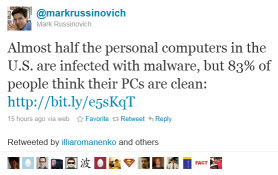
And yet that alarming and bogus 50% number was stated as if it were a fact in a feature story last week at CNNMoney.com. That story has so far been recommended by 371 people on Facebook. The same “fact” was repeated in a variety of other online sources, including thestreet.com, CNBC.com, businessweek.com, businessinsider.com, and boston.com, to name just a few.

It hit my radar when I saw the number quoted in a tweet from Mark Russinovich, a Technical Fellow at Microsoft and one of the smartest people I know.

My first reaction was “Oh really?” My second reaction was to do some research.

It took me less than 15 minutes to knock down this story, which is just the latest example of a depressing truism: If you give the mainstream press a computer story, you can usually count on them to get it wrong. If you give them a sexy press release with a provocative number, you can cinch the deal.

This case starts with a press release from Staples, dated April 5, 2011. Here’s the part that sucked in that CNN staff writer:

A common misconception uncovered in the IT IQ survey is that we falsely presume our computers are well-protected from the viruses, spyware, and other malware that put our personal information at risk and decrease performance. 83 percent of the survey respondents stated that they are somewhat or very confident their computer is free of malware. Yet, nearly half of personal computers in the U.S. are compromised by malware.*

That asterisk was in the original. It leads to this footnote at the bottom of the press release:

*According to findings released by PandaLabs in February 2011.

There’s no link to that study, but it took only seconds to find the original report from Panda Security:

According to data gathered by the free online antivirus Panda ActiveScan, 50 percent of scanned computers were infected with malware, mostly Trojans.

So, the sample consists of people from around the world who were suspicious that their computers were infected and went to an online virus scanner? That’s a far cry from “nearly half of all computers in the U.S.” (Amusingly, a commenter on the Panda blog points out that the sample is “highly flawed,” and a response from Panda Security acknowledges that fact: “[T]he data are taken from our online scanner ActiveScan. … Some people may think that the result is biased because some of those users suspect that they could be infected, which in fact is true.”)

Update 19-Apr: In response to this post, a spokeperson for Panda Security just contacted me. The company has edited the misleading headline on the press release to more accurately reflect its contents. The original headline read “In January, 50 percent of computers worldwide were infected with some type of computer threat.” The revised headline reads: “In January, 50 percent of computers scanned by Panda ActiveScan worldwide were infected with some type of computer threat.”

So why does Panda want to publish such an alarming and yet admittedly incorrect number? Because they’re trying to scare the crap out of you so they can sell antivirus software. Why does Staples want so spread that frightening but bogus statistic? Because they’re trying to scare the crap out of you so they can sell their EasyTech services. The original press release isn’t even subtle about it: “Our certified EasyTech associates are highly trained with expertise in diagnostics, repair, virus/malware removal and data back up solutions to name a few.”

The best numbers I’ve seen from an independent source (i.e., one that isn’t trying to sell a security product) are in Microsoft’s annual Security Intelligence Report. The Malware Trends section of the most recent report contains telemetry data drawn from more than 600 million Windows computers worldwide by a number of different Microsoft security tools and services, including the Malicious Software Removal Tool (which is included with automatic Windows updates every month), the free Microsoft Security Essentials and Windows Defender programs, and Microsoft’s enterprise security software.

According to the most recent data, covering a one-year period that ended in mid-2010, the five worst locations in the world (in terms of active malware infections that had to be cleaned) were Turkey, Spain, Korea, Taiwan, and Brazil. The infection rates for those regions varied from quarter to quarter, but they ranged from 30 to 60 infections per 1000 computers—worldwide, the number is roughly 10 infections cleaned per 1000 PCs. That’s about 1% on average, and about 6% in the worst cases. Update: Although the MSRT doesn’t remove every species of malware, it covers every widespread family—more than 150 in all—so I expect its figures to be representative of general infection rates.

If you use Windows and you have automatic updates turned on, you’re in that sample. If you’re even moderately cautious about how you use the Internet, your risk of infection is probably well below the midpoint of that sample.

Obviously, the rate of malware infection is unknown (and probably considerably higher) for people who refuse to update their computers. But those people are unlikely to pay a tech at Staples to clean up their PC.

I’ll leave the last word with Russinovich. When I pointed out the flaws in the study to him, responded, via Twitter: “Wow, typical mainstream press idiocy.”

Exactly.

Kick off your day with ZDNet's daily e-mail newsletter. It's the freshest tech news and opinion, served hot. Get it.

Topics

Ed Bott is an award-winning technology writer with more than two decades' experience writing for mainstream media outlets and online publications.

Disclosure

Ed Bott

Ed Bott is a freelance technical journalist and book author. All work that Ed does is on a contractual basis.

Since 1994, Ed has written more than 25 books about Microsoft Windows and Office. Along with various co-authors, Ed is completely responsible for the content of the books he writes. As a key part of his contractual relationship with publishers, he gives them permission to print and distribute the content he writes and to pay him a royalty based on the actual sales of those books. Ed's books written prior to fall 2011 have been distributed by Que Publishing (a division of Pearson Education) and by Microsoft Press. As of November 2011, Ed is a partner in the independent publishing company Fair Trade Digital Exchange, which exclusively publishes his books.

On occasion, Ed accepts consulting assignments. In recent years, he has worked as an expert witness in cases where his experience and knowledge of Microsoft and Microsoft Windows have been useful. In each such case, his compensation is on an hourly basis, and he is hired as a witness, not an advocate.

Ed does not own stock or have any other financial interest in Microsoft or any other software company. He owns 500 shares of stock in EMC Corporation, which was purchased before the company's acquisition of VMware. In addition, he owns 350 shares of stock in Intel Corporation, purchased more than two years ago. All stocks are held in retirement accounts for long-term growth.

Ed does not accept gifts from companies he covers. All hardware products he writes about are purchased with his own funds or are review units covered under formal loan agreements and are returned after the review is complete.

Biography

Ed Bott

Ed Bott is an award-winning technology writer with more than two decades' experience writing for mainstream media outlets and online publications. He's served as editor of the U.S. edition of PC Computing and managing editor of PC World; both publications had monthly paid circulation in excess of 1 million during his tenure. He is the author of more than 25 books on Microsoft Windows and Office, including the recently released Windows 7 Inside Out.

251
Comments

Join the conversation!

Just In

RE: How prevalent is malware on Windows PCs?
FAULKNE 13th Oct
Good day to confirm this comment I would appreciate T h e b e s t o f Z D N e t d e l i v e r e d your website very nice to everyone Yes, Oracle is the only one with shared-disk architecture, but that is there advantage. It means you can add or remove nodes and the database lives on. In a shared nothing architecture, if you lose a node, you lose the system. I'm sure Oracle appreciates EMC highlighting their advantage.I also desire to signal in your RSS feeds. Thank you as soon as once again and maintain up the great operate Awesome post! Thank you very much || thanks for nice content this is really benefit to me.
0 Votes
+ -
There was a time--oh, say when Outlook Express got in a message claiming to have a background sound file to be played and said to itself "Hmmm, this sound file is executable. I should run it" when things were "a little worse" than they are now.

Or when you could get a file with a malicious Window Definition resource onto a Mac (including one that came on a magazine CD which I evaded by being months behind reading the magazine).

But now, not so much. (The recent flurry of Excel bearing bad Adobe things helped the faulty news spread, of course.)
0 Votes
+ -
during the past two months, my desktop has been hit by at least 24 Malwares, my wife's laptop 20. Most of these came from facebook.

Lester Prehlm
0 Votes
+ -
@lprehm@... Your fault. Set your Facebook security up a little and quit using it like a 9 year old.
0 Votes
+ -
Stop clicking on everything!
lostarchitect 19th Apr 2011
@lprehm@... That's all the advice I can give you, because that's just crazy.
0 Votes
+ -
@lprehm@...
than not. Believe it or not, there are people who don't work in IT who own a computer. I clean a dozen PCs a month, and it's just something I do as a courtesy for friends and family. People who have kids are especially prone to needing their PC cleaned on a monthly basis at a minimum.
0 Votes
+ -
RE: How prevalent is malware on Windows PCs?
LiquidLearner 19th Apr 2011
@jasonp...

Clearly you don't work in IT, or at least not one that does it's job. With very little effort you could set up the children with their own accounts that wouldn't be able to infect the PC. It works for everyone I've done it for. Infections are very rare these days and are almost always user error. If you were doing your job you wouldn't be cleaning "dozens of PCs a month".
0 Votes
+ -
@jasonp@... I clean a dozen PCs a month, and it's just something I do as a courtesy for friends and family.

Standard user accounts.... use them. One administrator account that is only used when necessary is plenty. Along with a hardware firewall, and a decent anti-virus will save you a lot of those trips.

Unless of course you get a good meal, and a case of beer out of it or something. Then just keep doing what you're doing.
0 Votes
+ -
@lprehm@...
If in the last 2 months you and your wife have had 44 malwares (first of all how do you even know it came from facebook or are you assuming or using false logic to come to the conclusion). I suggest you and your wife take a long hard look at your history and see where you and people in your household have been surfing to.

More than likely you were already infected a long time ago and your zombie machines are now gathering additional friends.

Unless one of you have been visiting "special" sites for adults or looking for illegal software your chances of getting malware is 0.09%. Its actually very hard to accidentally go to a bad site these days.

I routinely intentionally start up virtual machines and go searching for sites with malware to measure my own defenses. Browsers/firewalls have gotten so good its actually hard for me to find sites with good malware. Most of them are laughable now.
0 Votes
+ -
@lprehm@...
and after you get one...
0 Votes
+ -
Try using common sense and ...
Cayble 24th Apr 2011
@lprehm@...
An AV program. I use FB and experience no such problems. Its as simple as that.

If your getting hit by that much malware then your doing something horribly wrong somewhere.
0 Votes
+ -
jasonp@...
Ya, I deal closely with hoards of the computer "unsavvy" and sorry to say that even the vast majority of them have known for some time now clicking on everything that comes your way is a no no.

Properly set up AV and anti spyware block all but the most uncommon forms so the people who own the dozen PC's a month you clean out are still being stupid to the degree of even well below the typical uneducated masses.
0 Votes
+ -
@lprehm@...

many virus/malware scanners classify everything as a threat in summaries. this includes cookies with the POTENTIAL to track. i use both a Norton security suite and MalWare bytes and unless i delve in to actually look at the details i really don't know what they are. all i see is a line that says X number of security threats have been removed. among these are cookies my bank leaves and other sites i pay utility bills on and some of the sites where i shop. it also seems the definition of a Trojan is pretty broad anymore.

as to Facebook- i preach to my friends and family who use it that all those cute little games and innocent apps grant access to your FB info in spite of what your security settings are. i also recommend never clicking on links when you get FB notifications in emails. i recommend opening a browser, navigating to FB that way and logging in them checking notifications and requests from your home page. people have become pretty good a spoofing FB notifications and so many people i know who get infected get a friend request from someone they don't know and immediately click the link to see who this person is. the malware writers do steal real identities of FB members so those people often don't know their IDs are being used for ill things.

and you said "hit" which means what? that malware successfully installed on your PC or it was thwarted? the former means you have issues likely associated with poor practices of some sort. the latter means you have been protected. this article doesn't say bad stuff isn't out there- it says people and software are getting better at protecting their computers.
0 Votes
+ -
this is a very useful blog for the upcoming businesses . the points that are listed are grea . For any business goal setting and developing
a plan are very essential and are the basis for the success.i will be applying these tips in my business . thank you. sukhumvit hotels
0 Votes
+ -
RE: How prevalent is malware on Windows PCs?
The Danger is Microsoft 20th Apr 2011
@John Baxter - Ed is such a whiner! If windows can only be secured by IT professionals that does not make it a secure OS! That 50% cited is because 80% of Windows OS users are NOT IT professionals and don't know how to figure out firewalls, etc.

Make the OS secure for dummies, like Mac OSX. Then, and only then, will the number of malware infected Windows boxes drop.

Mac boxes have the 2% Ed quoted. Not Windows.
0 Votes
+ -
@The Danger is Microsoft OSX is security through obscurity and that does not make it more secure.
0 Votes
+ -
RE: How prevalent is malware on Windows PCs?
Traxxion Updated - 21st Apr 2011
@The Danger is Microsoft
Windows is fantastic, but....

The Danger Is Microsoft has an indirect point. Isn't it about time the Windows OS at least featured a "Sandboxed mode" (i.e. limited simplicity like OSX) ? Perhaps an activated built-in Windows Steadystate feature? When you are installing something permanently or manually making an actual system change, it should prompt for a password (like sudo). In this way, unauthorised programs that makes permanent registry/system changes (i.e. viruses), would be undone with a simple reboot.

Any takers?
@Traxxion
Windows does have a "sandboxed mode". It's called setting up a normal user account. That account must approve any changes or application installs by entering the administrator password before the change can be completed...Just like SUDO. One thing that helps tremendously is to set up a Windows Home Server to back up all the PCs in the house. That way, if I get hit by malware or my machine gets flakey after installing a new application, I can just do a restore from the day before and it's all gone. Don't have to worry about how well my AV software cleaned it out .
0 Votes
+ -
RE: How prevalent is malware on Windows PCs?
beijing2008 Updated - 14th Sep
Thank you for the information. classic chanel bags
0 Votes
+ -
RE: How prevalent is malware on Windows PCs?
lucius_lobo@... 19th Apr 2011
While I agree with the analysis that the statement is exaggerated, it does not change the fact that 98% of the PC's which do not use windows update and perhaps the 50% which does not have antivirus are susceptible to easy exploitation. So if the infection rates are 6% tops, let say we are lucky - Lucius (http://luciusonsecurity.blogspot.com)
0 Votes
+ -
RE: How prevalent is malware on Windows PCs?
pllamonica@... 19th Apr 2011
@lucius_lobo@...
Once again here is a number with no source, where did you get the this 'fact' from? "98% of PCs do not use Windows Update" That's what got us into this in the frist place.
0 Votes
+ -
RE: How prevalent is malware on Windows PCs?
Hallowed are the Ori Updated - 19th Apr 2011
@pllamonica@...

To be fair, he said "98% of the PCs which do not use Windows Update"

The 98% still sounds like something he pulled out of a small, dark place, however.
0 Votes
+ -
@pllamonica@...
Good point, but you did misquote lucius. He said, "98% of THE PCs which do not use...." He didn't say that 98% of PCs do not use windows update. Your original point does stand, however. He probably made up the 98% figure as a way of saying that computer users who don't use automatic update are putting their computers at risk.
0 Votes
+ -
Two different things
WilErz 20th Apr 2011
@ Economister

There's an enormous difference between alleging that a small sample is so biased that it's useless for inference (as the Panda sample is) and claiming that Microsoft are somehow fudging the figures in their report to make Windows infection rates look lower than they are. With a sample as large as the SIR sample (600 million!), and one that looks to be broadly representative, deliberately faking the data is really the only way they could be getting an estimate of the infection rate that's very far from the actual value.

Panda's sample is clearly useless for inference, and the problem here appears to be lazy or incompetent journalists who haven't a clue about statistical inference and/or didn't bother to read what Panda actually wrote. An allegation of deliberate faking of data is something else entirely, and would need evidence. It isn't good enough to say 'they've got an interest in doing it because they sell the OS'. The cost of being caught faking data would be massively larger than any benefit they could hope to gain from doing it.
0 Votes
+ -
RE: How prevalent is malware on Windows PCs?
nickdangerthirdi@... 19th Apr 2011
@lucius_lobo@... Wow you people need to read better, the statement is 98% of machine WHICH DO NOT USE windows update are suceptible to easy exploitation, not that 98% of of machines dont use windows update... and honestly while he probably pulled that number out of the air, its probably not that far off, although I would like to know how many of the windows machines compromised by malware are compromised because of holes in third party apps like adobe flash and acrobat reader vs. known M$ security holes...
0 Votes
+ -
RE: How prevalent is malware on Windows PCs?
vulpine@... Updated - 19th Apr 2011
@lucius_lobo@... :
A personal observation based on following multiple reports from all antimalware vendors (not just Panda).

That approximately 50% number apparently counts all the Windows machines world-wide, most of which, especially in places like China and Russia, run pirated versions and potentially cannot use auto-update and more conventional anti-malware solutions. That said, a previous report from Panda pointed out that the US had something like a 30% infection rate of 'latent' malware with some 30%-50% of those with active infections. These numbers are not discussing vulnerabilities, they're flat-out discussing real infections, whether they're able to run or not.

@sackbut, I will agree that Windows PCs aren't the only ones susceptible, but they are the ones that have the vast majority of both latent and active exploits in use against them. That is no lie or exaggeration.
0 Votes
+ -
Contributr
I call BS
Ed Bott 19th Apr 2011
@vulpine@...

You need to supply links. The 50% number is specifically based on results from people who visited their Active Scan tool because they suspected they already had an infection.

You only get to toss around other numbers with a direct quote and a link. That's the rules here. wink
0 Votes
+ -
@vulpine@... Really? You get your IT security advice and statistics from a Panda? Sorry, but the name of the company alone has kept me from taking them seriously.
0 Votes
+ -
Well Ed..
Economister Updated - 19th Apr 2011
@Ed Bott

I agree that the 50% number is way overblown due to the sample used, but your own numbers are highly suspect also. So MS is not trying to sell you a security product, therefore their numbers are reliable? Come on, Ed, are you that naive? They are selling you the fricking (infected) OS. They have a HUGE incentive to understate the numbers, in particular given the Windows history and reputation, deserved or otherwise.

If you want to take issue with Panda's numbers, fine, but you got to do a bit better than just quoting MS in your rebuttal.
0 Votes
+ -
RE: How prevalent is malware on Windows PCs?
US Is ! Europe-ThankGod! 20th Apr 2011
@Economister
LMAO - with your history, you are the last person to be criticizing anyone about numbers and reliable sources. MS has nothing to gain from fudging the numbers, there are too many indiependent agencies - i.e. not selling software - and despite your fantasy world, I would say MS is working pretty heavily with security groups/companies/researchers...et al to fill holes and gaps and even redesign in their skunk works group. Your blatant bias and pure childish negativity toward MS shows even if the facts were presented from 18 other sources with the same numbers the fact that is is MS you would ignore it or poo-poo the results. However, you are pure entertainment - so I thank you for the humor.
  • Flagged
0 Votes
+ -
Were you trying to convey something?
Economister 20th Apr 2011
@US Is ! Europe-ThankGod!

Try to develop a few coherent and logical thoughts before posting.
0 Votes
+ -
@vulpine@...

Windows Update runs perfectly OK on Pirated Windows 7 and Windows Vista, even after service packs. And if one have cracked Windows 7/Vista successfully, Microsoft Security Essential does not complain at the time of installation. Even Genuine Advantage Tool runs OK too for downloading various add ons etc.

It is not that Microsoft is being generous and have allowed pirated Windows to download security updates and run MSE, it just gets fooled by excellent cracks.
0 Votes
+ -
In addition to Windows update
bobiroc 19th Apr 2011
@lucius_lobo@...

I find that many people ignore updates for other programs such as Java and Flash as I see many exploits in those areas due to out of date plug-ins.

If I work on a computer in a side job I usually install Secunia PSI and give them a cheat sheet on how to use it. I find that does a very good job at keeping those little plug-ins up to date.
0 Votes
+ -
RE: How prevalent is malware on Windows PCs?
d.j.elliott@... 19th Apr 2011
@bobiroc How does one ignore those Java and Adobe updates? Those annoying notices are hard to ignore--plus, they slow down my computer. How come MS gets dissed all the time, and Adobe & Java get a free pass?
0 Votes
+ -
RE: How does one ignore updates
bobiroc 19th Apr 2011
@djelliott@...

You know I am not sure but I see many computers with versions of Java many revisions behind.

Until recently Adobe did not have a decent update mechanism. Flash now pops up and says an update is ready making it near impossible to ignore or overlook but still people hit cancel or remind later. Adobe Acrobat has a little tray icon that I find gets ignored a lot.

Using my mother as an example I hear quite a bit that they are unsure if they should update those things or not. I came across Secunia PSI from either here or another tech forum and I must admit it is a good solution. It seems to download updates automatically even if ignored for many plug-ins.

So it is not only Windows and Microsoft software you need to keep up to date on your personal computer but those blasted plug-ins and other software as well.
0 Votes
+ -
Java
WilErz 20th Apr 2011
@ bobiroc

I'm not at all surprised Java often isn't up to date. I've got the 32-bit version installed on 64-bit Windows 7 (running as a non-administrator with UAC enabled), and the Java Update mechanism has never worked.

The Java Update notification mechanism works, and tells me when an update is available. If I then try to update, it starts up, and triggers a UAC prompt, but then the download mechanism consistently fails (100 per cent failure rate), leaving the old version in place. When I get the update-available notifications, I manually download/install the latest one, but a lot of users probably don't.

The abysmal quality of Sun's (now Oracle's) Java software on Windows has made me very sceptical of any Sun software written for Windows. They knew how to write a good Unix OS and good Unix software, but on Windows they always seemed to be utterly clueless. I highly doubt Oracle will improve things.
0 Votes
+ -
@lucius_lobo@...

Actually, with UAC and other protections in Windows 7? You don't really need antivirus anymore. I've personally been thinking of dropping my antivirus subscription because the only 'viruses' I have gotten are false alarms for game trainers and other things.
0 Votes
+ -
@Lerianis10: Woh! I couldn't go that far. UAC is a very strong protective measure but no way does it replace Anti-Malware.
0 Votes
+ -
@Lerianis10

And that sir is the kind of attitude that spreads malware. With plenty of good free solutions out there that use minimal resources you would be an idiot not to put something on there.

Just because your new car has front and side curtain air bags and all sorts of safety sensors does not mean you stop wearing your seatbelt.
0 Votes
+ -
RE: How prevalent is malware on Windows PCs?
Cylon Centurion 19th Apr 2011
Sad thing is... People buy this BS, each time the media picks up on it. Which then leads to people overdoing things, which then gets passed down to me when their machines start running like crap, only for me to discover the cause isn't malware, the cause is the user running 10 billion AV and AM programs.

Ugh.
0 Votes
+ -
Almost as bad as malware on Android market
0 Votes
+ -
@iPad-awan Did you even read the article?
0 Votes
+ -
@iPad-awan I've been an Android user since 2008, and I've never seen malware, never had a device issue.

On the other hand, I possibly can't fit on one hand the number of times I've found myself with malware since 2008 - and I'm more saavy than the average mom and pop user on things not to click, and how to handle popups that seemingly don't provide any way out other than click "OK". I even have a narrower path that I tread, I don't surf all over the place.
Yes, Windows is vulnerable.

And I'm not sure where Android was mentioned in the article, nor am I sure who runs Android on their PC's. You'll have to explain the relevance of Android to Windows or to PC's.
0 Votes
+ -
Sorry to hear that.
Lester Young 20th Apr 2011
@geolemon

If you're getting infected that frequently, you're doing something wrong. For starters, which version of Windows are you using?
0 Votes
+ -
My favorite malware myth is the one about how easy it is to infect a Windows machine from the Internet. If you believe these stories, a Windows PC will be pwned immediately if you attach it to the Internet for updating!

One of my former clients has an Internet-attached Microsoft SBServer that has run for probably two years w/o a single update, and only one, apparently LSASS memory-leak-related, restart. It sends me a health report every morning and although I can't be completely sure, I suspect (by comparing it to similar reports from current clients) that it is completely "healthy" despite being hacked at hundreds to thousands times per day, based on the failed login attempts recorded.
0 Votes
+ -
RE: How prevalent is malware on Windows PCs?
Cylon Centurion Updated - 19th Apr 2011
@PMC-CON

I think that malware myth stems from the XP days when there was no built in security. Microsoft's XP troubles are still playing games with them.
0 Votes
+ -
Contributr
Early XP days
Ed Bott 19th Apr 2011
@PMC-CON

Yes, that was from the early days of XP when there was a firewall but it was off by default, making possible attacks like Sasser and Blaster. That vector was effectively eliminated with XP SP2.
0 Votes
+ -
@PMC-CON - There are still people out there (I think) that have a PC running XP, maybe behind on updates, etc - that's connected direct to the internet, they are sitting ducks. A simple NAT router goes a long way.
0 Votes
+ -
@PMC-CON
Out of a perhaps morbid curiousity, is it directly connected to the Internet or is it behind a firewall or NAT router? When Windowx 7 SP1 first hit Microsoft's volume licensing site, I brought it up in a VM. Whether connected directly to the Internet or in the router DMZ, it didn't take very long for someone to pwn it. Several of the security holes used are now patched but I'm not going to bet more than jellybean money on the chances of that VM surviving more than a week if I brought it up now fully patched.
0 Votes
+ -
RE: How prevalent is malware on Windows PCs?
Cylon Centurion 19th Apr 2011
@DNSB Really? I have yet to be attacked in Win7. Right after I setup XP Mode, however, I was attacked as soon as I opened IE6.
0 Votes
+ -
Very unusual
WilErz 19th Apr 2011
@ DNSB

I'd say that's very unusual, given the Windows firewall defaults (unless of course you turned the firewall off). I recently set up a Windows web server (2008 R2) in a VM and connected it directly to the internet (but isolated it from other machines). I opened the HTTP port in the firewall, allowing access from anywhere, and the VM's been repeatedly attacked, but not compromised.

The most interesting thing to me isn't that the machine hasn't been compromised -- there's nothing unusual about that -- but rather that the vast majority of the attacks have targeted port 80, and in particular Apache/MySQL/PHP vulnerabilities. There have been a small number that looked to be targeting IIS, but the bulk have targeted the 'Amp' of 'Lamp'. Given the widespread use of Lamp web servers, it isn't all that surprising, but it did lead me to wonder how many vulnerable Lamp servers have been compromised without their owners noticing. After all, if they weren't getting results, these attackers wouldn't be repeatedly sending out all of these 'Amp' attacks.
Good day to confirm this comment I would appreciate T h e b e s t o f Z D N e t d e l i v e r e d your website very nice to everyone Yes, Oracle is the only one with shared-disk architecture, but that is there advantage. It means you can add or remove nodes and the database lives on. In a shared nothing architecture, if you lose a node, you lose the system. I'm sure Oracle appreciates EMC highlighting their advantage.I also desire to signal in your RSS feeds. Thank you as soon as once again and maintain up the great operate Awesome post! Thank you very much || thanks for nice content this is really benefit to me.

Join the conversation!

Formatting +
BB Codes - Note: HTML is not supported in forums
  • [b] Bold [/b]
  • [i] Italic [/i]
  • [u] Underline [/u]
  • [s] Strikethrough [/s]
  • [q] "Quote" [/q]
  • [ol][*] 1. Ordered List [/ol]
  • [ul][*] · Unordered List [/ul]
  • [pre] Preformat [/pre]
  • [quote] "Blockquote" [/quote]
ie8 fix
ie8 fix

The best of ZDNet, delivered

ZDNet Newsletters

Get the best of ZDNet delivered straight to your inbox

Facebook Activity

White Papers, Webcasts, & Resources
ie8 fix
ie8 fix