ie8 fix
madison

IE9 takes top benchmark prize, no cheating involved

By | November 17, 2010, 2:20pm PST

Summary: I was going to write a short post this morning passing along the news that Microsoft was releasing a new Platform Preview for Internet Explorer 9. And then I got distracted by (I am not making this up) a “slashdotted flamebait troll story.” Is it true? Who cares?

I was going to write a short post this morning passing along the news that Microsoft was releasing a new Platform Preview for Internet Explorer 9 (that’s number 7 for those keeping score). I had a quick briefing on it yesterday (with an embargo that was to lift when the build was released to the web).

I was probably going to mention that Microsoft was claiming it had made extensive overall performance improvements with this build, including a great deal of work on its Chakra JavaScript engine, and that they had managed to unlock the Top Scorer achievement on the widely followed SunSpider benchmark, ahead of even nightly and experimental builds of the latest and greatest rival browsers.

And I was planning to speculate a little about when Microsoft would deliver a release candidate, which is the next milestone. I was going to guess, given the quick turnaround for this preview release, that an RC will probably be ready before the end of the year.

And then a funny thing happened. Via Twitter, I saw a link to a disturbing headline: Microsoft caught cheating on IE9 SunSpider JavaScript tests? Oddly, it led to a post from my colleague Adrian Kingsley-Hughes. But when I started following the original sources, I learned that Adrian had been taken in by a Slashdotted flamebait troll story.

I do not mean those words as an insult or as hyperbole. That is, in fact, the label that the Slashdot editor who posted that story attached to it. Here’s the screen capture, complete with mandatory image of Gates-as-Borg.
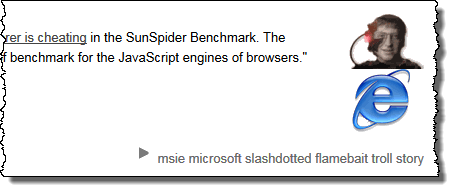
It’s the sort of stuff that Slashdot does well, catapulting an inflammatory story from a tiny website into something its community of ubergeeks can argue about. At Slashdot, the comments are usually more entertaining and informative than the main article.

If you follow the sources back just a few links, you see where this is coming from. Way back in early September, some 10 weeks ago, a Mozilla engineer named Rob Sayre wrote a fairly non-inflammatory blog post giving an update on Firefox JavaScript performance. Given that his blog’s tagline is “JS engineering and Kanye West updates,” this is not a surprising choice of subject matter. At the end of the post, he noted an odd result for IE9 on one score and speculated that there might be “a problem of some sort” with that result. There is no insinuation of cheating or misbehavior. In fact, it is the last example in a series designed to illustrate some of the small problems that crop up in software engineering.

Nearly 10 weeks later, a tiny blog called Digitizor (based in India, apparently) noticed that post and added its own inflammatory spin. That’s the post Slashdot highlighted.

Normally, here’s what happens: Slashdot’s readers get a big chuckle over the whole thing, the tiny web site goes back to obscurity after its servers take a Slashdot beating, and everyone moves on to the next topic. One positive outcome of the ruckus is that the Mozilla engineer who wrote the original blog post finally got around to filing a bug at Microsoft’s Connect site, which is the formal means of raising issues like this so that engineers can look at them in detail. I am authoritatively informed this particular bug is being looked at very carefully.

And there it should have ended. Except that this morning a blogger at ZDNet comes out and repeats the exaggerated allegation, even including the word “cheating” in its headline. ZDNet reaches a big audience. Bigger than Slashdot and orders of magnitude bigger than the little tiny outfit that stirred up this hornet’s test. So for ZDNet’s millions of readers, an inaccurate story turns into an inflammatory headline.

The original headline on Adrian’s post has been slightly updated, with an unconvincing disclaimer tacked onto the end. [By the end of the day the headline had been completely changed, with the word "cheating" removed.] An update at the end of the post itself now contains a response from Microsoft. Unfortunately, anyone who just sees the headline and skims the opener as they scan through their favorite websites will come away with an inaccurate conclusion. [The IE Blog post has now been updated in great detail to address this allegation, complete with an explanation of dead-code elimination as an optimization technique and some actual code samples. If you're a developer, pay attention. If you're not a code jockey, well, your eyes may glaze over.]

The thing that’s absurd about this entire incident is that it’s obviously untrue. If you try to game a benchmark, you’ll get caught as soon as you try to perform the same tasks doing real work. That’s especially true when millions of end users have been beating on your beta release for months and developers have been pounding on six previous platform previews stretching back for nearly a full year. Whether you’re a user or a developer, you can see the clear improvement in JavaScript performance when you run any of Microsoft’s Test Drive examples or visit script-intensive sites.

In fact, I’m about to install that new Platform Preview myself and look at its performance. I was really looking forward to that. It’s something I would have started hours ago if I hadn’t been distracted by a Slashdotted flamebait troll story. Sorry for the delay. I’ll be back with a more detailed look after I’ve done my homework.

Kick off your day with ZDNet's daily e-mail newsletter. It's the freshest tech news and opinion, served hot. Get it.

Ed Bott is an award-winning technology writer with more than two decades' experience writing for mainstream media outlets and online publications.

Disclosure

Ed Bott

Ed Bott is a freelance technical journalist and book author. All work that Ed does is on a contractual basis.

Since 1994, Ed has written more than 25 books about Microsoft Windows and Office. Along with various co-authors, Ed is completely responsible for the content of the books he writes. As a key part of his contractual relationship with publishers, he gives them permission to print and distribute the content he writes and to pay him a royalty based on the actual sales of those books. Ed's books written prior to fall 2011 have been distributed by Que Publishing (a division of Pearson Education) and by Microsoft Press. As of November 2011, Ed is a partner in the independent publishing company Fair Trade Digital Exchange, which exclusively publishes his books.

On occasion, Ed accepts consulting assignments. In recent years, he has worked as an expert witness in cases where his experience and knowledge of Microsoft and Microsoft Windows have been useful. In each such case, his compensation is on an hourly basis, and he is hired as a witness, not an advocate.

Ed does not own stock or have any other financial interest in Microsoft or any other software company. He owns 500 shares of stock in EMC Corporation, which was purchased before the company's acquisition of VMware. In addition, he owns 350 shares of stock in Intel Corporation, purchased more than two years ago. All stocks are held in retirement accounts for long-term growth.

Ed does not accept gifts from companies he covers. All hardware products he writes about are purchased with his own funds or are review units covered under formal loan agreements and are returned after the review is complete.

Biography

Ed Bott

Ed Bott is an award-winning technology writer with more than two decades' experience writing for mainstream media outlets and online publications. He's served as editor of the U.S. edition of PC Computing and managing editor of PC World; both publications had monthly paid circulation in excess of 1 million during his tenure. He is the author of more than 25 books on Microsoft Windows and Office, including the recently released Windows 7 Inside Out.

56
Comments

Join the conversation!

Just In

RE: IE9 takes top benchmark prize, no cheating involved
JACOBSONR 14th Oct
Good day to confirm this comment I would appreciate T h e b e s t o f Z D N e t d e l i v e r e d your website very nice to everyone Yes, Oracle is the only one with shared-disk architecture, but that is there advantage. It means you can add or remove nodes and the database lives on. In a shared nothing architecture, if you lose a node, you lose the system. I'm sure Oracle appreciates EMC highlighting their advantage.I also desire to signal in your RSS feeds. Thank you as soon as once again and maintain up the great operate Awesome post! Thank you very much || thanks for nice content this is really benefit to me.
0 Votes
+ -
Contributr
A few points ...
Adrian Kingsley-Hughes 17th Nov 2010
My use of the word "cheating" was in reference to the piece picked up on /. and I separate the data that Sayre posted (along with data I'd collected previously) from any finger-pointing.

Microsoft has now attributed this anomaly to dead code elimination but this explanation still doesn't account for the fact that the three functions tested by Sayre (and I've run them myself) all include he same amount of dead code ... the addition of true and return to the functions doesn't in any way change the amount of dead code the JScript engine has to process. Why the JS engine gives different results for what is functionally the same code with the same amount of dead code is still very interesting and worthy of discussion. The fact that the piece linked to on /. made wild unsupported accusations doesn't change the fact that there's something interesting going on here. Like I said, it's highly unlikely to be cheating but if dead code elimination can achieve such good results for the code used for the math-cordic test, this performance should be translated to the variants using the true and return statements too.
0 Votes
+ -
@Adrian Kingsley-Hughes

You're confusing an apology with being an apologist.

You made a mistake Adrian, admit to it and move on.
0 Votes
+ -
Contributr
RE: IE9 takes top benchmark prize, no cheating involved
Adrian Kingsley-Hughes 17th Nov 2010
@tonymcs@... Hey, if I gave the impression of accusing anyone of deliberate cheating, I offer all affected an unreserved and unconditional apology, no problems. But I never supported the idea of deliberate cheating.

But the issue here isn't cheating, it's about figuring out what's going on here. Experimenting with a SunSpider deadcode fork (https://github.com/cheald/SunSpider-deadcode) would indicate to me that IE 9 does indeed carry out dead code elimination, but that it only seems to kick in under certain circumstances.

There's a lot of dead code in JavaScript out there, you browsers process countless lines of it daily. If Microsoft can make this work more generally, then if would be great stuff all round.

Lot of good discussion here on different code thrown at IE9 being hadled differently ... http://apps.ycombinator.com/item?id=1913368

For me, this issue is interesting, and not some zealot stick I want to wave about.
@Adrian Kingsley-Hughes

Yes, dead code elimination is complex, but the problem is that most people don't have a clue how this stuff works, so it is easy to spread FUD when the results don't seem to make sense. Throwing in a single extra line (even if it eventually complies down to a no-op like "true" or "return") can trigger a threshold at which point he compiler no longer even considers the function for further analysis. A JS compiler is much more time constrained compared to an offline compiler (like C/C++/C#/Java etc).

The problem is that most people don't understand this stuff. For you to go and fuel this FUD is just making the problem worse. I realize people like you and the large amount of ABMers that post in these forums need all the anti-MS FUD you can get. But it is irresponsible to post these kinds of blogs that are designed to create fear, uncertainty and doubt without doing proper research first.
0 Votes
+ -
@Adrian Kingsley-Hughes Haven't you, yourself, written articles warning other bloggers of this same type of shotty blogging, Adrian?
0 Votes
+ -
RE: IE9 takes top benchmark prize, no cheating involved
GoodThings2Life Updated - 17th Nov 2010
@Adrian Kingsley-Hughes ... these sensationalist stories are why I stopped reading your blog, Adrian. Stick to hardware. Please.
0 Votes
+ -
@GoodThings2Life If you stopped reading it then how did you make your way into the comments section?
@xSteven777x
Umm, it seems to me that he found his way to the comments section on Ed Bott's Blog, not AKH's.
Maybe you forgot what story you were reading?
0 Votes
+ -
@ke6gwf ... yes, exactly right, and kudos for paying attention to details! happy
@Adrian Kingsley-Hughes

Mistakes happen just make sure it doesnt happen again. Remember, your's and zdnet's reputation is on the line here, please stay true to being a journalist. Be thorough on your research and be unbiased.

I dont know how you will feel but it will suck if your name gets associated to shoddy journalism
0 Votes
+ -
@Adrian Kingsley-Hughes
Using the word "cheating" even if followed by a question mark is highly inflammatory. It is a way to avoid taking responsibility for an allegation you still make. Perhaps that was not your intention, but with your experience you should know this. Until you have substantiated evidence you should refrain from relaying speculative allegations from highly biased sources (./).

You can do all the testing you want, make all the assumptions you want about how you believe a JS compiler should behave. Testing and reliably reproducing a result does not make you an authority on compiler construction and -optimization.

A function which returns a value (true) in JS is different from a function which does not (and implicitly returns "undefined"). This could throw a optimizer off. It may be a bug or it may be an artifact. It may even be due to optimizer heuristics and not considered a bug.

The point is you became an instrument in yet another M$ bashing frenzy. ZDNets and your reputation is on the line here.

You clearly smelled something fishy, as you stated that you were not prepared to call "cheating" (although it was implied that you were getting there). I hope in the future you will apply your own heuristics and try to get a comment from an authoritative source when that little bell goes off in the back of your head.
@Adrian Kingsley-Hughes

Seriously, you should admit you made a mistake and move on. Ed Bott called you out for your mistake. You are not perfect. You were commenting on a subject you have little authority in. You were overreaching. Game over man.

I commend Ed Bott for holding the line and keeping to a higher standard of journalism.
0 Votes
+ -
Be careful of standard benchmarks.
I am Gorby Updated - 18th Nov 2010
@Adrian Kingsley-Hughes I was working in the Relational Database industry during the benchmark wars in the 1990s. Oracle was able blitz everyone on the TPC benchmarks! It turned out they had written their code to behave differently when it recognized it was running a benchmark, by eliminating most of its internal checks, etc. That way they got great TPC benchmark results, but real word results were no where near that.
It would not be too hard to tune your "dead code elimination scanner" to recognize the benchmark code.
When the PR begins over browser speeds, it's pretty difficult to dispute published benchmark results, even if they won't reflect real life usage.
0 Votes
+ -
@Adrian Kingsley-Hughes
Obviously all Adrian is good at writing is click-bait articles.
Good luck for everything. swiss replica watches
0 Votes
+ -
Of course they didn't cheat, AKH was in too much of a hurry to post an article slamming Microsoft before checking the facts. That is his new routine now. I knew all along that it was just Microsoft optimizing code.
0 Votes
+ -
story, as it prompted others to research and help eliminate the aligation of the code in question.

The more of these aligations which are eliminated the better, as Once you eliminate the impossible, whatever remains, no matter how improbable, must be the truth.

In truth, the browser appears to need no help from cheating
0 Votes
+ -
Really?
honeymonster 18th Nov 2010
@Mister Spock

"There is nothing wrong with Mr. Kingsley-Hughes'
story, as it prompted others to research and help eliminate the aligation of the code in question."

And how many references do you believe we'll see to "M$ cheating!!!!" when they beat the others in the speed tests of the future.

You are referring loosely to a scientific process where it's ok to put out a hypothesis or a even question. When the recipients recognize it as such it only helps further the discussion.

But this is not a scientific publication. This is a media for tech-minded readers, not scientists. Trying to hide behind a "question" is the equivalent of CNN asking "Is Sarah Palin really lesbian?" and then reporting on someone somewhere speculating about how she saw her enter a hotel accompanied by 3 other women.
  • Flagged
0 Votes
+ -
@honeymonster
Microsoft have never been beyond cheating in the past so they have a history to correct before anyone takes anything they say seriously (apart from the MS fanbois of course who just suck it up).
So who can tell if they are or are not cheating - the code isn't visible for anyone to check.
0 Votes
+ -
@deaf_e_kate
"...the code isn't visible for anyone to check."

Nor is the code structure of works produced by Adobe, Apple, Oracle (owners of Java) etc; all who've been guilty of cheating and taking shortcuts, yet who fare much more favourably in such questions and reviews.

My ire doesn't come from the fact that the media and the general tech-based republic holds Microsoft to question as they continue to try and move themselves beyond their less-than-former glories; it is the fact that the same yard-stick is never applied to their contemporaries who played (or continue to play) the same games.
0 Votes
+ -
IE9 Performance
TV John 18th Nov 2010
I've been using IE9 for a while and have downloaded the latest preview. On the whole I like it a great deal, but there is one aspect that puzzles me. Some websites seem to take an absolute age to load for no good reason, that I can see. One I came across this morning is Engadget (www.engadget.com), which freezes for 35 seconds before you can scroll down the screen. Open the same page in Opera, on the same computer, and it's ready in less than 3 seconds. I'd be very curious to know what's going on here.
0 Votes
+ -
@TV John I go to www.engadget.com while reading your post, and it takes IE9 beta less than 3 seconds.
@TV John

I see the same thing periodically but it doesn't seem consistent. I'm sure it will be worked out in later builds.
0 Votes
+ -
Delay
People 18th Nov 2010
@TV John

I wonder if it's engadget. I experienced the same problem just a moment ago using Firefox 3.6.12 on a Mac.
0 Votes
+ -
Nice Job Ed.

Adrian, seriously dude. You've had too many goofups in your blog & half hearted apologies. That's why I rather read Ars or gdgt than yours. Just come clean, apologize with no conditions and stick to hardware. Also, lose the anti-Microsoft bias. It really hurts your credibility.
0 Votes
+ -
@Solid Jedi Knight
but you'd be happy for him to have a pro-MS bias though...
@deaf_e_kate

How did you concur that 'Solid Jedi Knight' wants Adrian to have a pro-MS bias. BTW, why do journalist need to have any bias...isnt journalism about being fair?

Is it that hard for Adrian to be unbiased and fair?
0 Votes
+ -
@DontBeEvil

Lets see you respond in the same way if he writes about Apple of Linux or BEos etc.... I have plenty of time for Adrians articles, he is generally unbiased unlike Ed Bott who makes his money from writing pro-MS articles - i never see any pro MS person complain about Ed's bias... double standards rule with MS fanbois.
0 Votes
+ -
Behold! Once more...
zkiwi 18th Nov 2010
Ed "Microsoft Bob" Bott attacks a blog technique he uses frequently and along the way defends his paramour Microsoft.

So Ed, stop whining about AKH's blogs.
@zkiwi

zkiwi "XServe" Troll thinks FUD should not be challenged with facts.

How sad...
0 Votes
+ -
I guess you never read...
zkiwi 18th Nov 2010
What AKH actually posted. Much the same as Ed.
0 Votes
+ -
This is the second time...
Stormbringer_57th 18th Nov 2010
...that Adrian resorted to spewing FUD about MS products, and got put in his place by Ed - the first was when he claimed MS would yield control of WP7 updates to carriers. I sense a trend here, one that smells even fishier than the subject matter here. Correspondent in-fighting has always been a good way to attract readers, after all...
From slashdot:
"Just to save you the trouble of reading it, if don't want to, it's pretty clear that IE9 is eliminating the heart of the math-cordic loop as dead code. It _is_ dead code, so the optimization is correct. What's weird is that very similar code (in fact, code that compiles to identical bytecode in some other JS engines) that's just as dead is not dead-code eliminated. This suggests that the dead-code-elimination algorithm is somewhat fragile. In particular, testing has yet to turn up a single other piece of dead code it eliminates other than this one function in Sunspider. So Rob filed a bug about this apparent fragility with Microsoft and blogged about it. The rest is all speculation by third parties." BZ
Now, Ed makes statement as easily as AKH.
If I had to do hypergeometric distribution on Ed's comments on MS... You get the idea. Same could be said of AKH probably in the other direction. But it is nice once in a while to get the popcorn and read the comments.
0 Votes
+ -
Contributr
@kirovs@... I was going to include that exact quote, but the post was long enough already. Thanks for including it here.
0 Votes
+ -
@kirovs@...

It is not as "fragile" as it might appear. What people seem to forget is that even though the extra "true" and "return" will eventually compile down to a no-op, this is not how it is seen when the compiler first scans the code. The JS compiler has to make tradeoffs between speed/depth of analysis. This could simply be a case where any extra line of code, whether it eventually becomes a no-op or not, is causing a threshold to be reached where the compiler excludes the piece of code for any further dead code analysis. At that point it still doesn't know which lines of code will result in a no-op. Do you expect the JS compiler to make an expensive dead code analysis on a function that is 10,000 lines of code? There has to be a threshold of lines-of-code, amongst many other checks that would include/exclude a piece of code for such analysis. That would perfectly explain why adding "true" or "return" causes the observed behavior.

Also, other tests have shown that renaming the variables or changing the loop counts still result in the same optimization, so this is hardly hard-coded to the SunSpider test. The original test just happens to be right under the threshold where the code is excluded for further dead code analysis.
I had to laugh at Adrian's "back-peddling". :-D
0 Votes
+ -
Why does anyone care?
trickytom3 Updated - 18th Nov 2010
Who cares if a browswer renders a page a quarter-second faster than another?

Pick a browswer, download it, and get on with your lives!
@trickytom3

Apparently everybody cares until MS starts kicking butt. Then benchmarks suddenly become a non-issue, or MS must be cheating.
@Qbt
I don't think anyone is denying that IE8 was an almost decent browser and IE9 has the potential of being very good browser. I would not go as far as to say that it is kicking ass. Let me see it in production.
The problem is- too little, awfully too late. I cannot live without my FF extensions (you know, even EC2 instances management) and if I need something slim and fast, there is always Chrome.
Oh, almost forgot- IE does not run very well under Linux.
So while I applaud the efforts and the fact IE is finally making efforts to be standards compliant it is a non-starter for me.
0 Votes
+ -
ok guys...you are the experts... Is IE9 gonna make it or not...I still can't even get the Beta to load without crashing...

JollyMoon
0 Votes
+ -
who cares
tech_walker 18th Nov 2010
IE9 is a great browser, its fast, compliant and is further proof Microsoft is finally getting it. Thanks to competition from Mozilla and Google we now have a wide variety of great browsers to use.
giggles that was fun reading
Perhaps AKH's real mistake was to forget how the world has become ADHD, and that no-one apparently reads
beyond the first 3 lines, and even then filters out "filler" words automatically. We have mostly become search engines instead of true cognition machines.

I see this symptom in every aspect of online life, when the majority of people, when sent an e-mail with detailed instructions, will e-mail back asking for the second or third thing that was already detailed in the instructions, or they would continue arguing their fallacy when it had already been completely exposed in an earlier reply.

Bottom line - in the Internet era, people may read more, but they read differently.
Thanks for the info about Preview 7.
http://www.msnbc.msn.com/
loads significantly faster.

Dan
0 Votes
+ -
Seriously, Ed
none none Updated - 21st Nov 2010
In light of your own hair-on-fire blog post about the IRC daemon not too far back, should people who live in glass houses really throw stones?


Uhm...OK?
0 Votes
+ -
I uninstalled I.E. 9
Narg Updated - 26th Nov 2010
I installed I.E. 9 when the first public beta release came available. I've often installed beta software from MS as well as a number of other companies, so I'm used to the trails and tribulatinos of such actions.

Today I've un-installed I.E. 9. Not because of it's beta status, but rather because I can't stand this version of I.E. 9 and the direction MS is taking I.E. I really dislike the "minimalist" approach. That approach is fine for Chrome, but simple doesn't belong in I.E. And, just like seemingly every version before it, it breaks far too many web sites. That one problem alone is becoming a real pain-in-the-....

When will we finally get a solid grasp of the web and produce browsers that simply WORK! 100%, no fancy B.S., no speed demon idiocy, no fancy features that ultimately go un-used. Just a browser that works, and is HTML 5 compatible. Sure Chrome is good, but still not 100% compatible with enough of the web to be a stand alone browser.

I fully realize 1/2 of this disdain should be directed at the web developers. SO to them: STOP IT! Stop with the unneeded fancy B.S. websites that require one browser over another. Nobody gains from pathetic web sites like that. Nobody.

Growth is definately a good thing. So why is the web just moving sideways and NOT UP! Seriously, it's only moving sideways. Changing for the sake of change and not for the sake of making things really better. These ill-gotten attempts at so-called "better" are more of a pain than anything.

Anyone else fed up with this B.S.???
0 Votes
+ -
Depends on How You Define Cheating
CFWhitman 1st Dec 2010
Of course it's possible that the code would just recognize the SunSpider benchmark and skip the dead code for this reason only. Judging from Microsoft's past behavior, they would certainly be willing to do this. (I point to the example of Windows 3.1 generating fake GPF errors when it found DR-DOS or PC-DOS instead of MS-DOS. That was clearly cheating.)

However, in this case it's much more likely to be the more conventional "cheat" of optimizing code for the benchmark rather than giving real world results. This is very common for any benchmark that becomes popular.

Microsoft puts dead code elimination routines in IE 9. These routines don't really work all that great in general (dead code elimination tends not to work all that great in general because dead code really should be eliminated by the programmer rather than by the interpreter or virtual machine), but Microsoft makes sure that they work for the benchmark. Is that cheating? Well, sort of, but not really. Microsoft would simply define it as "sound marketing." It does give an illusory result for the benchmark to try to make people think that IE 9 is faster than it will be most of the time in real world operation, but Microsoft is hardly the first company to optimize for a benchmark.
I also desire to signal in your RSS feeds. Thank you as soon as once again and maintain up the great operate! nccma cooler
I used to be more than happy to seek out this internet-site.I wanted to thanks in your time for this glorious read!! I positively enjoying each little bit of it and I have you bookmarked to check out new stuff you weblog post. this thread is amazing i like your work and i appreciate you that you have share a useful stuff thanks for sharing the i shop abatwa
Good day to confirm this comment I would appreciate T h e b e s t o f Z D N e t d e l i v e r e d your website very nice to everyone Yes, Oracle is the only one with shared-disk architecture, but that is there advantage. It means you can add or remove nodes and the database lives on. In a shared nothing architecture, if you lose a node, you lose the system. I'm sure Oracle appreciates EMC highlighting their advantage.I also desire to signal in your RSS feeds. Thank you as soon as once again and maintain up the great operate Awesome post! Thank you very much || thanks for nice content this is really benefit to me.

Join the conversation!

Formatting +
BB Codes - Note: HTML is not supported in forums
  • [b] Bold [/b]
  • [i] Italic [/i]
  • [u] Underline [/u]
  • [s] Strikethrough [/s]
  • [q] "Quote" [/q]
  • [ol][*] 1. Ordered List [/ol]
  • [ul][*] · Unordered List [/ul]
  • [pre] Preformat [/pre]
  • [quote] "Blockquote" [/quote]
ie8 fix
ie8 fix

The best of ZDNet, delivered

ZDNet Newsletters

Get the best of ZDNet delivered straight to your inbox

Facebook Activity

White Papers, Webcasts, & Resources
ie8 fix
ie8 fix