Microsoft releases final IE9 preview, beta due in September

Internet Explorer 9 continues its steady pace toward a final release. Today's milestone is an important one. The fourth and final Platform Preview, like its predecessors, is intended for developers to test their web sites and report bugs. Most of the major pieces of IE9's HTML5 support were put in place in the previous release. This preview incorporates a slew of bug fixes (more than 1300 bug reports have been filed at Microsoft's Connect site) and shows off what Microsoft claims are big improvements in its new Chakra JavaScript engine. IE boss Dean Hachamovich argues that how a JavaScript engine is integrated into the browser is as important as the engine itself, in terms of performance:
The fourth Platform Preview moves the new JavaScript engine, codenamed Chakra, inside IE9 and brings them together into one single, integrated system.
Through this deep integration, the performance of real world websites significantly improves, and IE9 becomes the first browser to have a shared DOM between the browser and the script engine based on ECMAScript5. The benefits start with real-world performance and consistency.
Microsoft has published test scores that show the new JavaScript engine acing the SunSpider test (and beating the current shipping version of Safari), but the company continues to emphasize holistic, real-world performance measurements.
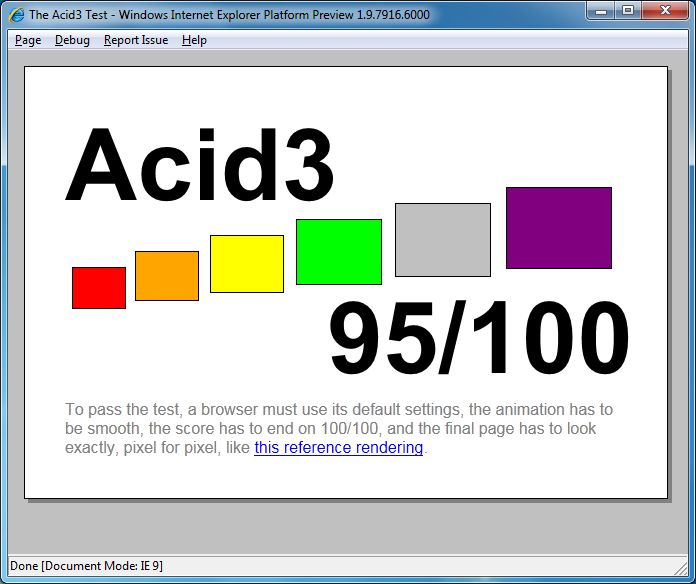
Probably the single biggest headline in today's release is IE9's final score on the Acid3 test. As I noted back in June (see IE9 adds key HTML5 features in new preview release), each successive platform preview release has sported an improved score on the 0-100 Acid3 scale, starting at 55 in March, increasing to 68 in May, and jumping to 83 in June. Today's release hits a 95, and Hachamovich argues that striving for a perfect 100 on this imperfect test isn't necessary or desirable. The two Acid3 failures are on features that are "in transition," he writes:
Support for SVG Fonts in the web development and font communities has been declining for some time. There’s already been discussion without objection of dropping SVG fonts from the Acid3 test. The community has put forth a proposal in the SVG Working Group to give SVG Fonts optional status.
Instead, developers can use the Web Open Font Format (WOFF, supported in IE9 Platform Preview 3 as well as other browsers) for both HTML and SVG content. It works well in conjunction with the CSS3 Fonts module and has broad support from leading font vendors (e.g. here, “a majority of font makers have already settled on WOFF or services like Typekit as their format of choice”). WOFF fonts are a better long-term solution for many reasons discussed previously.
Similarly, support for SMIL animation of SVG in the web development community is far from strong. The leader of the SVG standardization effort wrote that not supporting SMIL in its current state is probably best “since the SVG WG intends to coordinate with the CSS WG to make some changes to animation and to extend filters.”
Today's newly released performance tests continue Microsoft's tradition of showing off full hardware acceleration using PC-based GPUs to render text, graphics, and media, both audio and video. I haven't tried the tests themselves yet, but I've seen videos of Hamster Dance Revolution and Psychedelic Browsing in action. The former is guaranteed to get that silly hamster jingle stuck in your head for the rest of the day, and the latter could cause vertigo. You've been warned.
What's next? A beta, of course, with a full-fledged user interface instead of the bare frame that the platform previews use. When I spoke with Microsoft's Ryan Gavin earlier today, he declined to offer an exact shipping date but suggested that the next release would follow the same cadence as the platform previews. On that timetable, it's reasonable to expect a beta in the second half of September.