ie8 fix
madison

Snow Leopard upgrade: what's in it for me?

By | August 25, 2009, 3:54pm PDT

Summary: Last month, I purchased a new Mac mini to help me make accurate comparisons of features and performance between Windows 7 systems and their Mac counterparts. As it turns out, though, my new Mac doesn’t support some key new features in Snow Leopard, and if your Mac is more than a year old you might be in the same boat. I’ve got details in table format.

Last month, I purchased a new Mac mini to replace the borrowed Macbook I had been using earlier this year. Among other things, I want to be able to make accurate comparisons of features and performance between Windows 7 systems and their Mac counterparts later this fall. I was pleasantly surprised to learn that my cheap system (which was officially part of the Mac lineup as recently as March of this year, when it was replaced by a new design) qualified for a free upgrade to Snow Leopard, which should be waiting for me when I get back from vacation next week.

I thought it was a nice touch on Apple’s part to deliver the update a few days early. But I’m still puzzled over exactly what’s in it for me. Apple’s Snow Leopard page is uncharacteristically modest, promising only that it will be “faster, more reliable, and easier to use” and will have some “new core technologies.”

Fortunately, I ran across an excellent post by Stephen Foskett yesterday, who summarized who gets what:

Snow Leopard is really a major jump forward in terms of advanced hardware and software integration. It brings Grand Central, OpenCL, full 64-bit mode, and QuickTime X along with Exchange support and many tweaks. But many of these features are highly hardware-dependent, so not all Mac users will get everything.

As it turns out, my Mac was introduced in 2007, although it was still part of Apple’s lineup until March 2009, just a few months before I bought it. Because it uses older technology (notably a 32-bit EFI and onboard Intel graphics), it is unable to take advantage of several of those new core technologies in Snow Leopard. I have plenty of company, though. With Stephen’s permission, I’m reprinting a chart he put together from Apple’s documentation, listing which features are available for each family of Macs. I added color coding (red if a feature is unavailable, yellow if it’s partially enabled) to make the chart a bit easier to read (the chart is available after the jump):
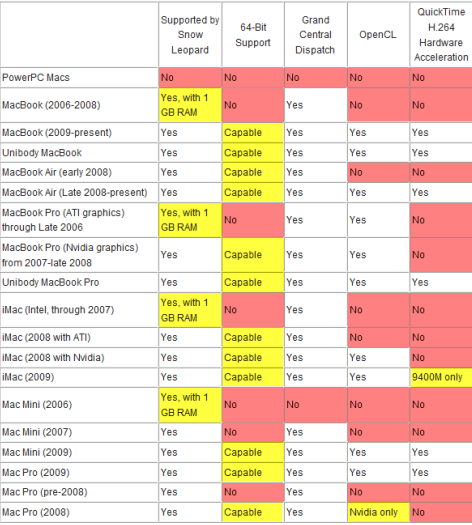
[Chart by Stephen Foskett. Used with permission.]

I was initially startled to learn that the Snow Leopard 64-bit kernel won’t run at all on some models (like mine and, surprisingly, a two-year-old Mac Pro). Even on those notebooks and desktops that do support a 64-bit kernel, Snow Leopard will run a 32-bit kernel by default. (To boot into the 64-bit kernel on a Mac that supports it, you need to press the 6 and 4 keys during startup or add a boot parameter.) For the record, I don’t think this is that big of a deal, as even the 32-bit OS X kernel can run 64-bit apps. Purists might want only 64-bit code running, but Windows users can sympathize with the need to wait for hardware makers to catch up with 64-bit drivers.

I was very disappointed to learn that OpenCL support and H.264 hardware acceleration wouldn’t be available on my machine. In fact, the latter feature appears to be available only on systems with Nvidia 9400M graphics. On Windows 7, I’ve compared HD playback using an Intel GMA 950 (the same graphics chip used in my Mac Mini) against the same source on a system with an Nvidia 9500 GS. It’s no contest: the discrete GPU annihilates the onboard graphics, especially with a CUDA-enabled Windows app like PowerDVD 9. I’ll need to upgrade to a more powerful Mac to make a fair comparison.

The one Snow Leopard feature I’m most looking forward to is native support for Exchange Server. For most Mac users, that will elicit a big “who cares?” but if I can avoid having to install and run Entourage it might be worth the $29 for that feature alone.

All in all, this release of OS X looks a lot like a service pack. It makes some interesting architectural changes that will no doubt be useful in Macs designed in 2009 or later, but it’s not likely to make a noticeable difference for anyone with a 2008 model or earlier.

Kick off your day with ZDNet's daily e-mail newsletter. It's the freshest tech news and opinion, served hot. Get it.

Topics

Ed Bott is an award-winning technology writer with more than two decades' experience writing for mainstream media outlets and online publications.

Disclosure

Ed Bott

Ed Bott is a freelance technical journalist and book author. All work that Ed does is on a contractual basis.

Since 1994, Ed has written more than 25 books about Microsoft Windows and Office. Along with various co-authors, Ed is completely responsible for the content of the books he writes. As a key part of his contractual relationship with publishers, he gives them permission to print and distribute the content he writes and to pay him a royalty based on the actual sales of those books. Ed's books written prior to fall 2011 have been distributed by Que Publishing (a division of Pearson Education) and by Microsoft Press. As of November 2011, Ed is a partner in the independent publishing company Fair Trade Digital Exchange, which exclusively publishes his books.

On occasion, Ed accepts consulting assignments. In recent years, he has worked as an expert witness in cases where his experience and knowledge of Microsoft and Microsoft Windows have been useful. In each such case, his compensation is on an hourly basis, and he is hired as a witness, not an advocate.

Ed does not own stock or have any other financial interest in Microsoft or any other software company. He owns 500 shares of stock in EMC Corporation, which was purchased before the company's acquisition of VMware. In addition, he owns 350 shares of stock in Intel Corporation, purchased more than two years ago. All stocks are held in retirement accounts for long-term growth.

Ed does not accept gifts from companies he covers. All hardware products he writes about are purchased with his own funds or are review units covered under formal loan agreements and are returned after the review is complete.

Biography

Ed Bott

Ed Bott is an award-winning technology writer with more than two decades' experience writing for mainstream media outlets and online publications. He's served as editor of the U.S. edition of PC Computing and managing editor of PC World; both publications had monthly paid circulation in excess of 1 million during his tenure. He is the author of more than 25 books on Microsoft Windows and Office, including the recently released Windows 7 Inside Out.

301
Comments

Join the conversation!

Just In

RE: Snow Leopard upgrade: what's in it for me?
FAULKNE 13th Oct
Good day to confirm this comment I would appreciate T h e b e s t o f Z D N e t d e l i v e r e d your website very nice to everyone Yes, Oracle is the only one with shared-disk architecture, but that is there advantage. It means you can add or remove nodes and the database lives on. In a shared nothing architecture, if you lose a node, you lose the system. I'm sure Oracle appreciates EMC highlighting their advantage.I also desire to signal in your RSS feeds. Thank you as soon as once again and maintain up the great operate Awesome post! Thank you very much || thanks for nice content this is really benefit to me.
0 Votes
+ -
Wow, that's brutal! None of the new features that Apple is touting loud and proud are available to 4 year old Macs and half of them aren't available on a large percentage of the Macs sold since then!

I also have to laugh at the 1GB minimum requirement. Whatever happened to each version being more efficient than the last? LOL!!
I guess that's hard to understand, but you only bought your MacBook Pro
recently as I recall. happy
0 Votes
+ -
None NZ?
Metronome49 26th Aug 2009
"None of the new features that Apple is touting loud and proud are available to 4 year old Macs and half of them aren't available on a large percentage of the Macs sold since then!"

You act like the 4 things Ed mentioned are all the new features. They have a significant amount of UI improvements, file previewing, expose, yada.
0 Votes
+ -
No Different than a Windows System Rev
steve@... Updated - 26th Aug 2009
This is not unique to Apple. XP required more processing power and
memory than '98 to take advantage of all its bells and whistles, as did
Vista over XP. This is not brutal, but the nature of the beast.
0 Votes
+ -
Microsoft Does It = Brutal?...
windozefreak 26th Aug 2009
Apple does it = "the nature of the beast"?
0 Votes
+ -
Great response!!!
tim@... 26th Aug 2009
Finally - somebody who get's it! No - your old Apple ][ won't run that 64-bit app... color me surprise!

Thank you for assisting the editor with such a poor article. Two year technology in this industry is an eternity. PC users simply accept change and go buy new.

Tim
0 Votes
+ -
XP to Vista
FFeliciano 28th Aug 2009
So the big brouhaha over applications that worked on XP not working on Vista was uncalled for?
0 Votes
+ -
Yes not called for
bklooste 28th Aug 2009
VERY few Windows apps didn't work under Vista with default settings and most of these were Very old ( think before OSX existed) , or by developers that didnt follow standards . In nearly all these cases it was due to security and most would work if you ran them with admin rights. However even these apps are important to MS and they have improved support for this in Windows 7.
0 Votes
+ -
Minimum RAM to run OS
chromeronin 30th Aug 2009
XP started out only needing 512MB RAM, by SP2
and with a full load of office onboard 1GB is
actually needed to run WELL.
When Vista came out, it really needed just 1GB
to boot. It needed 2 or 3GB RAM to actually run
well.
This meant a lot of corporates stayed away as
they would have to double or tripple the
installed ram in their desktops top upgrade,
and vista only was allowed on new machines.
Where you have a couple of thousand desktops,
it is difficult to support two desktop OS at
the same time, so they tended to stay on XP.
Now Win7 will actually run OK on 1GB RAM, and
we are 3 years down the track and most desktops
actually have 1 - 2 GB RAM, so installing 7
isnt the chore it used to be.

OS X is the same. Tiger worked OK on 512MB RAM,
but much better with 1GB. For the last few
years 1GB was the minimum Apple would sell you,
so now the fleet of capable machines makes it
less painful to release a new OS. Hardware
requirements are actually about the same as
Leopard to get an actually usable system.
I may not get a huge boost from the other new
technologies on my 2007 Mac Mini, but I am not
really running anything that needs it. I don't
do 3D image rendering, I don't play games on it
(The intel GMA card sees to that. It was
cheaper to buy an xbox360 than to upgrade the
computer for games)
I'm spending the NZ$60 because this is the only
software I have needed to buy for my Mac in 2
years (I bought an eyeTV tuner, and the
software updates have been free so far), and
that is pretty cheap for an upgrade really.
I'm going to have to spend a lot more to get
Windows 7 on my 2.2GHz AMD PC if I want to
upgrade that. But then why replace Linux Mint -
already offering most of the UI goodies from
Win7 thanks to the latest versions of Gnome and
compiz desktop effects.
0 Votes
+ -
Tiger
Evilyn 2nd Sep 2009
Tiger officially requires 256MB RAM, not 512MB. 512MB is recommended
for better performance, and of course 1GB will be even better. Just
wanted to clarify since the title of your post is Minimum RAM to run OS.
0 Votes
+ -
Microsoft man educates us about Macs!
dogbreath1 Updated - 26th Aug 2009
How odd it is that an established resource like ZDnet would put a
Microsoft guy onto the task of telling us what we'll get from a Mac OS X
upgrade. The only Mac he has is an out-dated, lowest-end model that he
bought merely for the purpose of testing Mac compatibility.
0 Votes
+ -
So then...
gnesterenko 28th Aug 2009
...only new Mac buyers with pricer more expensive parts are the ones that matter? Forget the rest of the folks that baught one a bit earlier eh?

"The views expressed here are mine and do not reflect the official opinion of my employer or the organization through which the Internet was accessed."
0 Votes
+ -
Didn't learn from Microsoft.
phatkat 26th Aug 2009
I hate this misuse of the term "capable". Microsoft had this campaign when they released Vista and look what they got when they put all of those "Vista Capable" stickers on virtually PC out there but when Vista came we found out those "Vista Capable" where not truly Vista Capable.
Also Apple wants you to buy more new Apple hardware to increase their margins.
My Mac Mini PPC will stay 10.5 forever since I need to run Classic programs which I don't mind.
0 Votes
+ -
How were those Vista Capable PCs not Vista Capable?
NonZealot Updated - 26th Aug 2009
They could run Vista, they just couldn't use Aero. Oh, kind of like half the Macs Apple has put out in the last 3 years can't use most of the features in Snow Leopard.

Like I said, this is Apple's "Snow Leopard Capable" fiasco. When we apply ABMer logic where, if you can't run every feature of an OS, it means you can't run that OS at all, then very few Macs can run Snow Leopard.
  • Flagged
0 Votes
+ -
hardly comparable
grail@... 26th Aug 2009
"Vista Capable" was a way to encourage people to buy outdated
computers with a new OS.

"Snow Leopard Capable" is a way to prevent people buying a new OS for
their outdated computer.

Don't you think the two scenarios are a little different?
0 Votes
+ -
Agreed but not all MS's fault
otaddy 27th Aug 2009
OEM's wanted to dump this equipment and so they made the decision to sell this with Vista.

If MS tried to stop them, they would be accused of "abusing their monopoly status".

This is the dilemma MS faces..OEM's mess up their product and there's little they can do about it.

Apple on the other hand has total control and so the end result is more consistent.

0 Votes
+ -
Didn't you get the memo?
zkiwi 27th Aug 2009
Microsoft bowed to Intel's pressure on them, not the OEM's. Where you get the "OEM's did it" view, I just don't know. The buck stops with Intel and Microsoft.
0 Votes
+ -
nt
0 Votes
+ -
Are you sure?
Evilyn 3rd Sep 2009
Classic is not supported in 10.5. The last version that supported Classic
was 10.4.11. Are you booting into 10.4.11 (or earlier) to use Classic?
0 Votes
+ -
maybe you should think first
dfp48 28th Aug 2009
think perhaps you may have a bias against apple despite a claim of being
a nonzealot. I've got machines limited to Mac OS 7, XP, OSX10.5.9, 3
machines runing vista,and now 10.6. i appreciate the fact that Microsoft
and apple don't handicap their systems by being 100% backwards
compatable.
don't wet your pants laughing at the 1GB requirement. 1 gig is cheaper
than the 256 mb sticks sold for older systems.
what you ignore is the fact the OS is now for both 32 and 64 systems. its
sleeker,faster,and costs $29!!!! Forget the fact that it never crashes being
built on the stable unix foundation.
0 Votes
+ -
Thanks for sharing happy hermes bags
0 Votes
+ -
How does "the 32-bit OS X kernel can run 64-bit apps" work? Is it a hack, or could Microsoft have implemented this in Windows too?
0 Votes
+ -
Doesn't answer above post
gnesterenko 28th Aug 2009
Didn't see an explanation there as to how 64 bit apps can run in a 32 bit environment - just that the opposite, 32 bit apps can run in 64 bit. Also, article is over a year old so a lot of outdated information (biggest is the unavailability of 64 bit drivers and incompatibility of 32 bit apps in 64 bit windows - both have long since been addressed, actually I think even before that article was written - well by most RESPECTABLE manufatureres anyway).

"The views expressed here are mine and do not reflect the official opinion of my employer or the organization through which the Internet was accessed."
0 Votes
+ -
Yes, MS could
Richard Flude Updated - 25th Aug 2009
Snow Leopard requires an Intel processor.

The table equates "64-support" to running a 64-bit kernel, which has
little to do with it (popular misunderstanding on ZDNet).

The majority of Snow Leopard applications are 64-bit, leading to a
significant performance improvement (largely register related) even
when running a 32-bit kernel.

Grand Central Dispatch applies to multiprocessor CPUs, hence n/a to
Mac Mini (2006).

It's disappointing that OpenCL and QuickTime H.264 Hardware
Acceleration has not been extended to more GPUs. History tells us
Apple is unlikely to move to support more architectures after release,
but I'd be happy to be wrong.

Unlike MS desktops, Mac OS X supports 32GB RAM whilst running a
32-bit kernel.

Despite the article, all Intel Macs users will see significant benefits
from upgrading. Whether they believe it's worth USD10, USD29 or
USD169 is up to the individual.
0 Votes
+ -
Contributr
Misunderstandings
Ed Bott Updated - 26th Aug 2009
The chart comes from another source, as I made clear in the test, where I also made clear that it is only about running a 64-bit kernel and isn't that big a deal.

As for adding H.264 hardware acceleration, I don't see how Apple can extend support to more (older) GPUs when those GPUs don't support hardware acceleration!

0 Votes
+ -
But they do
Richard Flude 26th Aug 2009
"As for adding H.264 hardware acceleration, I don't see how Apple can
extend support to more (older) GPUs when those GPUs don't support
hardware acceleration!"

Significantly more shipped video cards support H.264 hardware
acceleration (or a subset of the operations), as they do on other
architectures. e.g. GeForce 8800 GT

http://www.nvidia.com/page/8800_tech_specs.html

Apple (and/or their suppliers) has chosen to limit to NVIDIA 9400M.

Why publish a chart from an uninformed source? Why is there so
much misinformation about Snow Leopard?
0 Votes
+ -
Contributr
Built-in graphics
Ed Bott 26th Aug 2009
Intel onboard graphics are not hardware accelerated and cannot be upgraded on a Mac Mini, Macbook, or Macbook Pro. Or an Imac, I suspect. So unless I have a Mac Pro I am stuck with what "Apple and/or its suppliers" chose.

What am I missing?
0 Votes
+ -
Integrated or not doesn't make a difference
Richard Flude 26th Aug 2009
Plenty GPUs in the MacBook, iMac and MacBookPro line have h.264
acceleration capability - and do on other OSes.

Look at the PureVideo supported NVIDIA chipset, say nVidia Geforce
8600M GT in the MBP since late 2007.

Whilst I don't have the time to go through every Mac, I suspect only those
with integrate Intel graphics would be at a disadvantage (and even
then...).
0 Votes
+ -
Contributr
Let me know when...
Ed Bott 26th Aug 2009
...you're actually willing to do the work.
0 Votes
+ -
That's a good question
NonZealot 26th Aug 2009
Why is there so much misinformation about Snow Leopard?

Once you figure that one out maybe you can figure out why there is so much misinformation about Windows?
0 Votes
+ -
stop the damage control...
CrashPad 26th Aug 2009
Apple missed this release badly, admit it and move on.
0 Votes
+ -
1st-gen Mac Pro - no 64-bit?!
mrbofus 26th Aug 2009
I can't believe that a 1st-gen Mac Pro with two quad-core Intel Xeon processors can't run the 64-bit kernel. Is that a hardware limitation or a software limitation?
0 Votes
+ -
No 64-bit EFI, no 64-bit kernel
dogbreath1 26th Aug 2009
The first two generations of Mac Pro (Woodcrest and Clovertown Xeons)
have a 32-bit EFI. The Snow Leopard 64-bit kernel requires a 64-bit EFI,
which first became available in 2008 Mac Pros having Harpertown Xeons.
0 Votes
+ -
No 64-bit kernel, no 64-bit OS
NonZealot 26th Aug 2009
All you are doing is pretending. Have fun with your 32-bit OS! happy
  • Flagged
0 Votes
+ -
More untruths
Richard Flude 26th Aug 2009
"The Snow Leopard 64-bit kernel requires a 64-bit EFI, which first
became available in 2008 Mac Pros having Harpertown Xeons."

The 64-bit kernel can be launched from 32-bit EFI.

The availability of 64-bit kEXT is what is holding back more systems
using the 64-bit kernel.
The 64-bit kernel can be launched from 32-bit EFI.

So Apple is lying when they say this can't be done. It makes sense, Apple makes far more money from hardware sales so if they can convince you that your 3 year old Mac is obsolete and isn't compatible with a 64 bit kernel, maybe a few of you will rush out and spend a few thousand dollars on a new Mac. Smart!!!!
  • Flagged
0 Votes
+ -
Link please
Richard Flude 26th Aug 2009
"So Apple is lying when they say this can't be done."

Where does Apple claim this?

Apple has limited the 64-bit kernel to XServes for now. Apple has
restricted the 6+4 boot override to systems with 64-bit EFI.

Ignorance of this issue is amazing.
0 Votes
+ -
Fair enough, let me rephrase
NonZealot 26th Aug 2009
So Apple has chosen to artificially disable full 64 bit functionality from Macs they know can handle it? It makes sense, Apple makes far more money from hardware sales so if they can convince you that your 3 year old Mac is obsolete and isn't compatible with a 64 bit kernel, maybe a few of you will rush out and spend a few thousand dollars on a new Mac. Smart!!!!

happy
  • Flagged
0 Votes
+ -
Basic comprehension
Richard Flude 26th Aug 2009
"So Apple has chosen to artificially disable full 64 bit functionality from
Macs they know can handle it? . It makes sense, Apple makes far more
money from hardware sales so if they can convince you that your 3 year
old Mac is obsolete"

Point is they can't handle it, don't have the required 64-bit kEXT.

You believe Apple is disabling 64-bit kernel so users upgrade to XServes
(the only supported hardware)?;-)
0 Votes
+ -
Hey, it was YOUR quote
NonZealot Updated - 26th Aug 2009
This is your quote:
The 64-bit kernel can be launched from 32-bit EFI.

Got it. I understand. What you are saying is that the 64-bit kernel is compatible with every single Intel Mac ever released.

Here is another one of your quotes:
You believe Apple is disabling 64-bit kernel so users upgrade to XServes
(the only supported hardware)?;-)


Now XServes are the only machines that can support 64-bit kernels? Huh, I wonder what I'm getting then when I hold down '6' and '4' when I bootup my MBP? Are you suggesting I'm not getting a 64-bit kernel?

No. The truth is that some Macs are, and I quote Apple, "Capable" of supporting 64-bit kernels and it isn't just XServes. I don't know why you would write that. It is anti-Apple FUD. Please don't spread FUD against Apple. XServes are not the only Macs capable of running 64-bit kernel.

All Macs with 32 bit EFIs, according to Apple, will not be given 64-bit kernel support. Now, from your first quote, you admit that those "old" Macs are technically capable of running 64-bit kernels and that Apple could do it if they wanted to. They chose not to. It makes sense because it forces people with 3 year old Macs to upgrade and that makes Apple a ton of profit. Like I said, very smart!

PS One more thing. This whole discussion has me thinking that the Windows 7 upgrade chart is a walk in the park compared to all this 32 bit / 64 bit EFI 32 bit / 64 bit kernel 32 bit / 64 bit userland / '6' and '4' key bootup sequence, only XServes get this by default garbage!!! LOLOLOLOL!!!!!!
0 Votes
+ -
Right, now try comprehending what was written
Richard Flude Updated - 26th Aug 2009
"What you are saying is that the 64-bit kernel is compatible with every
single Intel Mac ever released."

Any Mac with a 64-bit processor can run a 64-bit kernel. However
driver issues will restrict the number of compatible systems.

"Now XServes are the only machines that can support 64-bit kernels?
"

64-bit kernel requires 64-bit kernel extensions for ALL hardware.
XServes are, currently, the only fully supported hardware by Apple.

"Huh, I wonder what I'm getting then when I hold down '6' and '4'
when I bootup my MBP?"

You are forcing a 64-bit kernel on a system that Apple has not yet
listed as supported. This may or may not work depending on required
kEXT.

"Are you suggesting I'm not getting a 64-bit kernel?"

No.

"No. The truth is that some Macs are, and I quote Apple, "Capable" of
supporting 64-bit kernels and it isn't just XServes. I don't know why
you would write that."

Link please to Apple quote! All Macs with a 64-bit processor are
"capable" of supporting 64-bit kernels (even with 32-bit EFI), but not
all Macs are currently supported by Apple.

"All Macs with 32 bit EFIs, according to Apple, will not be given 64-bit
kernel support."

Link please.
0 Votes
+ -
It shouldn't be this hard
NonZealot Updated - 26th Aug 2009
but not all Macs are currently supported by Apple.

I KNOW! THAT IS WHAT I'M TRYING TO SAY! Sheesh! I accepted that 32bit EFI Macs could technically load 64 bit kernels BUT THAT APPLE WON'T LET YOU! And if you bring up hacks (and I know they exist) then you might as well say that Apple allows you to install anything you want on the iPhone because you can jailbreak your iPhone.

Apple doesn't want you using old Macs, they want you to upgrade so they tell you that they won't support your old Macs and your only supported course of action is to pay Apple hundreds or thousands of dollars to upgrade.

Wow, it is so hard dealing with you Apple people. You are so sensitive about anyone writing something that isn't 110% glowing positive about Apple! LOLOLOL!!!!

For another example, look at Psystar. They proved that OS X can be installed on non Mac hardware but Apple won't allow it. That's all I'm saying. I understand that 64-bit kernels can be run on 32 bit EFI machines but that Apple won't allow it, not for technical reasons but for purely profit based reasons. Even you admitted to that:
but not all Macs are currently supported by Apple.
  • Flagged
0 Votes
+ -
It isn't, it's simple
Richard Flude 26th Aug 2009
"Apple doesn't want you using old Macs, they want you to upgrade so
they tell you that they won't support your old Macs and your only
supported course of action is to pay Apple hundreds or thousands of
dollars to upgrade."

Apple runs 64-bit OS and userspace applications on a 32-bit kernel
to support ALL Intel Macs, how could this be any simpler?

Mac users shouldn't worry about what kernel they use.

"Wow, it is so hard dealing with you Apple people. You are so
sensitive about anyone writing something that isn't 110% glowing
positive about Apple! LOLOLOL!!!!"

I've given Apple a swipe in this article's talkback regarding h.264
acceleration. It's not about being sensitive, it about not making stuff
up.

"I understand that 64-bit kernels can be run on 32 bit EFI machines
but that Apple won't allow it, not for technical reasons but for purely
profit based reasons."

There are good reasons not to push a 64-bit kernel on all Macs. The
primary reason is it is not required (64-bit OS and application on 32-
bit kernel, PAE supports 32GB RAM), offers very little advantages
(comparatively little time spent in kernel compared to applications and
OS on desktops, which are 64-bit) and in many cases 64-bit drivers
for hardware aren't yet available (64-bit kernel requires 64-bit kEXT).

The XServe, being a server, has significantly fewer extensions that
need to be tested/developed. This is why it is the only hardware Apple
currently supports for 64-kit kernel. It is also the systems most likely
to benefit from running a 64-kit kernel (it's a server).

I'm with you on Apple lack of security features in Mac OS X vs windows
(not with the amount of malware, or the risk this presents), but to
present not running a 64-bit kernel as either a profit driven decision
or user doesn't benefit from 64-bit environment is UNTRUE.
0 Votes
+ -
Apple has been doing that for years
madmax_2069 27th Aug 2009
Apple has been doing that for years (predates PPC), they basically try to force you to buy a new machine.

I have a Digital Audio G4 533mhz that they say would not run Leopard, with a little bit of OS installer editing it runs great on it.

as for Snow Leopard that wont run on my PPC Mac and i would have to get a intel Mac to run it (or wait for OSx86 for a hackintosh to run it).
0 Votes
+ -
RE Apple has been doing it for years!
gnesterenko 28th Aug 2009
Agreed! I am convinced there is a self-destruct code inside every iPod that is activated anytime a new iPod line is introduced. Without fail, each of my iPods has died very shortly after a new line was introduced. If I didn't have the 4 year warranty from Best Buy, Id've had to replace it myself 6 TIMES!! in a space of 4 years (the other 2 times were due to my own stupidity by leaving the ipod in a car that was parked in the sun... stopped doing that after the 2nd one).

Ok, maybe I'm stretching a little here, but it wouldn't surprise me in the least.

"The views expressed here are mine and do not reflect the official opinion of my employer or the organization through which the Internet was accessed."
0 Votes
+ -
I respectfully disagree with Ed's conclusion, "... but it?s not likely to
make a noticeable difference for anyone with a 2008 model or
earlier."

Looking at Stephen Fosket's chart that Ed cited, I found four 2008
model Apple platforms that would benefit to a noticeable degree
from the Snow Leopard upgrade (MacBook Air (late 2008 to
present), MacBook Pro (Nvidia graphics) from 2007-late 2008,
iMac (2008 with Nvidia), Mac Pro (2008) (Nvidia only).

And, including those four platforms just listed, six more late to
current Apple computer platforms from Fosket's chart that the new
OSX upgrade would definitely enhance the end user's experience
beyond what Ed's opinion that a Snow Leopard addition to those
computers would amount to just "... a service pack ..." upgrade.

Ten out of 19 listed Apple platforms amounts to a lot of
computers that would see significant performance and overall user
enhancement upgrades in my opinion.

On a slightly different note, I am somewhat curious about Ed's
future feature and performance experiment "... between Windows
7 systems and their Mac counterparts later this fall."

For that experiment, I would hope that Ed ... since he chose to use
a minimal Apple 2007 model computer platform (his "new" mac
mini") ... would also choose a minimal 2007 PC platform to install
his Windows 7 upgrade on. Then again, perhaps the most feature
rich version of a Windows 7 upgrade that Microsoft will offer might
not even be capable of being installed on a minimal 2007 PC
platform.

Just curious what minimal 2007 PC platforms could benefit from a
full install of Windows 7. Could they even run Aero graphics?

By the way, I'm not knocking MS Windows 7 ... I think that its a
fine and important upgrade to the PC universe. I'm just offering a
different interpretation of Steve Fosket's chart data that Ed
proposed in his article.

0 Votes
+ -
Contributr
I already said...
Ed Bott 25th Aug 2009
I will use an upgraded Mac platform for any hardware-dependent comparisons.

But for things like the Dock, Finder vs Explorer, Spotlight, Epose, etc. etc., hardware is a non-issue.
0 Votes
+ -
!=
Demzon 26th Aug 2009
The point still exists that you are, to us a car analogy that people sems to love,
comparing a Cobalt SS to a McLarian. I'm sure that the teat bed you are using
for Windows is the best that you can get other than the part you are testing;
while you got the cheapest, most dumbed down version of a Mac you could.
This does not denote a valid test between the two; or even on their own.
This is the second time you have written something that even vaugely caught m
attention to read; and the second time that you have used shoddy logic. You
are one of the reasons I get most of my tech news from other sources. If you
can't prove your point with out fixit the results find something better to do with
you time as it wasetes everyone elses and make all the other writers
associated with you look bad.
While I understand the argument being made you have to keep in mind most $500 PC's are bound to out perform the Mini. In order to reach the performance level of the Mini you would have to choose the most entry level based systems. This just shows how poor a value the Mini is.
Good day to confirm this comment I would appreciate T h e b e s t o f Z D N e t d e l i v e r e d your website very nice to everyone Yes, Oracle is the only one with shared-disk architecture, but that is there advantage. It means you can add or remove nodes and the database lives on. In a shared nothing architecture, if you lose a node, you lose the system. I'm sure Oracle appreciates EMC highlighting their advantage.I also desire to signal in your RSS feeds. Thank you as soon as once again and maintain up the great operate Awesome post! Thank you very much || thanks for nice content this is really benefit to me.

Join the conversation!

Formatting +
BB Codes - Note: HTML is not supported in forums
  • [b] Bold [/b]
  • [i] Italic [/i]
  • [u] Underline [/u]
  • [s] Strikethrough [/s]
  • [q] "Quote" [/q]
  • [ol][*] 1. Ordered List [/ol]
  • [ul][*] · Unordered List [/ul]
  • [pre] Preformat [/pre]
  • [quote] "Blockquote" [/quote]
ie8 fix
ie8 fix

The best of ZDNet, delivered

ZDNet Newsletters

Get the best of ZDNet delivered straight to your inbox

Facebook Activity

White Papers, Webcasts, & Resources
ie8 fix
ie8 fix