Google TV will revolutionize television once viewers understand it

Summary: Consider for a moment how Google TV will bridge the worlds of television and Web video and bring them together to alter your television-viewing experience. It's revolutionary.
Anyone who was an early adopter of TiVo will recall how difficult it was to explain digital video recording. It was one of those things that you couldn't really explain to people. It was something they had to see in action, something that they had to experience to really appreciate the way the technology would change their lives.
Today, that's the uphill battle in front of Google TV, which is preparing for its big launch in the coming weeks.
Also see: Open thread: Will Google TV change your viewing habits?
Watching television is one of those near-sacred experiences that some people just don't want to disrupt - especially with something like Web content. Do you really want tweets or Facebook updates flashing across the screen during a action-packed movie or a laugh-out-loud sitcom? Probably not.
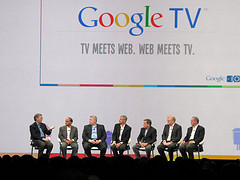
But what about during American Idol, the Oscars or the World Series? Hmmm. Maybe you would - after all, there are already a lot of people who are already bringing their own TV commentary to live, event television via Facebook feeds and Twitter blasts.
Just for a minute, though, put aside how Google TV will make the experience more interactive. Forget, for a moment, how Google will do a better job than the old TV ratings system to determine what you like or don't like on TV, when you start channel surfing for something else or which shows you might watch several times. And, of course, don't think about how Google - the advertising company - will use all of this data to serve up ads that are supposed to be relevant to you.
Instead, just consider for a moment how Google TV will bridge the worlds of television and Web video and bring them together to alter your television-viewing experience.
It's revolutionary.
Also see: Google makes TV smarter
In a blog post yesterday, Google highlighted the partners who are excited about "how they can use the Google TV platform to personalize, monetize and distribute their content in new ways." Most, the company noted, already work with Google TV but many want to "further enhance their premium web content for TV viewing." Among those on-board early: NBC Universal, HBO, Turner Broadcasting and the NBA. In the post, the company also noted that it had created a special web site devoted to Google TV. On that site, Google explained why Google TV will change the video viewing experience:
We haven't been this excited about TV since Saturday morning cartoons. Not only are TVs the center of our living rooms, but five billion of us use them. That's more than the number of people who use mobile phones or computers. Knowing how the web radically transformed those devices, we wondered what it could do for the most ubiquitous screen in the world. Which is why we've been busy geeking out on how to make TV as awesome as possible. The result, coming shortly, is Google TV. It's an adventure where TV meets web, apps, search and the world's creativity. Like Android, it will be an open software platform. From the start, it will be able to work with any TV. And before long, anyone will be able to build applications for it. The coolest thing about Google TV is that we don't even know what the coolest thing about it will be.
That last sentence is the money line. We have no idea what the coolest thing about Google TV will be - and that's OK, because the stuff that it's promising to do now is pretty damn cool already.
For some time, consumers have been squawking about the hold that cable and satellite TV have over us, forcing us to pay for programming we don't necessarily want but are forced to pay for because it comes as part of the bundle. Google TV isn't necessarily a technology that is replacing the cable or satellite companies - but I certainly can see those folks scrambling around a bit to make sure that customers don't start jumping ship. (It's amazing what a bit of competition will do, huh?)
I would be remiss if I failed to mention the revamped Apple TV and how that product is also looking to enhance the television experience. As the long-time owner of an Apple TV device, I can honestly say that the offering was cool when we first got it - but that luster has gone away. Frankly, I wasn't impressed with Apple's update when the company unveiled it last month. In typical Apple fashion, the platform is still very closed and very restrictive - and still very tied to iTunes.
The only content available on the Apple platform is the content that Apple is able to put on it by cutting deals with the content providers. By contrast, Google TV is unleashing content on the Internet by making it searchable by your TV.
Which one sounds like the better deal to you?
Also see:
Kick off your day with ZDNet's daily email newsletter. It's the freshest tech news and opinion, served hot. Get it.
Talkback
Revolutionary?
RE: Google TV will revolutionize television once viewers understand it
easy media center
The reality is that most people don't have media center PCs because they aren't tech savvy enough or don't have an extra computer. I've replaced cable with mine long ago and have used a combination of firefox extensions and vlc to create something remarkably similar to what Google TV offers. However, I still can't get access to content such as HBO and have to work with suboptimal controls and screen resolutions.
No doubt.
Many TV stations around the world put their content on the Web
1) News - Any TV station that puts news on the web tends to put only the headline articles up. It usually has limited commentary and only one or two video clips for each category. They're playing to the fact that web viewers tend to have a very short attention span. As such, most of that station's TV news is just that--on the TV alone.
The same pretty much holds true whether you're talking weather or sports channels as well. They offer highlights and maybe even guides to their programming, but they don't put all their programming onto the web. As such, you're still stuck with cable, satellite or ordinary broadcast if you want full television programming. However...
2) Hulu and other content sites - Most of these require some form of payment--whether by advertising or subscription--to view prime-time programming. They serve similarly to the TiVo, letting you watch the program when you are able rather than forcing you to schedule a specific time each week, but you still have to pay for that benefit one way or another. The same is basically true with GoogleTV or Apple's iTunes--one way or another, you pay.
So, no, television content on the web is not free nor is it complete. It won't be until all content, from local network affiliates to the networks themselves, is on the web that something like Google TV or AppleTV will see real capability. Apple currently has the advantage and Google will likely take it a step farther, but until they both prove that the consumer want to watch their programming when <i>they</i> want to watch it will television really start to become a more web-based system. I, personally, don't like being forced to sacrifice watching one favorite program because it's on at the same time as another. Multi-screening isn't good enough--I want to devote my full attention to each program as I watch it.
RE: Google TV will revolutionize television once viewers understand it
What are you doing wrong? You can get a $30(albeit after MIR) video card that will push 4 megapixels, twice as many as 1080p, and will scale a 720p signal to 4MP better than most TVs scale Comcasts 720p to 1080p.
RE: Google TV will revolutionize television once viewers understand it
@vulpine@...
Sorry, internet TV is already free, it's just not legal. Visit any torrent site and you'll see any show you can think of available around 4 hours after it is broadcast in DivX or H264 format both of which scale fine. In a few cases, shows have even been available before they were broadcast.
webTV did not integrate sources
In fact it was a typical Microsoft fiasco of half-assed features. A GoogleTV box (or integrated TV) will replace your cable box, and add internet sources, aggregating content from both with a single guide, UI and output.
This can save you money if it allows you to let go of more expensive cable content. It can save you inputs on your AV tuner if you face a growing issue of more HDMI sources than your tuner can handle. It might not be for everyone, but it is infinitely better thought out than WebTV, and considerably more simple to use than a media PC hacked into your family room AV rack.
RE: Google TV will revolutionize television once viewers understand it
Be fair, MS bought WebTV in the days when many people couldn't afford a PC or didn't understand one. A lot of older folks used WebTV for dial-up email.
The problem for Google is that the TV companies rightly see this as an effort to scavenge value out of their content without paying for it. Unless Google is willing to share the pie, they could have a wonderful interface that shows empty screens. Unless they get major studios supporting them (and sharing the revenue), I doubt it will go anywhere in the longer term.
RE: Google TV will revolutionize television once viewers understand it
What makes Google TV different
In fact, TV makers won't care if there's no market for it. Since it barely costs them anything to implement anyway, then they might as well ride on it since it'll give them something new to promote. Heck, if so many TV makers so easily rode on the 3D bandwagon (and frankly, nobody cares), then what more for this feature.
So expect a future where you will be seeing TV sets with the "with Google(TM)" sign plastered on them. Expect Samsung to be among the very first to jump in. And then expect other TV makers to feel that they have to have it or else their TV sets might look like old tech--the way smartphones now make basic phones look like old tech.
The key will be that they can use Arm and MIPS processors to drive the
RE: Google TV will revolutionize television once viewers understand it
If you believe nobody else has patents that read on this, you are in dreamland. Google is in denial when it comes to the realities of licensing technology.
WebTV... are you kidding...
If you like to put it in someway, the WebTV is akin to Apple's Newton, that is the first of its kind, but not the one that actually created the market. That merit will lie to Palm in the latter case, and to Roku (maybe) in the former case.
RE: Google TV will revolutionize television once viewers understand it
So Google figured how to add advertising to webtv. I thought that's why we left broadcast.
Wow advertising on television, who would have thought?
Oh Wow!
RE: Google TV will revolutionize television once viewers understand it