U.S. IBM supercomputer is world's fastest: Does it matter?

Summary: In a world where supercomputers are an expensive commodity, shouldn't the focus be on the scientists rather than the tools?
IBM's "Sequoia" has taken the crown as the world's fastest supercomputer after achieving 16.32 petaflops.
It's the first time the U.S. has won the top spot since it was beaten by China two years ago, according to the BBC.
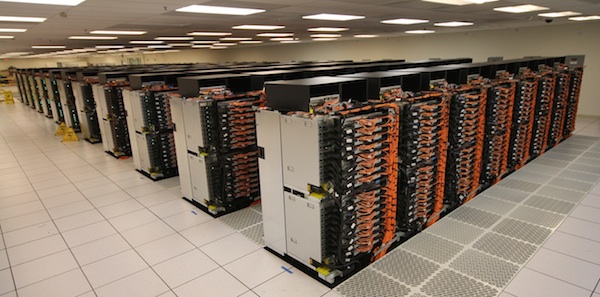
Sequoia will be used to carry out simulations as part of efforts to work out how to prolong the life of nuclear weapons. Nice to know the U.S. is still committed to nuclear proliferation by using its fastest supercomputer to actively keep older nuclear weapons going.
(I imagine it'll also be used by the laboratory lackeys to calculate how much student debt they've racked up.)
The supercomputer is 1.55 times faster than the Japanese Fujitsu model that landed in second place. It also has less than half the number of CPUs than IBM's number-crunching behemoth.
At the end of the day, does it really matter? The race for the supercomputer king seems to switch between the U.S. and Asia on an almost year-by-year basis. The back-and-forth between the two continents will no doubt continue on for years to come.
It's not the computing power that matters: it's the human capital. In a global environment where a U.S. scientist can rent access to an Asian supercomputer, it doesn't particularly matter which country boasts the top supercomputer.
Ultimately it's about where the people who know how to use these machines are. The scientists, the researchers, the meteorologists, astrologists: the list goes on.
The U.S. may claim home to some the world's top scientists, just as China has for two non-consecutive years claimed the world's fastest computer.
At the end of the day: supercomputers are just tools.
Image credit: IBM/Top500.
Related:
- IDC: HPC server market sees first quarter growth
- Supercomputer binge fuels HPC sales
- IBM’s Holey Optochip could be supercomputing, data center boon
- Amazon Web Services lands on supercomputer list, bolsters HPC offering
- Top 10 supercomputers hold position: Intel, IBM, Nvidia shine
Kick off your day with ZDNet's daily email newsletter. It's the freshest tech news and opinion, served hot. Get it.
Talkback
Does it matter? Yes.
Does it matter that the top spot fluctuates from Asia to the US on a fairly regular basis or that the computer was made by IBM or Fujitsu? No. No, it does not matter at all. That's the wrong question to ask.
Yes. Hand China calculations needed for better nuclera wepons.
Fujitsu is a Japanese corporation, not a Chinese corporation
But, point well taken. Nations should do their best to maintain a technological advantage. This is merely a different way of re-articulating my point: Namely: it does not matter which company produces the fastest computer as long as that computer meets the needs of their client.
Eating your own words?
When?
I appologize, it was not you.
Feh
Until someone...
Top tools attract top scientists.
You need the tools first, Zack, before you get the scientists. Remember the "old" adage: If you build it, he will come!
U.S. IBM supercomputer is world's fastest: Does it matter?
astrologists
Or maybe the real-time stellar evolution model
Thanks to this achievement...
astrologist vs astronomer (only one of which is a scientist)
since astrology is based on a myhtical set of rater arbitrary rules cocerning zodiac-siigns and so on, astrologists would not have a use for a supercomputer in the first place.
moreover, i think you`d agree that suoercomputers schould be reserved for real scientists, such as astromers.
Your command of the English language is quite sufficient
funny
Requires
Not for me
Priorities...
Oh good. The economy is f****** but at least we know we'll always have weapons that can literally end all life on the planet.
We've got our priorities in order. Breathe a sigh of relief.
F***** tired of the people in this world.